How to Prepare for the GMAS Test: A Month-by-Month Plan for Parents
Spring 2027 GMAS testing starts in mid-April, which gives families about six months. This plan breaks that time into four short steps, from reading last year's score report to the night before the test, so your child prepares a little at a time instead of cramming in April.


Spring GMAS testing typically begins in mid-April across most Georgia school districts. With roughly six months to prepare, there’s no need for last-minute cramming. A consistent, manageable routine can make a big difference.
The best way to prepare for the GMAS test is to start early and practice a little at a time. Aim for just 15–20 minutes of focused practice, three times a week, with extra attention to the skills your child struggled with last year.
This month-by-month plan is designed for parents of Georgia students in grades 3–8. It breaks the six months leading up to the GMAS into four simple steps, so you always know what to focus on and when.
Not familiar with the test yet? Start with our guide to what the GMAS test is to learn what the assessment covers, how it works, and how it is scored.
The countdown and the "You are here" marker update on their own every day. The countdown runs to April 15, 2027, the earliest district start date we found.
- How Much Time Do You Have Before the GMAS Test?
- Step 1: Read Last Year's GMAS Score Report (October to November)
- Step 2: Fix the Weak Skills (December to January)
- Step 3: Practice the GMAS Test Format (February to March)
- Step 4: Light Review and Test Week (April to May)
- What Math Skills Does the GMAS Test Check in Each Grade?
- When Does Your Child Need Extra GMAS Math Help?
- How Can Cuemath Help Your Child Prepare for the GMAS Test?
- Frequently Asked Questions
- Sources
How Much Time Do You Have Before the GMAS Test?
You have about 28 weeks. Spring 2027 GMAS testing for grades 3–8 runs from mid-April to mid-May, and each school district picks its own days. For example, Cobb County elementary schools test between April 15 and May 14, 2027.
| Step | When | What to do | Time per week |
|---|---|---|---|
| 1. Find the gaps | October–November | Read last year's score report and find weak skills | One short talk with your child |
| 2. Fix the gaps | December–January | Practice the 2–3 weakest skills | 3 × 15–20 minutes |
| 3. Practice the test | February–March | Take free practice tests, some with a timer | 2 × 30 minutes |
| 4. Light review | April–May | Short review, normal routine, good sleep | 2 × 15 minutes |
Step 1: Read Last Year's GMAS Score Report (October to November)
- Last year's GMAS score report shows you where to start.
- You can find it in your district's parent portal (like Infinite Campus) or on the paper report the school sent home.
- Math, science, and social studies scores for spring 2026 came out on August 6, 2026.
- ELA scores will come out later this fall because the ELA test was new in 2026.
Check three things on the report:
- The level: Your child gets one of four levels: Beginning, Developing, Proficient, or Distinguished Learner.
- The score: On every GMAS test, a score of 475 means "Developing" and 525 means "Proficient." So a 515 is just 10 points away from "Proficient." A 450 means there's more to catch up on.
- The skill areas: The report breaks math into parts, like numbers, algebra, geometry, and data. Look for the parts marked lowest. Those are your starting points.
| Last year's level | What it means | What to work on |
|---|---|---|
| Beginning Learner | Some earlier skills are missing | Go back one grade on the weakest skill area and rebuild it first |
| Developing Learner | Almost there; a few skills missing | Work only on the 2–3 lowest skill areas |
| Proficient Learner | On track | Keep skills fresh and practice the harder written-answer questions |
| Distinguished Learner | Ahead of grade level | Light practice plus challenge problems to keep it interesting |
Don't have the report? If your child is new to Georgia, ask the teacher at the fall conference: "Which two math skills should my child work on before spring?" Teachers can answer this from classwork.
Can your child crack these GMAS-style questions?
Pick your child's grade and try all 3 questions. Each one has a trap answer that costs points on test day.
A classroom has 4 tables with 6 students at each table. Then 3 students leave for music class. How many students are still in the classroom?
Show the answer
First multiply: 4 × 6 = 24 students. Then subtract the 3 who left: 24 − 3 = 21. The trap is stopping after one step.
Which fraction is bigger: 1/3 or 1/4?
Show the answer
Cut the same pizza into 3 slices or 4 slices. Fewer slices means bigger slices, so 1/3 is bigger. The trap is thinking 4 is bigger than 3, so 1/4 must be bigger.
A rug is 3 feet wide and 5 feet long. What is the area of the rug?
Show the answer
Area means length × width: 3 × 5 = 15 square feet. 8 comes from adding the sides, and 16 is the perimeter (the distance around).
Score: 0 of 3
Want to keep practicing?
Sign up free in the Cuemath app for daily practice like this, matched to your child's grade and level.
🚀 Sign Up Free & Practice More100% Free • No Card Needed • 5 Minutes a Day
Step 2: Fix the Weak Skills (December to January)
In step two, your child practices the 2–3 weak skills you found in Step 1. Short sessions work best. Three 15-minute sessions a week help more than one long session on the weekend, because your child sees the skill again before forgetting it.
How to run a 15-minute practice session:
- Start with 2 easy problems your child can already do. It builds confidence.
- Spend 10 minutes on one weak skill. Use the textbook, school worksheets, or a free practice site.
- Ask your child to explain one answer. Just ask, "How did you get that?" You'll see if they understand it or are guessing.
- End on a problem they get right. Finishing on a win makes the next session easier to start.
Match practice to school. Ask the teacher what unit is coming next. If fractions start in January, practice last year's fraction skills in December. Your child walks into class ready.
Step 3: Practice the GMAS Test Format (February to March)
In step three, your child gets used to how the GMAS test looks on a computer. Kids lose points on question types they've never seen before, even when they know the math.
Use the free official practice site. Experience Online Testing Georgia is the state's free GMAS practice site. Your child can try real question types and the test tools at home before test day. Open it in Google Chrome, the only browser the site supports.
What to practice on the site:
- Question types: picking one answer, picking more than one answer, drag-and-drop, filling in tables, and typing short answers.
- Test tools: the highlighter, the cross-out tool, and the calculator (only on math parts that allow it).
- Typing answers: some questions ask your child to type the answer and the steps. Practice this, because typing math takes longer than writing it.
Practice with a timer once or twice. The GMAS math test has two parts, and kids get up to 65 minutes for each part. In March, have your child do one full timed part so they know how 65 minutes feels. Most kids finish early. The practice helps the ones who rush or freeze.
Teach three test habits:
- Read the last sentence first on word problems. It tells your child what the question is asking.
- Show every step on typed answers. These questions give points for correct steps, even if the final answer is wrong.
- Check if the answer makes sense. If the question asks how many buses are needed and the answer is 4.6, something went wrong.
Find Your Child's Math Gaps While There's Still Time
Book a free 1:1 session with a Cuemath math expert. They'll show you exactly which math skills your child is missing, so you know what to practice first.
The countdown updates every day. It counts to April 15, 2027, the earliest district start date we found. Check your school calendar for your child's dates.
Step 4: Light Review and Test Week (April to May)
The last step is easy: keep practice short and keep the routine normal. Don't start new topics in the last two weeks.
| When | Do this |
|---|---|
| Two weeks before | Review only skills your child already knows |
| Two weeks before | Take one last practice test on the official site |
| One week before | Check the test days on your school calendar |
| Night before | Normal bedtime, no extra worksheets |
| Night before | Charge the school laptop if it comes home |
| Test morning | Get to school on time |
| Test morning | Tell your child: "Do your best, then move on." |
What Math Skills Does the GMAS Test Check in Each Grade?
The GMAS math test checks Georgia's math standards for your child's grade. Georgia started testing its new math standards in spring 2024. This table shows the main skills to check first in each grade, plus the other GMAS tests your child takes in spring 2027.
| Grade | Main math skills to check first | Other GMAS tests this year |
|---|---|---|
| 3 | Multiplication and division facts, early fractions, area | ELA |
| 4 | Multi-digit multiplication, equivalent fractions, angles | ELA |
| 5 | Adding and multiplying fractions, decimals, volume | ELA, Science |
| 6 | Ratios and rates, negative numbers, expressions | ELA |
| 7 | Proportions, adding and multiplying negatives, equations | ELA |
| 8 | Linear equations, functions, Pythagorean theorem | ELA, Science, Social Studies |
When Does Your Child Need Extra GMAS Math Help?
Your child may need extra GMAS math help if they scored Beginning or Developing Learner in math last year, or if the same skill area is still low after a month of practice at home. Both usually mean an earlier skill is missing, and worksheets alone don't fix that.
Other signs to watch for:
- Homework takes twice as long as the teacher says it should.
- Your child can follow the steps in class but can't explain why they work.
- Math homework ends in tears or arguments more than once a week.
- You aren't sure how to explain the new math methods your child learns at school.
How Can Cuemath Help Your Child Prepare for the GMAS Test?
Cuemath helps kids in grades 3–8 get ready for the GMAS math test with live 1:1 online classes. A tutor first finds your child's exact math gaps, then works on them twice a week until spring testing. Each class is 55–60 minutes and follows state standards, so the same classes help with school math and the GMAS.
Here's how Cuemath fits into each step of the plan:
Step 1, done for you: a free assessment finds the gaps
Before the first class, your child takes a short assessment. It shows exactly which math ideas your child is missing, not just which grade level they're at. The tutor then plans classes around those gaps.
Step 2: one tutor fixes one skill at a time
Your child works with the same tutor every class, so the tutor knows which skills are fixed and which still need work. Tutors don't hand over answers. They ask questions that help your child figure it out.
Step 3: practice explaining answers
Some GMAS questions give points for showing the steps. In Cuemath classes, your child solves problems on a shared online whiteboard and explains their thinking out loud, which is the same skill those questions check.
The Free Cuemath App: Practice on Days Without Class
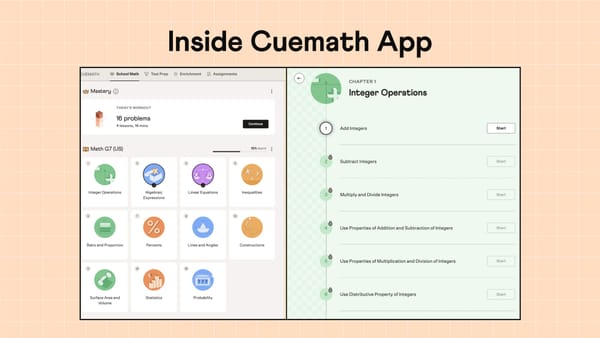
The Cuemath app is free, and your child can use it every day, with or without tutoring classes. It has three parts, and each one helps with a different piece of GMAS prep:
100% Free • No Card Needed • 5 Minutes a Day
What you see as a parent: the tutor sends you regular progress updates, and the parent dashboard shows how your child is doing. You'll know where things stand in March, not after scores come out in the summer.
Start early to get the most out of it. If you start in October, your child gets about 50 classes before mid-April (at two classes a week). If you start in March, that drops to about 12. Starting early leaves time to fix older gaps, not just review this year's work.
Make April the Easy Month
Book one free 1:1 session now. A Cuemath math expert finds the gaps behind last year's GMAS score and shows you which skills to work on before testing starts.
Rated 4.9 on Trustpilot by parents like you
Frequently Asked Questions
What is the GMAS test?
The GMAS test (Georgia Milestones Assessment System) is Georgia's yearly state test for grades 3–8 and four high school courses. Kids in grades 3–8 take ELA and math every year, grade 5 adds science, and grade 8 adds science and social studies.
How do I prepare my child for the GMAS test?
Prepare for the GMAS test by starting with last year's score report, practicing the 2–3 weakest skills for 15–20 minutes three times a week, and trying the free official practice site in February and March. Keep the last two weeks light, with good sleep and short review.
When should my child start preparing for the GMAS test?
Start preparing for the GMAS test in October or November, about six months before spring testing. That leaves time to find weak skills, fix them with short practice, and still have two months to practice the test itself.
Is there a free GMAS practice test?
Yes, Experience Online Testing Georgia is the free official GMAS practice test site. Kids can try real GMAS question types and test tools, like the highlighter and calculator, before test day.
How long is the GMAS math test?
The GMAS math test has two parts, and kids get up to 65 minutes for each part. Schools usually give the two parts on different days or with a break in between.
What is a good GMAS score?
A good GMAS score is Proficient Learner or Distinguished Learner. On every GMAS test, a score of 525 or higher is proficient, and 475 or higher is developing.
Can I opt my child out of the GMAS test?
No, Georgia law has no official opt-out from the GMAS test. Some parents send a written refusal to the principal before testing, but the school may then give a different test to check if your child is ready for the next grade, so talk to the school first.
Does the GMAS test count toward my child's grades?
The GMAS test does not count toward report card grades in grades 3–8. In high school, end-of-course tests count for 10% to 20% of the final class grade, depending on the district.
My child scored Beginning Learner in math last year. What should I do?
If your child scored Beginning Learner on the GMAS math test, start by rebuilding the weakest skill area from one grade back, then move on to this year's skills. A beginning score usually means an earlier skill is missing, and a 1:1 tutor like Cuemath can find and fix it faster than extra worksheets.
Can a tutor help my child prepare for the GMAS math test?
Yes, a math tutor can help with GMAS prep by finding the exact skills your child is missing and practicing them every week. Cuemath tutors work 1:1 with kids twice a week and follow state standards, so the same classes help with school math and the GMAS math test.
Is there a free app to practice for the GMAS math test?
Yes, the Cuemath app is a free math practice app your child can use for GMAS math prep. It has a 5-minute Daily Workout, skill-by-skill practice, and math games, all matched to your child's level.
Sources
Test dates and format
- Cobb County School District — 2026–27 elementary testing calendar (April 15 – May 14, 2027 EOG window)
- Georgia Cyber Academy — Georgia Milestones (EOG subjects by grade; math test sections and time)
- Experience Online Testing Georgia — official free practice site
Scores and results
- Georgia Department of Education — Georgia Milestones Assessment System (official program page)
- GaDOE EOC Score Interpretation Guide — 475 and 525 achievement-level cut scores
- Georgia Partnership for Excellence in Education — 2025–26 Georgia Milestones results (August 6, 2026 release; ELA later in fall)
- EDC State Test Score Results — Georgia: 2026 Assessment Results (45.3% grades 3–8 math proficiency)
Promotion and opt-out
- Georgia SBOE Rule 160-4-2-.11 (Cornell LII) — grades 3, 5, and 8 promotion checkpoints
- WTOC — Can a parent opt out of GA Milestones testing? (no legal opt-out under Georgia law)
Parent reviews

I was never the kid who loved math. I was much more interested in books, stories, and writing, and, somewhere along the way, I became even more curious about people. Why do we learn differently? Why does something make sense to one child but not another? And what makes a student feel confident enough to keep trying?
That curiosity led me to study Applied Psychology, where I learned more about how children think, learn, and make sense of the world around them.
My love for writing did the rest. What started as something I simply enjoyed became a career. Over the past five years, I've worked as a freelance writer across edtech, SaaS, B2B, travel, lifestyle, and healthcare, learning how to write for very different audiences without losing the human side of the story.
Today, I'm an SEO Content Writer & Editor at Cuemath, where I get to bring many of these interests together. Working in education, and especially around math, has made me even more curious about what happens behind the screen or textbook: what parents worry about, what students struggle with, and what actually helps them learn.
That's also how I like to research. I don't just look at search results and call it a day. I go where parents and students actually talk: forums, reviews, communities, and conversations with real families. Because sometimes the most useful insight isn't hiding in a keyword; it's in a parent's question, a student's frustration, or a small detail someone shares about their learning experience.
I write because I'm curious. I research because I want to understand. And I love turning what I learn into content that feels genuinely useful to the people reading it.