IAR Cut Scores Changed: How to Read Illinois' 2026 Results
Illinois lowered IAR proficiency cut scores for ELA and math in 2025, raising statewide proficiency rates. Here’s what changed and how parents should read their child’s 2026 results under the new benchmarks.

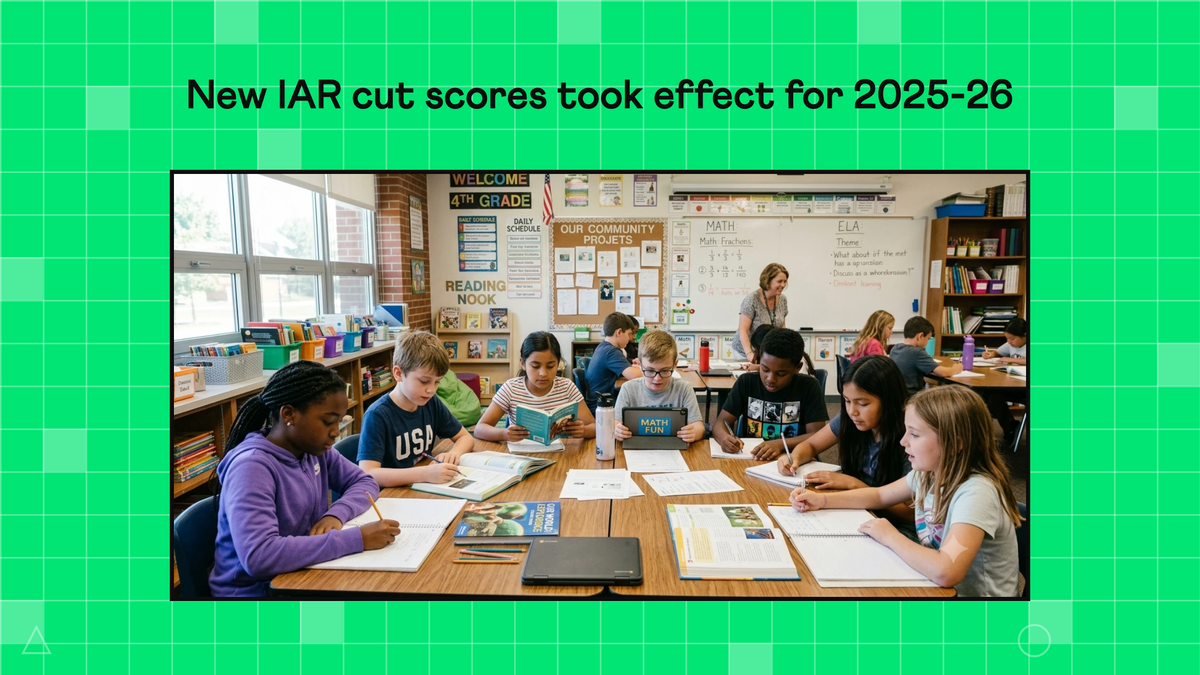
The Illinois State Board of Education (ISBE) adopted the new, research-informed performance levels in August 2025 as part of a broader effort to “right-size” proficiency benchmarks. ISBE says the change was intended to better align Illinois' performance levels with expectations for college and career readiness. The tests and Illinois Learning Standards themselves did not change.
That means a 2026 IAR score should be interpreted using the new benchmarks—the same performance-level framework used for 2025—not the 750-point proficiency benchmark that was used in earlier years.
This guide puts the old and new cut scores side by side, explains how the benchmark change affected reported proficiency rates, and walks parents through how to read a child's 2026 IAR score report.
| Item | Figure | Detail |
|---|---|---|
| Old Proficient Score | 750 | Every grade, ELA and math, before August 2025 |
| New Proficient Score | 732–745 | Varies by grade and subject |
| ELA Proficiency | 41.2% → 53.1% | Statewide IAR, 2024 to 2025 |
| Math Proficiency | 28.4% → 38.5% | Statewide IAR, 2024 to 2025 |
| Next IAR Window Opens | March 1, 2027 | Online closes April 16, 2027; paper closes April 2, 2027 |
| 2026 Report Card | Date Not Announced | ISBE has not set a public release date |
- What Changed on the IAR Cut Scores?
- What Did Not Change?
- Why Did Illinois Proficiency Jump in 2025?
- Is Proficient Equally Hard in Every Grade?
- How to Read Your Child's 2026 IAR Score Report
- What Happens Next: 2026 Report Card and 2027 Test Dates
- How to Help Your Child, Whatever the Label Says
- Frequently Asked Questions
- Sources
What Changed on the IAR Cut Scores?
- ISBE set new cut scores for the IAR, the Illinois Science Assessment (ISA), and the ACT in August 2025. Its tables are dated August 13, 2025: math and ELA.
- In ELA and math, the proficient score fell in every grade (table below).
- All Illinois state tests now share four levels: Above Proficient, Proficient, Approaching Proficient, and Below Proficient. The old IAR used five levels, and each state test used different names.
- Science went the other way. On the ISA, the proficient score for grades 5 and 8 rose from 799 to 812, according to ISBE.
- ISBE says the old bars were among the most restrictive in the country and that students passing Advanced Placement and dual-credit courses were still labeled “not proficient.”
| Grade | ELA Old | ELA New | Math Old | Math New |
|---|---|---|---|---|
| Grade 3 | 750 | 735 | 750 | 732 |
| Grade 4 | 750 | 737 | 750 | 740 |
| Grade 5 | 750 | 739 | 750 | 740 |
| Grade 6 | 750 | 741 | 750 | 742 |
| Grade 7 | 750 | 743 | 750 | 745 |
| Grade 8 | 750 | 745 | 750 | 745 |
What Did Not Change?
- The tests keep the same format, length, and platform, according to ISBE.
- The Illinois Learning Standards, which set what students learn, did not change.
- Scale scores and Student Growth Percentiles (SGP) are not affected by the new cut scores.
- ISBE says proficiency levels do not affect state funding, teacher evaluations, grade promotion, graduation, or a child's eligibility for an individualized education plan (IEP).
Why Did Illinois Proficiency Jump in 2025?
- ISBE's own preview, published before the Report Card, projected about 53% in ELA and 38% in math under the new bars, versus 41% and 28% in 2024 (parent fact sheet).
- A rate that moves 10 to 12 points in one year because the bar moved says little about learning. ISBE tells families to compare scale scores and growth percentiles over time instead (ISBE FAQ).
| Year | ELA | Math |
|---|---|---|
| 2022 | 30.2% | 25.4% |
| 2023 | 35.4% | 27.0% |
| 2024 | 41.2% | 28.4% |
| 2025 | 53.1% | 38.5% |
Rates are for IAR grades 3 to 8, from ISBE's Illinois Report Card trend data.
Is Proficient Equally Hard in Every Grade?
- In 2025, 49.6% of Illinois third graders were proficient in math, compared with 32.9% of eighth graders.
- In ELA, the pattern reversed: 47.3% of third graders were proficient, compared with 56.7% of eighth graders.
- Larry Gavin's analysis in the Evanston RoundTable (August 5, 2026) cites a paper by John Gotta of the ECRA Group, which estimates the grade 3 math cut score near the 55th national percentile and the grade 8 math cut score near the 69th.
- ISBE's August 13, 2025 statement, quoted in that piece, said the new levels “align vertically and horizontally from grade to grade.” Treat the RoundTable piece as one analyst's view, not ISBE's position.
- What to do with it: judge your child against their own scale score and growth percentile, not against grade-to-grade proficiency rates.
| Subject | Grade 3 | Grade 8 |
|---|---|---|
| ELA | 47.3% | 56.7% |
| Math | 49.6% | 32.9% |
How to Read Your Child's 2026 IAR Score Report
- Scale score: Every IAR score runs from 650 to 850. Match it to the tables below to see which level it falls in.
- Performance level: Proficient and above proficient count as “proficient.” Approaching Proficient and Below Proficient do not.
- Student Growth Percentile: It compares your child's growth with students who started at the same level. It is a percentile, not a percent, and 50 is the state average.
- Last year: 2025 and 2026 levels use the same cut scores, so you can compare them. For 2024 and earlier, compare scale scores and growth percentiles, not labels.
- Next step: If your child scored Approaching Proficient or Below Proficient, ISBE suggests asking the teacher how to help at home or get extra support. If your child scored proficient or above, ask about opportunities to advance.
| Grade | Approaching Proficient | Proficient | Above Proficient |
|---|---|---|---|
| Grade 3 | 705 | 732 | 781 |
| Grade 4 | 708 | 740 | 784 |
| Grade 5 | 709 | 740 | 782 |
| Grade 6 | 705 | 742 | 773 |
| Grade 7 | 712 | 745 | 781 |
| Grade 8 | 705 | 745 | 791 |
| Grade | Approaching Proficient | Proficient | Above Proficient |
|---|---|---|---|
| Grade 3 | 685 | 735 | 780 |
| Grade 4 | 695 | 737 | 780 |
| Grade 5 | 700 | 739 | 780 |
| Grade 6 | 705 | 741 | 780 |
| Grade 7 | 710 | 743 | 785 |
| Grade 8 | 710 | 745 | 795 |
Below Proficient runs from 650 up to one point below the Approaching Proficient score.
One App, Every Angle Your Child Needs, Whatever the Score Report Says
A proficiency label is one data point; steady practice moves the score. The Cuemath app covers all of it — schoolwork, test prep, enrichment, and assignment help — free to try, no card needed.
🚀Try the Cuemath AppWhat Happens Next: 2026 Report Card and 2027 Test Dates
- Illinois educators are previewing the 2026 Report Card now, and ISBE is walking them through it in an October 6, 2026, webinar. ISBE has not published a public release date (ISBE Report Card page).
- Last year, ISBE scheduled the Report Card for October 30, 2025 (parent fact sheet). Statewide 2026 results are expected around the same time.
- 2025 and 2026 use the same cut scores, so the 2026 Report Card should give the first like-for-like year-over-year comparison since the change.
- ISBE said in 2025 that a new accountability system would start in fall 2026, and the 2026 Report Card glossary now defines a school “Profile of Performance.”
| Date | What Happens |
|---|---|
| Expected October 2026 (date not announced) | 2026 Illinois Report Card with statewide results |
| March 1, 2027 | IAR windows open, online and paper |
| April 2, 2027 | Paper IAR window closes |
| April 16, 2027 | Online IAR window closes |
The IAR windows are for grades 3 to 8, from ISBE's 2026-27 state assessment dates. The Illinois Science Assessment for grades 5 and 8 runs from March 1 to April 30, 2027.
How to Help Your Child, Whatever the Label Says
- Read the score report together and find the weakest area before the next school year's work piles up.
- Practice the specific skill in short sessions, instead of re-teaching a whole year.
- Ask the teacher what the school's own tests, such as NWEA MAP or i-Ready, say about progress. ISBE notes schools choose those tests locally to track progress during the year.
Not sure what your child's IAR level means for next year?
Book a free 1:1 evaluation with a math specialist. They will show you where your child's math stands today and which skills to practice before the next IAR.
Rated 4.9 on Trustpilot by parents like you
Frequently Asked Questions
Did the IAR cut scores change for 2025-26?
The Illinois State Board of Education (ISBE) adopted the new IAR cut scores in August 2025, and they first applied to spring 2025 results. Spring 2026 results, from the 2025-26 school year, use the same four levels, so you can compare 2026 with 2025 but not with earlier years.
What score is proficient on the IAR now?
A proficient IAR score runs from 732 to 745 depending on the grade and subject. In ELA, the proficient score is 735 in grade 3 and 745 in grade 8; in math, it is 732 in grade 3 and 745 in grade 8. Before August 2025, the proficient score was 750 in every grade.
Did the IAR get easier?
No. ISBE says the test format, length, platform, and learning standards did not change; only the score needed for each performance level did.
Can I compare my child's 2026 IAR results with last year's?
Yes, compare the scale score and the Student Growth Percentile, and compare performance levels only with 2025. Scale scores and growth percentiles do not depend on the cut scores. Levels from 2024 or earlier used the old bars and do not compare.
What are the four IAR performance levels?
The four IAR performance levels are above proficient, proficient, approaching proficient, and below proficient. Above proficient and proficient count as proficient. All Illinois state tests now use these same four names.
What is a Student Growth Percentile on the IAR?
A Student Growth Percentile (SGP) shows how much your child grew compared with students who started at the same score level. It is a percentile, not a percent, and 50 is the state average. For example, an SGP of 75 means your child's growth beat 75% of those peers.
Does my child need to be proficient to graduate in Illinois?
No. ISBE says Illinois graduation requirements are based on passing grades in required courses, not state test scores. Your local district may add its own requirements.
When will Illinois release the 2026 IAR results statewide?
ISBE has not announced a public release date for the 2026 Illinois Report Card. Last year was scheduled for October 30, 2025, and statewide results are expected around the same time this year. Educators are previewing the 2026 Report Card now.
When is the next IAR test in Illinois?
The next IAR testing windows run from March 1 to April 16, 2027, online and from March 1 to April 2, 2027, on paper, for grades 3 through 8. Your child's school sets the test days inside those windows.
What should I do if my child scored Approaching or Below Proficient on the IAR?
Talk to your child's teacher about how to support learning at home or get extra help, as ISBE suggests. Use the score report to find the weakest area, then practice that skill in short sessions. A free 1:1 evaluation with Cuemath can show where your child's math stands and which skills to build first.
Sources
- ISBE — Illinois Assessment of Readiness (program hub)
- ISBE — New Proficiency Benchmarks: What Families Need to Know (parent fact sheet, August 2025)
- ISBE — Right-Sizing Illinois' Benchmarks for Proficiency: FAQ (August 19, 2025)
- ISBE—New, Unified Performance Levels and Right-Sized Proficiency Benchmarks (presentation: old vs. new benchmarks, what proficiency affects)
- ISBE — Math Cut Scores and Score Ranges (August 13, 2025)
- ISBE — ELA Cut Scores and Score Ranges (August 13, 2025)
- ISBE — 2026-27 Illinois State Assessment Dates
- ISBE — Report Card Data Library (2025 Report Card trend data, statewide IAR proficiency)
- ISBE — Illinois Report Card (2026 preview webinars)
- ISBE — 2026 Illinois Report Card Glossary of Terms (October 1, 2026)
- Evanston Roundtable—Analysis and viewpoint: Misalignment of ISBE's new proficiency cut scores across grades may cause confusion (August 5, 2026)

I was never the kid who loved math. I was much more interested in books, stories, and writing, and, somewhere along the way, I became even more curious about people. Why do we learn differently? Why does something make sense to one child but not another? And what makes a student feel confident enough to keep trying?
That curiosity led me to study Applied Psychology, where I learned more about how children think, learn, and make sense of the world around them.
My love for writing did the rest. What started as something I simply enjoyed became a career. Over the past five years, I've worked as a freelance writer across edtech, SaaS, B2B, travel, lifestyle, and healthcare, learning how to write for very different audiences without losing the human side of the story.
Today, I'm an SEO Content Writer & Editor at Cuemath, where I get to bring many of these interests together. Working in education, and especially around math, has made me even more curious about what happens behind the screen or textbook: what parents worry about, what students struggle with, and what actually helps them learn.
That's also how I like to research. I don't just look at search results and call it a day. I go where parents and students actually talk: forums, reviews, communities, and conversations with real families. Because sometimes the most useful insight isn't hiding in a keyword; it's in a parent's question, a student's frustration, or a small detail someone shares about their learning experience.
I write because I'm curious. I research because I want to understand. And I love turning what I learn into content that feels genuinely useful to the people reading it.