What Is the Area Model in Math? The New Way Schools Teach Multiplication
Area model multiplication turns a multiplication problem into a grid you can see, breaking big numbers into tens and ones so a child understands why the steps work, not just how to follow them. Here's a full worked example, why schools switched to it, and how far it carries into later grades.

If your kid has come home from school talking about “area models” and you’re like, “Wait… isn’t multiplication just multiplying?” you’re not alone.
Many parents were taught multiplication in a different way than it is taught in elementary math classrooms today. One of the most common is the area model, a visual strategy that makes multiplication something kids can see.
Instead of just memorizing a multiplication algorithm, students take numbers apart into smaller, friendlier pieces and use a rectangle (yes, a rectangle!) to show how those pieces fit together. For example, instead of attempting to do 23 x 14 all at once, a child can break the numbers apart, work on smaller multiplication problems, then put the answers back together.
It may seem unfamiliar at first, but there is a good reason schools are using it: the area model helps kids understand what multiplication actually means, not just memorize what steps to follow.
So, what's an area model? Why are teachers using this? And how can you help your child with homework without feeling like you have to relearn elementary math yourself?
Let’s break it down, block by block.
- Area model multiplication splits each factor into place values (tens/ones) and multiplies the parts separately, then adds them
- It's the strategy Common Core introduces for 4th grade multiplication, most schools nationwide teach it this way
- It doesn't replace the standard algorithm — it comes first, so a child sees why the answer works before memorizing the shortcut
- The same grid returns later for dividing, multiplying decimals, and — in algebra — multiplying binomials (the “box method”)
- Cuemath tutors use the same grid to build toward the standard algorithm, not skip past it
- What Is the Area Model in Math?
- Why Don’t Schools Just Teach It the Old Way?
- Area Model Multiplication by Grade
- Till Which Grade Is the Area Model Used?
- Does This Actually Help Kids Learn Multiplication Better?
- The Real Problem: Parents Weren’t Taught This Way
- How a Cuemath Tutor Builds on the Area Model
- From Area Model to Algebra
- How to Practice the Area Model at Home
- FAQs
School math + test prep + skills AI can't match, at $0 cost.
Everything your child needs from Grade K to 12, curriculum mastery, test prep, and enrichment math, is now in one free app.
Simple log in with email, nothing else
What Is the Area Model in Math?
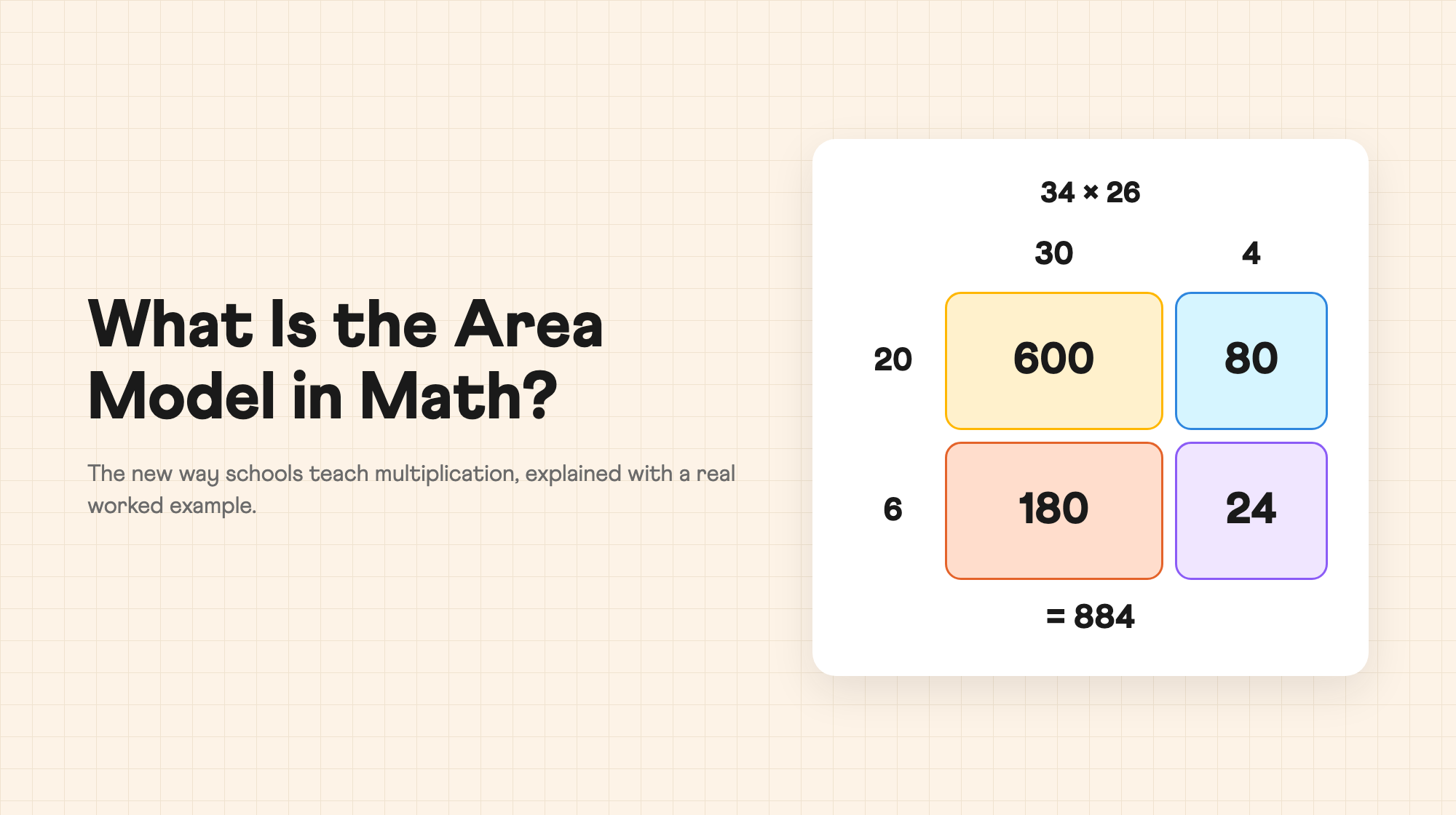
The area model is a way to multiply two numbers by breaking them into smaller, friendlier pieces, drawing a grid, and adding up the pieces. Instead of one big scary multiplication problem, your child solves four small, easy ones.
Here's what that looks like for 34 × 26:
Step 1: Break 34 into 30 + 4 and 26 into 20 + 6.
Step 2: Draw a box and split it into a 2-by-2 grid.
Step 3: Write 30 and 4 across the top and 20 and 6 down the side.
Step 4: Multiply where each row and column meet: 30×20, 30×6, 4×20, and 4×6.
Step 5: Add the four answers together.
That's it. No carrying, no mystery digits. Just four small multiplications and one addition. Look at the example below for a clearer explanation:
Why Don’t Schools Just Teach It the Old Way?
Because the old way gets the right answer without showing your child why it's right. When you stack 34 and 26 and carry a digit, the "6" and "1" you're carrying are really tens and hundreds in disguise, and most kids never find that out. The area model keeps every piece visible, so your child sees exactly where each part of the answer comes from.
Here's the same problem, solved both ways:
Notice something? Both ways land on 884. The difference is what your child understands along the way. If you've noticed your child can add and subtract just fine but freezes the moment two-digit multiplication shows up, this is usually why: the old method hides the exact thing they're struggling with. Curious what else changed? See our full New Math vs. Old Math guide for more examples.
Area Model Multiplication by Grade
The area model isn't a one-grade thing. It starts small in 3rd grade, becomes the main method in 4th, and keeps being useful after that. Here's what your child actually does at each stage.
- 3rd Grade — Kids cover a rectangle with small squares and count them. A rectangle 4 squares wide and 3 squares tall has 12 squares in it, the same answer as 4 × 3. That's the first time your child sees area and multiplication give the same number.
- 4th Grade — Now your child uses the full grid on real 2-digit problems, like 42 × 13. They split both numbers, fill in four boxes, and add them up to get 546. This is the grade where the method really matters most.
- 5th Grade—The same grid now works for decimals too, like 1.2 × 1.4. A similar grid also shows up for division. Whole-number multiplication, though, moves on to the stacked method your child will use for the rest of school.
Till Which Grade Is the Area Model Used?
Further than you'd think. The same grid comes back in high school algebra when your child multiplies two expressions like (x + 3)(x + 2). Teachers call it the "box method" there, but it's the exact same idea: split, box, multiply, add. Only the numbers turn into letters.
Does This Actually Help Kids Learn Multiplication Better?
Yes. The area model builds four specific skills that carry into everything your child does with numbers later.
The Real Problem: Parents Weren’t Taught This Way
Most parents learned only one way to multiply: stack the numbers, carry a digit, and get an answer. Nobody explained why it worked, and no one drew a grid to show it. Schools started teaching the grid-based way much more recently. So if your child's homework looks completely unfamiliar, that's not because you're behind; it's because this wasn't around when you were in school.
How a Cuemath Tutor Builds on the Area Model
A Cuemath tutor doesn't just check whether your child got 884. They ask, "Which box is missing?" or "What does this box actually stand for?" small questions that force your child to think about place value instead of just following steps. This "cue, don't tell" approach runs through every Cuemath 1:1 session, part of the MathFit framework's focus on real understanding, not just correct answers.
Still Adding Instead of Seeing the Boxes?
A free evaluation checks whether your child can split numbers by place value and multiply each part, the exact skill behind every area model problem.
Book a Free EvaluationFor Students in Grades K to 12 Worldwide
From Area Model to Algebra: The Same Idea, One Step Further
In algebra, a letter like x just stands in for a number you don't know yet. The algebra "box method" is the exact same grid your child already uses: split, box, multiply, add, just with a letter sitting in some of the boxes instead of a number. A child who can fill in 34 × 26 already knows the steps to multiply (x + 3) by (x + 2).
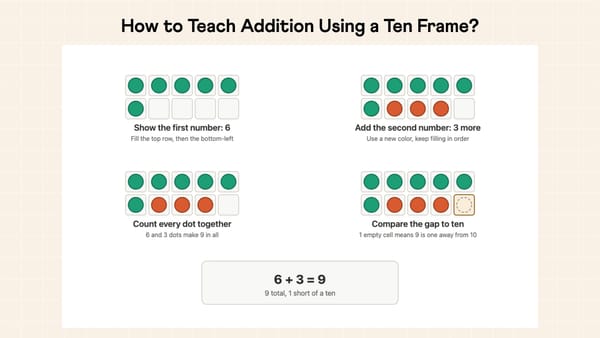
This is part of a bigger pattern. See how ten frames build this same kind of visual thinking for addition, and how number bonds lay the groundwork even earlier.
How to Practice the Area Model at Home
You don't need anything special. Grab paper and a pencil, and walk through these four steps together.
Try It Yourself—work through these together, easiest first:
| Problem | Answer |
|---|---|
| 3 × 4 | 12 |
| 6 × 7 | 42 |
| 12 × 4 | 48 |
| 14 × 5 | 70 |
| 23 × 3 | 69 |
| 26 × 4 | 104 |
| 15 × 12 | 180 |
| 23 × 16 | 368 |
| 34 × 21 | 714 |
| 45 × 32 | 1,440 |
| 1.3 × 1.2 | 1.56 |
| 2.4 × 1.5 | 3.6 |
Frequently Asked Questions
What is the area model in math?
The area model is a way to multiply two numbers by breaking each one into smaller parts, drawing a grid, multiplying each part separately, and adding the results. It turns one big multiplication problem into several small, easy ones.
How do you multiply using the area model?
You multiply using the area model by splitting both numbers into tens and ones, drawing a grid with one row and column for each part, filling in each box with its product, then adding all four boxes together. For 34 × 26, that's 600 + 80 + 180 + 24, which adds up to 884.
What grade is area model multiplication taught in?
Area model multiplication is taught mainly in 4th grade. Kids get an early introduction in 3rd grade through tiling rectangles, and the same grid comes back in 5th grade for decimals and division.
Is the area model the same as the box method?
Yes, the area model and the box method are the same grid. "Area model" is what it's called in elementary school, and "box method" is the name that sticks once your child uses the same grid in algebra.
Why do schools use the area model instead of just teaching the standard algorithm?
Schools teach the area model first because it shows your child exactly where each part of the answer comes from, instead of hiding it inside a carried digit. The stacked method comes later, once that understanding is already in place.
What is the distributive property, and how does the area model show it?
The distributive property means you can multiply a number by a sum by multiplying each part separately, then adding. The area model shows this literally: splitting a rectangle into smaller boxes and adding their areas gives the exact same answer as multiplying the whole thing at once.
How can I practice area model multiplication with my child at home?
You can practice area model multiplication at home with four steps: split both numbers into tens and ones, draw the grid, fill in each box, and add them up. Start with easy problems like 12 × 4 before moving to two 2-digit numbers.
Does Cuemath teach the area model?
Yes, Cuemath tutors use the area model in live 1:1 sessions, asking guided questions like "which box is missing?" instead of just confirming the answer, so your child understands the reasoning, not just the steps.

I was never the kid who loved math. I was much more interested in books, stories, and writing—and, somewhere along the way, I became even more curious about people. Why do we learn differently? Why does something make sense to one child but not another? And what makes a student feel confident enough to keep trying?
That curiosity led me to study Applied Psychology, where I learned more about how children think, learn, and make sense of the world around them.
My love for writing did the rest. What started as something I simply enjoyed became a career. Over the past five years, I've worked as a freelance writer across edtech, SaaS, B2B, travel, lifestyle, and healthcare, learning how to write for very different audiences without losing the human side of the story.
Today, I'm an SEO Content Writer & Editor at Cuemath, where I get to bring many of these interests together. Working in education—and especially around math—has made me even more curious about what happens behind the screen or textbook: what parents worry about, what students struggle with, and what actually helps them learn.
That's also how I like to research. I don't just look at search results and call it a day. I go where parents and students actually talk—forums, reviews, communities, and conversations with real families. Because sometimes the most useful insight isn't hiding in a keyword; it's in a parent's question, a student's frustration, or a small detail someone shares about their learning experience.
I write because I'm curious. I research because I want to understand. And I love turning what I learn into content that feels genuinely useful to the people reading it.