Cuemath vs Mathnasium: Which Maths Program Is Better for Australian Students?
Two of Australia's most-searched maths tutoring options work in completely different ways — one puts your child with a dedicated online tutor, the other with a local learning centre. Here's what each actually involves, and how to tell which one fits your family before NAPLAN season arrives.

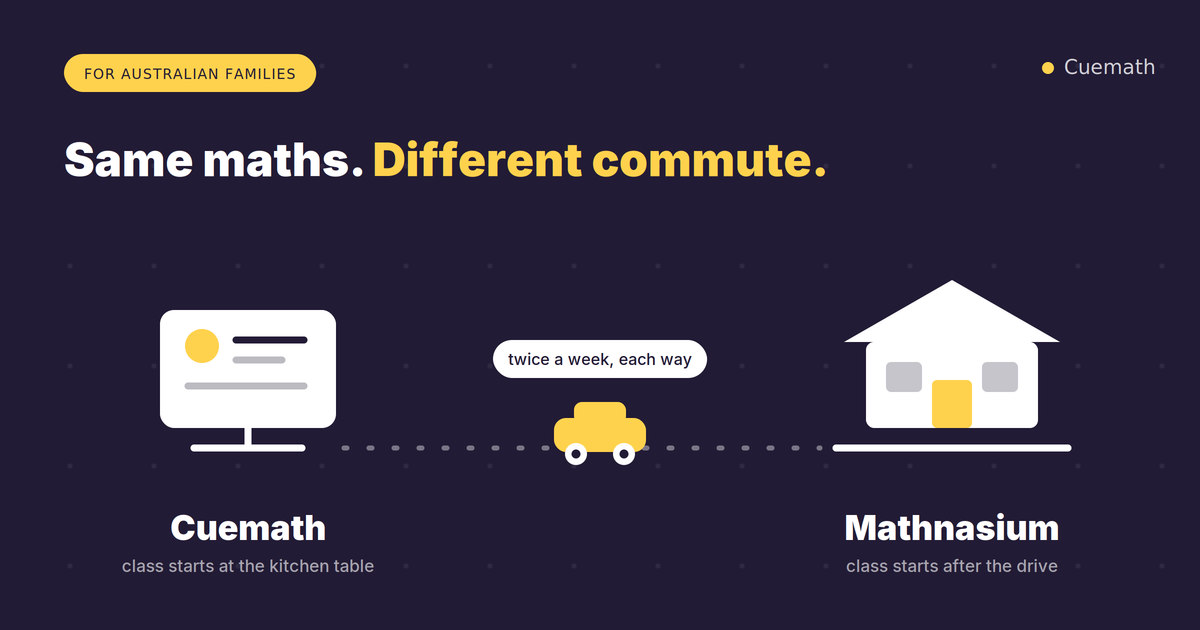
It usually starts with a message from another parent. "We started Cuemath last month — she actually asks to do her maths homework now." A few replies later, someone else in the group chat says their son goes to the Mathnasium centre twice a week and loves it.
Cuemath and Mathnasium are two of the most-searched maths tutoring options for Australian families, and they're built on genuinely different ideas about how children learn maths. One is a dedicated online tutor. The other is a local learning centre. This guide compares them side by side, using verified information from both companies' websites.
- Quick Answer
- What Is Cuemath?
- What Is Mathnasium?
- Teaching Approach Comparison
- Learning Experience Comparison
- Pricing Comparison
- Tutor and Instructor Comparison
- NAPLAN and School Curriculum Support
- Flexibility and Scheduling
- What Parents Are Saying
- Which One Is Better for Different Types of Learners?
- Frequently Asked Questions
- Sources
Quick Answer
If you're short on time, here's the short version. Neither is universally better; Cuemath and Mathnasium take different approaches for different kinds of families.
| Compare | Cuemath | Mathnasium |
|---|---|---|
| Learning format | Always online, always 1-on-1 | In-centre by default, with an online option |
| Subjects | Maths only, Kindergarten–Year 10 | Maths only, K/Prep–Year 10 |
| Session length | 40 minutes to an hour | Varies by centre |
| Fees | From $17/class | Set locally — contact your centre |
| Getting started | Free trial class | Free diagnostic assessment |
Source: Cuemath Australia · Mathnasium Australia — How It Works
What Is Cuemath?
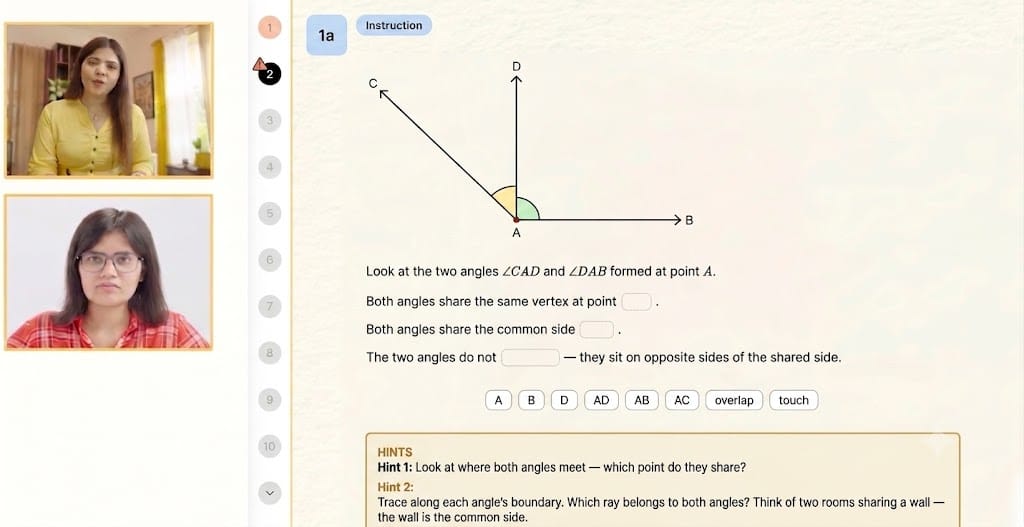
Cuemath is a live, one-on-one online maths tutoring program for children from Kindergarten to Year 10. In Cuemath, every child is matched with a dedicated tutor who teaches two to three classes a week over video, using Cuemath's own teaching platform.
Cuemath states it now works with more than 200,000 families across over 80 countries, and is rated 4.9+ on Trustpilot (Source). Its curriculum aligns with the Australian Curriculum and individual state syllabuses.
For families, the pitch is simple: no travel, no group setting, and the same tutor every time.
What Is Mathnasium?
Mathnasium is a maths-only learning centre franchise operating across Australia. The process starts with a free diagnostic assessment, followed by a customised learning plan, then ongoing sessions "in-centre or online" with trained instructors.
Mathnasium's approach is built around what it calls the Mathnasium Method™ (Source) — teaching to five different learning styles and building a sequence it calls "Number Sense" before moving into algebra and beyond.
For families, the pitch is different: a physical place to go, a team of instructors, and a model built around regular attendance.
Teaching Approach Comparison
The two programs are built on different theories about what helps a child learn maths.
Cuemath's approach centres on one-on-one live coaching. A dedicated tutor identifies exactly where your child is struggling and adjusts each session accordingly. It's personalised from the first class, with no fixed curriculum path shared with other students.
Mathnasium's approach is built around a structured method applied consistently across every student. Instructors are trained to use "Socratic Questioning" (Source) — guiding a child toward the answer and teaching the same five learning styles — so the approach stays consistent from one instructor to the next.
Put simply: Cuemath adapts a tutor to a child. Mathnasium adapts a method to a child.
| Compare | Cuemath | Mathnasium |
|---|---|---|
| Core method | Personalised 1-on-1 coaching | The Mathnasium Method™ — 5 learning styles + a "Number Sense" sequence |
| Curriculum basis | Australian Curriculum, adapted per child | Structured internal method |
| Teaching technique | Tutor adjusts live to the child's pace | "Socratic Questioning" — guided discovery |
| Consistency | Same tutor learns your child over time | Method stays consistent; the instructor may vary |
Source: Cuemath Australia · Mathnasium Australia — The Mathnasium Method
Learning Experience Comparison
With Cuemath, your child logs into a video class from wherever you are — no drive, no waiting room. It's just them and their tutor, using a shared digital whiteboard.
With Mathnasium, your child is physically at a centre (or logged into Mathnasium@home), working through their plan alongside other students, with instructors circulating to help. Some kids like the low hum of other students working nearby. Others find it distracting.
Neither environment is better in the abstract — it depends on how your child concentrates.
Pricing Comparison
Cuemath's Fees
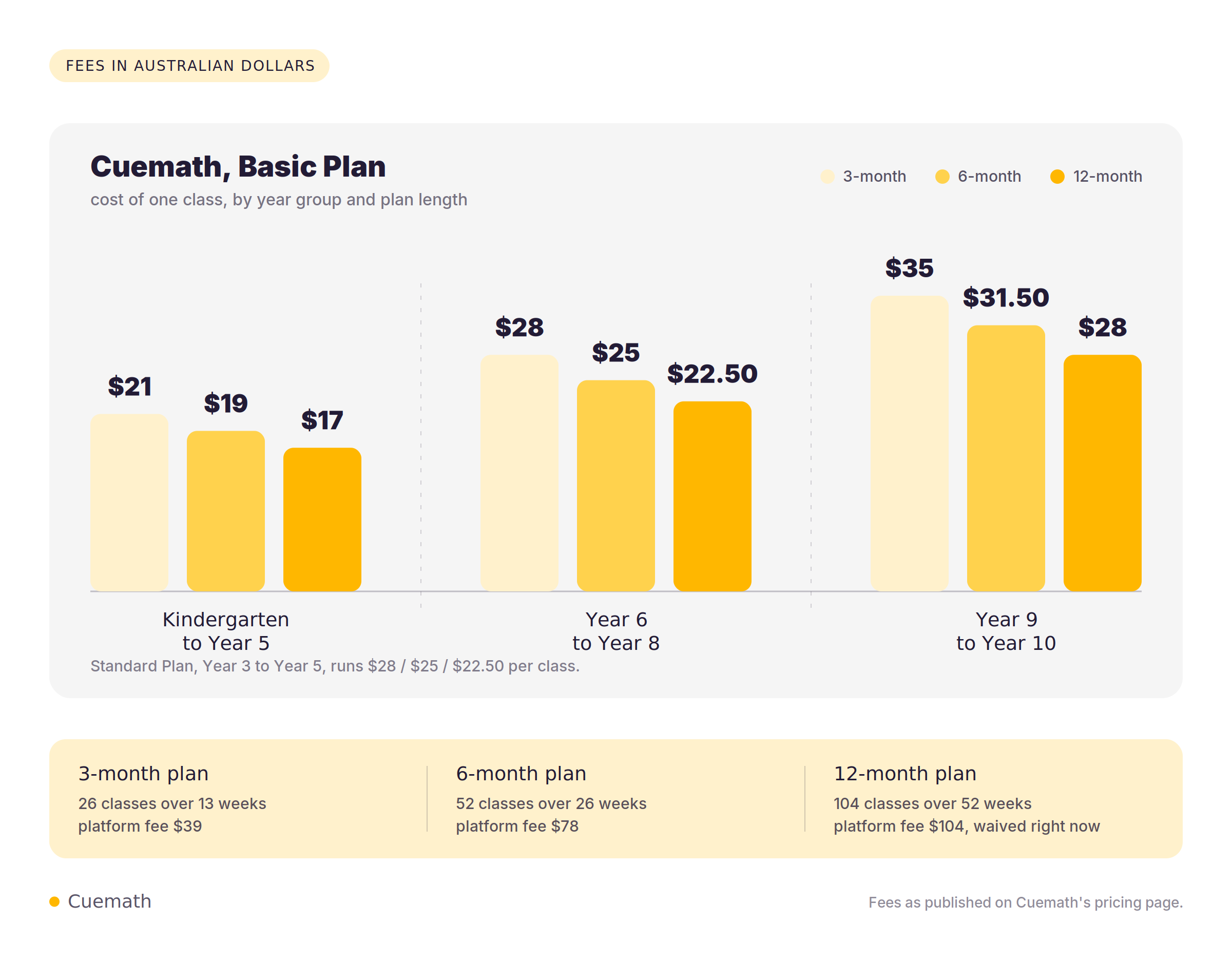
Cuemath publishes exact pricing, broken down by year group and plan length, before you enter any contact details. It currently lists two plan tiers, Basic and Standard.
Source: Cuemath Australia — pricing page
Each plan includes a set number of classes per billing cycle: 26 classes over 13 weeks on the 3-month plan, 52 classes over 26 weeks on the 6-month plan, and 104 classes over 52 weeks on the 12-month plan. A platform fee applies per billing cycle — $39 on the 3-month plan, $78 on the 6-month plan, and $104 on the 12-month plan — though the 12-month platform fee is currently waived ($0). (Source)
Mathnasium Fees
Mathnasium doesn't publish a price list. It states that pricing is set locally: "There is a flat enrolment fee for our program... pricing varies by program and geographic area. Contact your local centre for more details." (Source) Because Mathnasium operates as a franchise, each centre sets its own packages — the only way to get an exact number is to contact your nearest centre directly.
Not Sure Which Fits Your Child's Budget and Pace?
See exactly where your child's maths understanding stands right now. Cuemath's MathFit evaluation is one live session with a real tutor — 100% free, no credit card required, and no obligation to continue.
Book the Free EvaluationFor Students in Kindergarten to Year 10
Tutor and Instructor Comparison
Cuemath tutors are certified to teach to Australian Curriculum standards, with test-prep certifications, and are trained in both maths and child psychology before their first class. Tutors hold degrees in maths, engineering, or education, and each family keeps the same tutor for the life of their plan.
Mathnasium instructors are described as "members of your community" who are background-checked and trained in the Mathnasium Method, including Socratic Questioning. Rather than one fixed tutor, your child works with a team of instructors at the centre. (Source)
For some families, a single dedicated tutor who remembers last week's lesson is the whole point. For others, a well-trained team feels just as consistent, as long as the method stays the same.
| Compare | Cuemath | Mathnasium |
|---|---|---|
| Certification | Australian Curriculum + test-prep certified | Background-checked, Method-trained |
| Background | Degrees in maths, engineering, or education | "Members of your community," background-checked |
| Consistency | Same tutor every session | Team of instructors at the centre |
| Training focus | Maths and child psychology | Socratic Questioning and 5 learning styles |
Source: Cuemath Australia — Our Tutors · Mathnasium Australia — Our Instructors
NAPLAN and School Curriculum Support
NAPLAN is one of the biggest reasons Australian parents start looking at maths tutoring in the first place, so it's worth knowing how each program actually handles it.
Cuemath includes NAPLAN, Opportunity Class, and Selective School preparation inside the regular plan. There's no separate sign-up — the same tutor who already knows your child simply shifts focus as the test date gets closer.
Mathnasium runs NAPLAN, OC Test, and Selective School preparation as dedicated programs, each with its own page on its website. It states the approach plainly: "Students need maths knowledge, not test tricks." (Source)
| Test | Cuemath | Mathnasium |
|---|---|---|
| NAPLAN | Included in the regular plan | Dedicated NAPLAN Test Prep program |
| OC Test | Included in the regular plan | Dedicated OC Test Prep program |
| Selective School | Included in the regular plan | Dedicated Selective School program |
Source: Cuemath Australia · Mathnasium Australia — NAPLAN Test Prep
Flexibility and Scheduling
Cuemath offers a flexible leave policy for planned and unplanned absences — you simply let your tutor know. Classes run online, so there's no commute to plan around, and rescheduling doesn't depend on a centre's opening hours.
Mathnasium sessions happen during a centre's operating hours, so timing depends on your nearest location. Families who can't always make it to a centre can use Mathnasium@home as an online alternative, though in-centre remains the model most of its Australian marketing describes.
What Parents Are Saying
Here's what real Australian parents say, in their own words.
Which One Is Better for Different Types of Learners?
There's no single answer here — only which type of learner your child is right now.
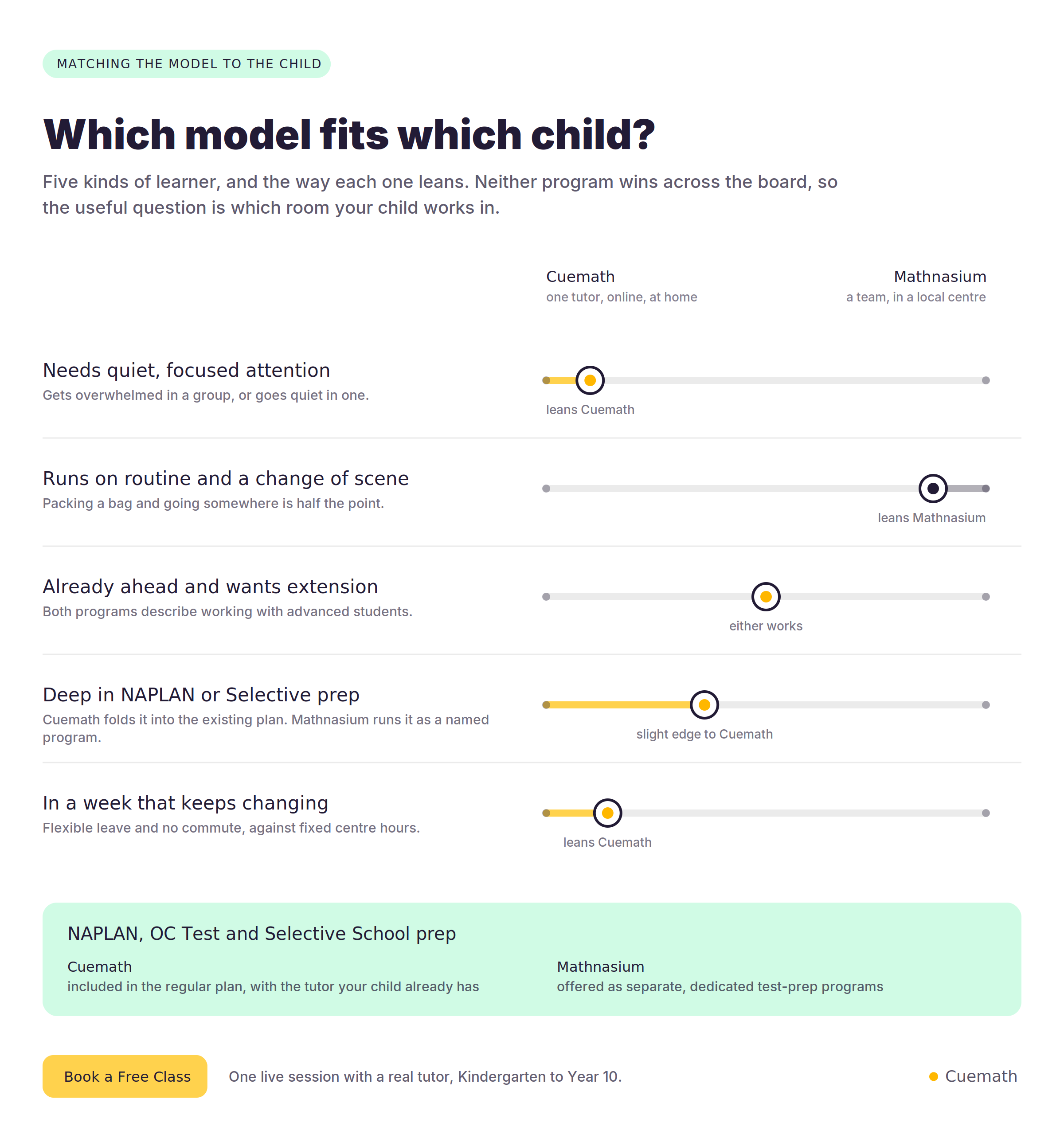
- The child who needs quiet, focused attention: A child who gets overwhelmed easily or goes quiet in group settings often does better with Cuemath's one-on-one model. There's nowhere to hide, but there's also nowhere to feel lost in a crowd.
- The child who likes routine and a change of scenery: Some kids do better with a physical ritual — packing a bag, going somewhere, working alongside other students. Mathnasium's centre model is built around exactly that.
- The advanced learner wanting extension: Both programs describe working with advanced students, not just those catching up. Cuemath tutors can move faster one-on-one; Mathnasium's Method includes structured pathways for stronger students too.
- The child deep in NAPLAN or Selective School prep: Both offer dedicated support — Cuemath within the existing plan, Mathnasium as a named program. The right choice often comes down to whether your child already has a tutor they trust.
- The family juggling a busy, changing schedule: Cuemath's online model and flexible leave policy suit families whose week changes often, since sessions can move without working around a centre's hours. Mathnasium's centre model suits families who can commit to the same time slots each week.
See How Your Child Responds to 1-on-1 Attention
The only way to really know if a program fits your child is to see them in it. Cuemath's free trial class is one full session with a real tutor — 100% free, no credit card needed, and no obligation to continue.
Book a Free Class →For Students in Kindergarten to Year 10
Frequently Asked Questions
Is Mathnasium better than online tutoring like Cuemath?
They're designed differently. Mathnasium suits families who want a physical centre and a team-based method. Cuemath suits families who want a dedicated online tutor and no commute. Neither is better in general; it depends on your child and your week.
Source: Cuemath Australia · Mathnasium Australia — How It Works
Does Cuemath help with NAPLAN preparation?
Yes. Cuemath includes NAPLAN preparation inside the regular plan, using the same tutor your child already has, with no separate sign-up required.
Source: Cuemath Australia · NAP.edu.au — About NAPLAN
Can children really learn maths well over video?
Cuemath states its model is built specifically for live, one-on-one video teaching, with a shared digital whiteboard and a dedicated tutor. Many of the parent reviews on Cuemath's own site describe strong outcomes from this format — though, as with any program, results vary by child.
Source: Cuemath Australia (parent testimonials)
Which option suits a busy, unpredictable family schedule better?
Cuemath's online format and flexible leave policy suit families whose week changes often, since there's no commute or centre opening hours to work around. Mathnasium's in-centre sessions run within a centre's operating hours, though Mathnasium@home offers an online alternative.
Source: Cuemath Australia — pricing/plan details · Mathnasium Australia — How It Works
How many sessions a week should my child attend?
Cuemath recommends two to three classes a week. Mathnasium recommends a similar two- to three-visit schedule.
Source: Cuemath Australia — pricing page · Mathnasium Australia — How It Works
How much does Cuemath cost compared to Mathnasium in Australia?
Cuemath publishes exact per-class pricing upfront, starting from $17/class on its 12-month Basic Plan for Kindergarten–Year 5. Mathnasium does not publish pricing — it operates as a franchise, so fees are set locally and you need to contact your nearest centre for an exact number.
Source: Cuemath Australia — pricing page · Mathnasium Australia — FAQ
Does Mathnasium follow the Australian Curriculum?
Not directly. Mathnasium uses its own proprietary Mathnasium Method rather than a curriculum labelled as Australian Curriculum-aligned, though it states the method is designed to close the specific gaps a student has at school. Cuemath, by comparison, states its curriculum is aligned to the Australian Curriculum and individual state syllabuses.
Source: Mathnasium Australia — The Mathnasium Method · Australian Curriculum v9 — Mathematics · Cuemath Australia
Which program is better for Selective School or Opportunity Class entry?
Both offer dedicated support. Cuemath includes Selective School and OC Test preparation inside a student's existing plan with their regular tutor, while Mathnasium runs it as a separate named program at its centres. The better fit often comes down to whether your child already has a tutor relationship they trust going into test prep.
Source: Mathnasium Australia — NAPLAN Test Prep · NSW Department of Education — Selective High Schools and Opportunity Classes
Sources
All facts, figures, and quotations in this article are taken directly from Cuemath's and Mathnasium's own official websites, plus independent government and curriculum authority sources.
- Cuemath Australia — official site
- Cuemath Australia — pricing page
- Mathnasium Australia — How It Works
- Mathnasium Australia — The Mathnasium Method
- Mathnasium Australia — Our Instructors
- Mathnasium Australia — FAQ
- Mathnasium Australia — NAPLAN Test Prep
- NAP.edu.au — About NAPLAN — official Australian government source explaining what NAPLAN tests and why schools run it
- Australian Curriculum v9 — Mathematics — official national curriculum authority, cited for the curriculum-alignment claims in this article
- NSW Department of Education — Selective High Schools and Opportunity Classes — official government source on Selective School and OC placement

I write because I like understanding things properly, and I've never been able to do that quietly.
Six years in, what still interests me most isn't the writing itself. It's the person on the other side. Who are they, what were they actually worried about when they opened this page, and did they leave with what they came for? Most content fails that last test. It answers the easy question instead of the one that was asked.
At Cuemath, I write for parents and students in India and around the world. That range is the part I enjoy. A parent in Bangalore and a parent in Canada are asking about the same child, but not always in the same words, and that difference matters.
So I research before I write. Not just search results. Forums, reviews, the long comment threads where somebody finally admits what they're really confused about. That's usually where the useful thing is hiding.
I also spend time on how people find this writing at all, since a growing number of them now ask an AI instead of typing into Google. But that only works if the writing is clear to begin with. There's no shortcut around that part.