
In short
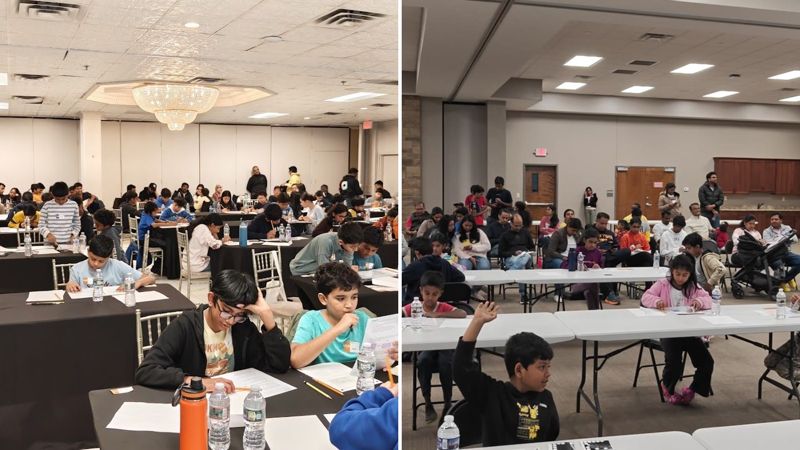
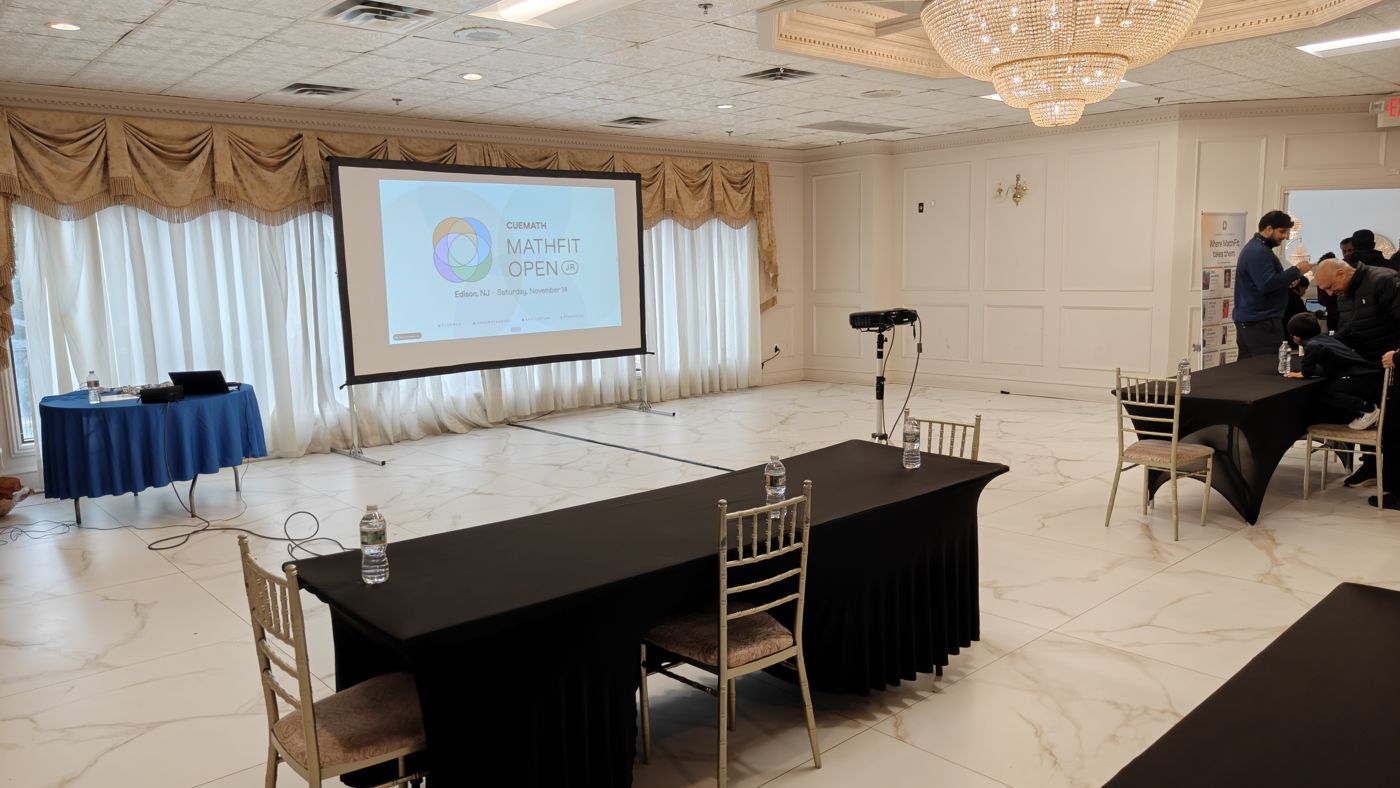
On Saturday, November 14, 2026, Cuemath held the first MathFit Open, at Parlor Banquet in Edison, New Jersey. Two math competitions shared one ballroom: the Junior for grades K-5 in the morning, where each child plays alone, and grades 6-8 in the afternoon, played in teams of two.
- 96children played
- 66families played the parents' quiz
- 4rounds in each competition
- 1podium place won by a child playing solo
The champions: EagleSharks (grade 6), Pythons (grade 7) and Root (grade 8). In the Junior, gold went to Armaan G. (K-1), Reyansh G. (grades 2-3) and Vikhyath L. (grades 4-5).
Arrival and check-in
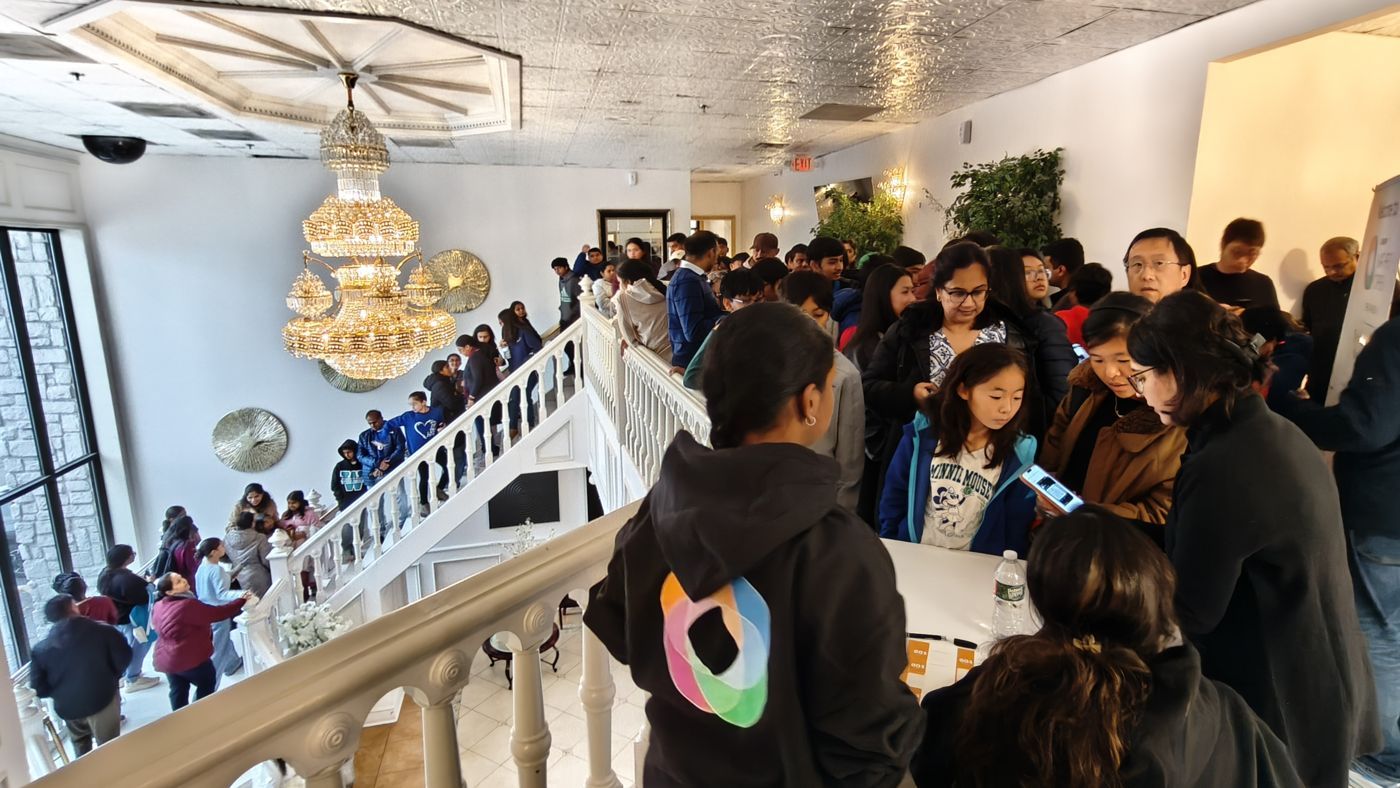
The Gold Ballroom is at the top of a white marble staircase. Families showed the QR code on their ticket, a volunteer checked them in, and each child went in with a goody bag and a number to wear.
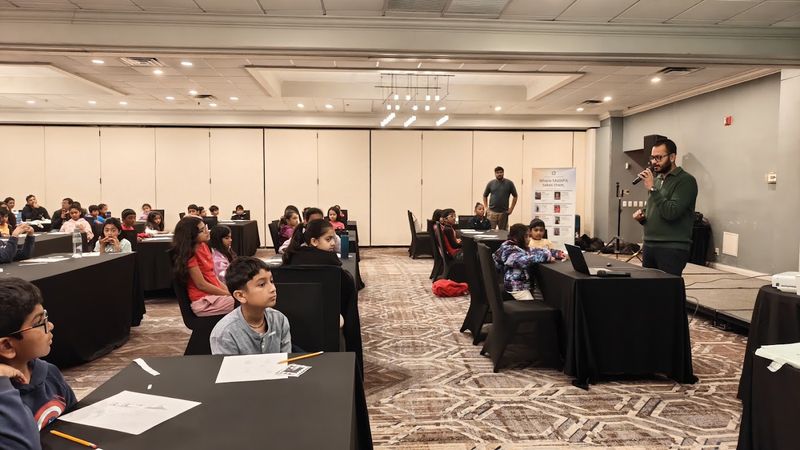
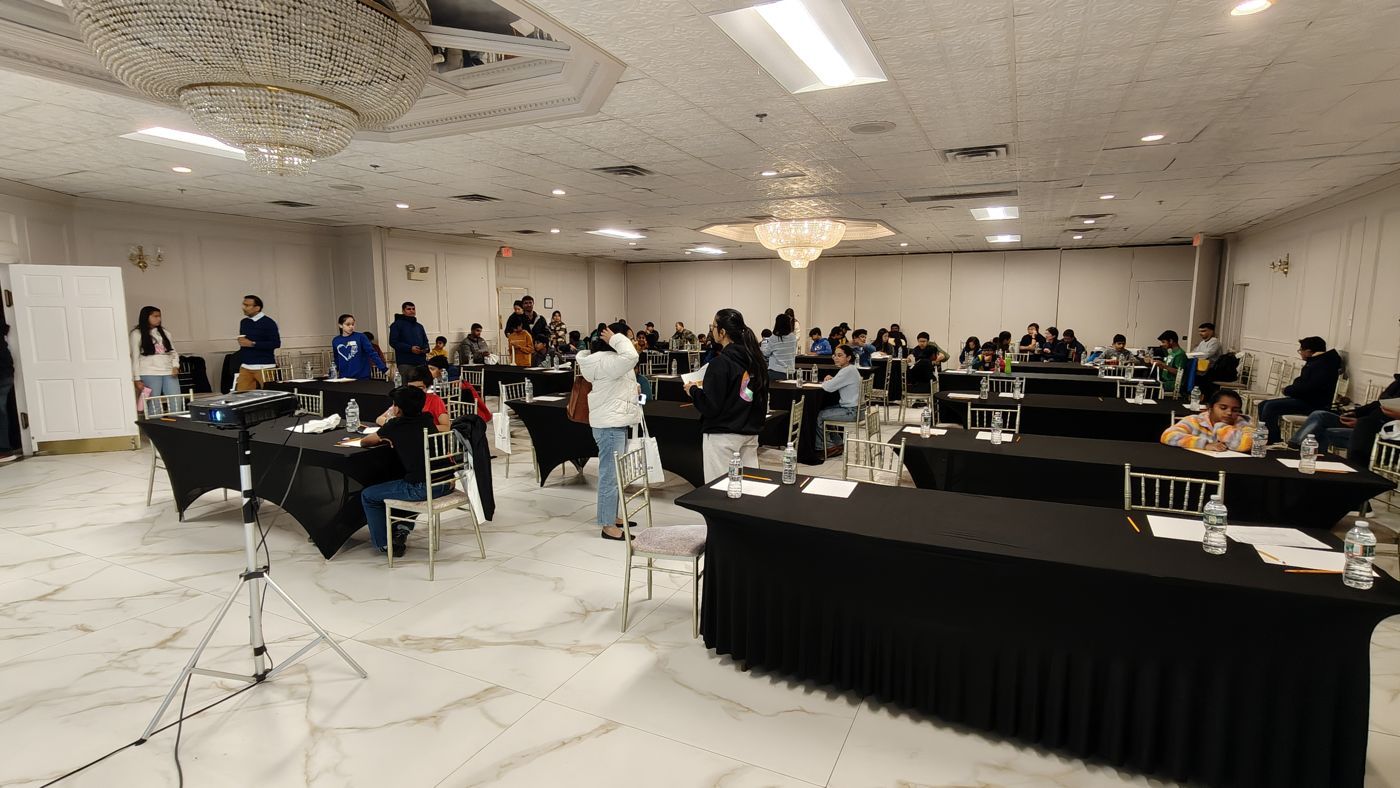
Inside, long black tables faced one big screen. A sheet scanner and a laptop sat at the side for scoring.
The Junior, round by round
The Junior is the K-5 math contest. Each child plays alone and is ranked only against children in the same grades. Every question has three answers, and the child marks one with a black dot sticker, so nobody has to write.
- 1 · Number NinjaFluency · 50 points
Ten quick questions on number facts.
Room average 82%The warm-up. Most children got most of these.
- 2 · Why WizardUnderstanding · 80 points
Eight questions on why an answer is right.
Room average 79%A step harder, but steady across all three grade groups.
- 3 · Daily DetectiveApplication · 120 points
Six questions on math in real life: money, time, sharing.
Room average 70%Almost everyone in grades 2-3 got full marks. In grades 4-5, a bike-and-helmet price question caught most children with the answer that jumps out first.
- 4 · Logic LegendReasoning · 150 points
Six puzzles and patterns, worth the most.
Room average 51%The hardest round in every grade group: about half marks on average.
Grades 6-8, round by round
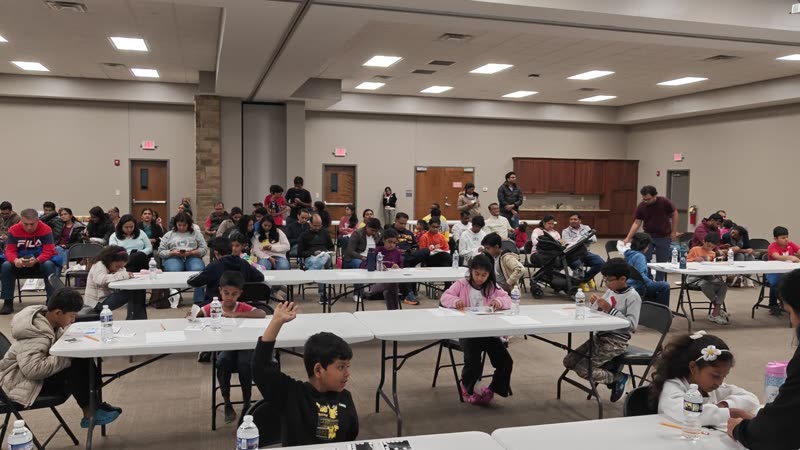
In the afternoon, 60 middle schoolers played the team math competition: two students from the same grade, one set of answers, 600 points in all.
- 1 · SprintFluency · 80 points
Sixteen calculations, split eight and eight between partners.
Room average 53%A race against the clock. EagleSharks and Team 602 in grade 6 both scored 80 of 80.
- 2 · JuryUnderstanding · 120 points
Twelve items: the answer is given, and the team picks the reason it is true.
Room average 67%The best-scored round. One grade 6 item asked whether a rectangle of sticks keeps its area when pushed into a slant; most teams said yes. It doesn't.
- 3 · CaseProblem solving · 160 points
Ten questions on real information, using evidence cards.
Room average 49%Pythons in grade 7 got every Case question right.
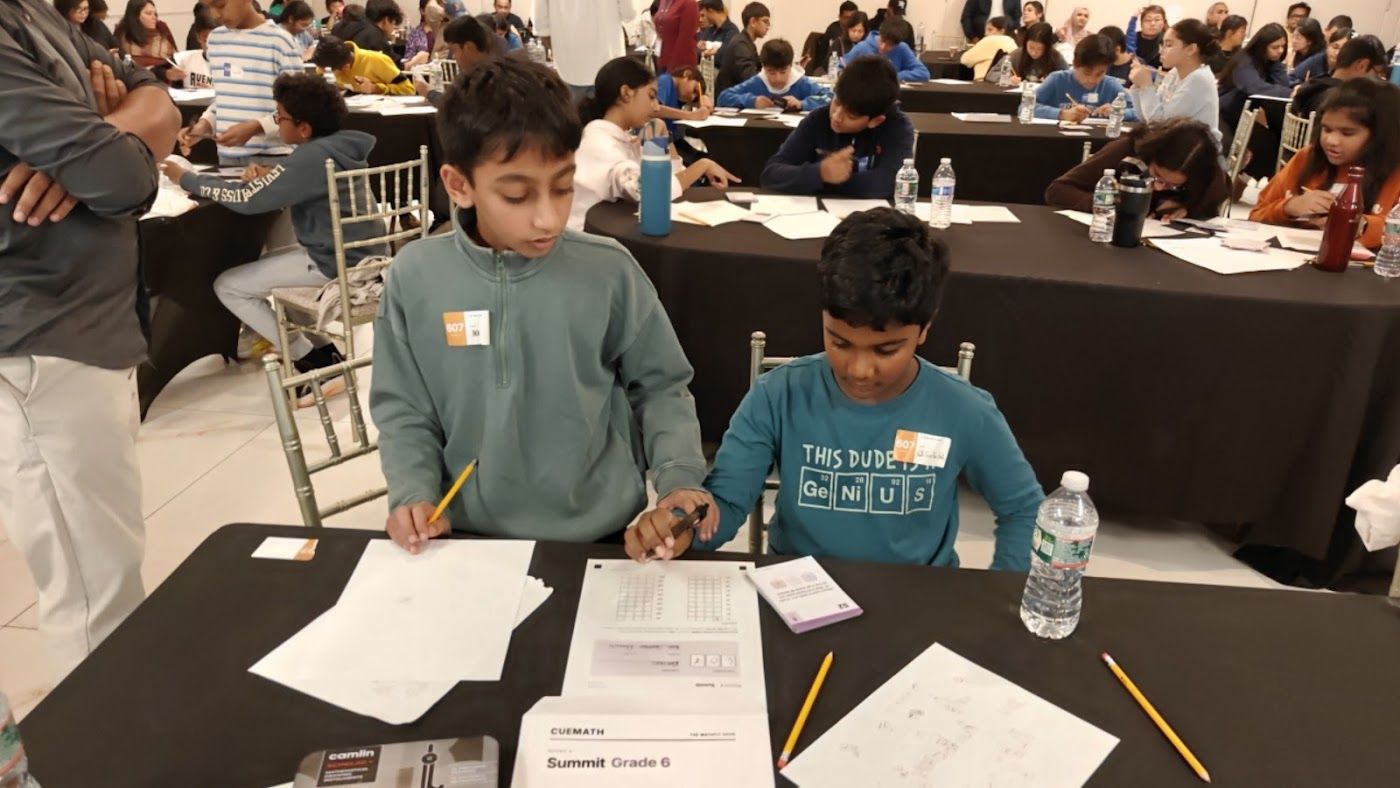
- 4 · SummitReasoning · 240 points
Twenty puzzle cards, no formula needed. The biggest round.
Room average 35%The hardest round of the day, and where the winners pulled away: Root scored 235 of 240.
The one tie on a podium
Bronze in Junior grades 2-3 came down to two children on 350 points. A tie goes to whoever did better in the last round, Logic Legend. Aria G. had 125 there and Krithik S. had 100, so Aria took bronze.
One more podium place stood out: Vihaan P. played grade 6 without a teammate and finished third, as the Ferocious falcons.
Scoring and the leaderboard
Nobody in the room marks a paper. Every answer is a number or a letter, so each sheet goes through the scanner and is scored against the answer key. Staff check any handwriting the scanner can't read.
In the Junior, the big screen showed each round's stars, the top five in each grade group, as soon as that round was scored. The running total stayed hidden until the end.
The awards
The host announced the podium one grade at a time: bronze, silver, then gold. The top three in every grade or grade group got medals, and every child got a certificate.

What parents did during the rounds
Parents stayed in the room and played a quiz of their own on their phones. A short set opened each time the host started a round and closed at pencils down. It mixed a little math, some questions about their child and learning, and one prediction: how many will my child get right?
Between rounds, the big screen showed the room what the parents said.
What parents told us
66 families in Edison played the parents' quiz across the two rooms. These are their answers, as a share of the parents who answered each question.
- 94%say puzzles and brain teasers build real thinking
- 87%want their child to know why math works, not just the answer
- 80%want math tied to real life, much more than now
Which kind of math matters most for your child right now?
It's a busy weeknight. The math help that would actually work for your family is…
- A coach on a laptop at home32%
- A center nearby14%
- A small group with friends14%
- An app, any time28%
- Me, at the kitchen table10%
How does your child find math at school?
- Just right54%
- Too easy39%
- Too hard3%
- Not sure3%
If you could change one thing about your child's math right now, it would be…
- More confidence44%
- More of a challenge32%
- Nothing10%
- Better grades6%
- Less homework stress6%
Has your child been in a math competition before?
- Never: this was the first55%
- Once or twice31%
- A few times11%
- Regularly2%
After today, what would you most like to know about your child's math?
- Their strengths and gaps55%
- How to help them improve31%
- How they did in each round11%
- What challenge to try next2%
The day at a glance
The first MathFit Open ever, run on the day's schedule:
- 10:45 amJunior families check in at the top of the staircase.
- 11:00 amThe Junior starts: K-1, grades 2-3 and grades 4-5 in one room, four rounds.
- By 1:00 pmJunior medals and certificates.
- 1:30 pmGrades 6-8 teams check in.
- 2:00 pmFour rounds, with the parents' quiz running alongside.
- 3:40 pmMedals and certificates.
- 4:00 pmDone.
Every Edison podium
Names as the public leaderboards show them: first name and last initial, with the team name.
The Junior, K-5 (out of 400)
Grades K-1
7 children- 1Armaan G.375of 400
- 2Ishaan S.365of 400
- 3Krishika B.350of 400
Grades 2-3
12 children- 1Reyansh G.Full marks on Logic Legend.390of 400
- 2Shlok P.375of 400
- 3Aria G.Level on 350 with Krithik S.; ahead on Logic Legend.350of 400
Grades 4-5
17 children- 1Vikhyath L.375of 400
- 2Krishna P.Full marks on Logic Legend.360of 400
- 3Nishka J.350of 400
Grades 6-8 (out of 600)
Grade 6
13 teams- 1EagleSharksAarav A. & Kavin A.Full marks in Sprint and Jury.556of 600
- 2Team 602Ayansh L. & Nivan S.421of 600
- 3Ferocious falconsVihaan P., playing solo347of 600
Grade 7
13 teams- 1PythonsAyaan P. & Nikhil D.Full marks in Jury and Case.517of 600
- 2Limit BreakersRaya S. & Tara V.442of 600
- 3Team 708Nihira J. & Shreya R.418of 600
Grade 8
6 teams- 1RootIvan L. & Zoey Y.235 of 240 on Summit. Top score of the day.567of 600
- 2PhoenixSwarit K. & Divye G.333of 600
- 3Team 803Sanjam M. & Viaan S.232of 600
What's next
The next day the MathFit Open moved to Princeton: read the Princeton log. Every Edison score, round by round, is on the leaderboards: Junior, K-5 and grades 6-8.
Questions parents ask
Who won the MathFit Open in Edison, NJ?
In grades 6-8: EagleSharks in grade 6 (556 of 600), Pythons in grade 7 (517) and Root in grade 8 (567, the top score of the day). In the Junior: Armaan G. in K-1 (375 of 400), Reyansh G. in grades 2-3 (390) and Vikhyath L. in grades 4-5 (375).
How many children took part in Edison?
96 children: 36 in the Junior (7 in K-1, 12 in grades 2-3 and 17 in grades 4-5) and 60 middle schoolers in grades 6, 7 and 8.
How does a team math competition work for middle schoolers?
In the MathFit Open, two students from the same grade enter as a team. They split the Sprint sheet, eight questions each, and work together on the other three rounds: Jury, Case and Summit. Teams are ranked within their grade, and the team's total is out of 600.
Can my child play without a teammate?
Yes. Families can register on their own and ask to be matched with a partner in the same grade. In Edison one child played grade 6 alone and still finished third.
What is the MathFit Open?
The MathFit Open is Cuemath's in-person math competition, held in cities across the US. Grades 6, 7 and 8 play in teams of two over four rounds: Sprint (speed), Jury (understanding), Case (problem solving) and Summit (reasoning puzzles), 600 points in all. The MathFit Open Junior is the K-5 level: each child plays alone, in K-1, 2-3 or 4-5, over Number Ninja, Why Wizard, Daily Detective and Logic Legend, 400 points in all. Every score joins a national leaderboard.
When is the next MathFit Open near me?
The season runs from November 2026 to March 2027 in cities across the US, with a National Final in spring 2027 for the top teams. The events page lists every city with open places, for grades 6-8 and for the Junior, K-5.
Play the next one
The MathFit Open comes to cities across the US through March 2027. Middle schoolers enter as a team of two; K-5 children play the Junior on their own.