
In short
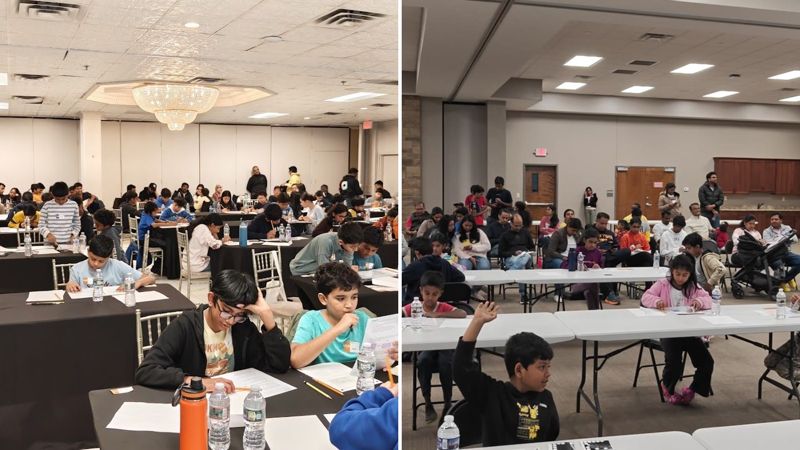
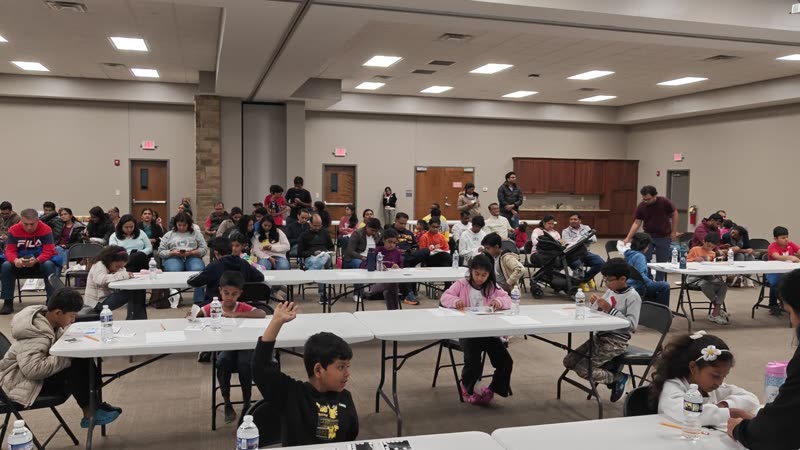
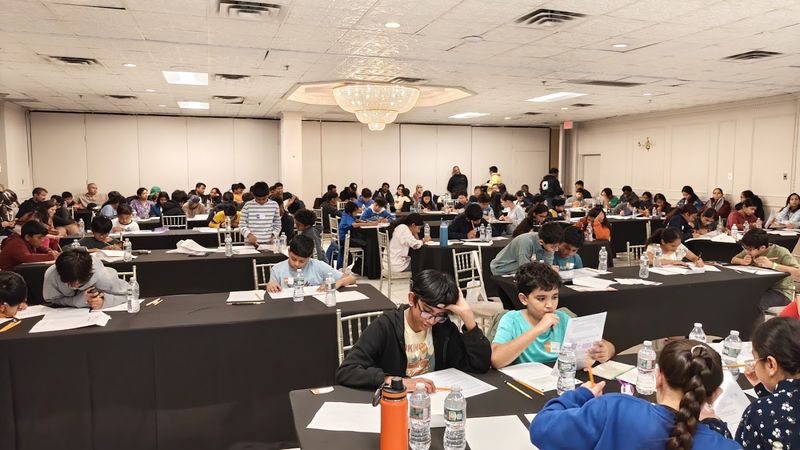
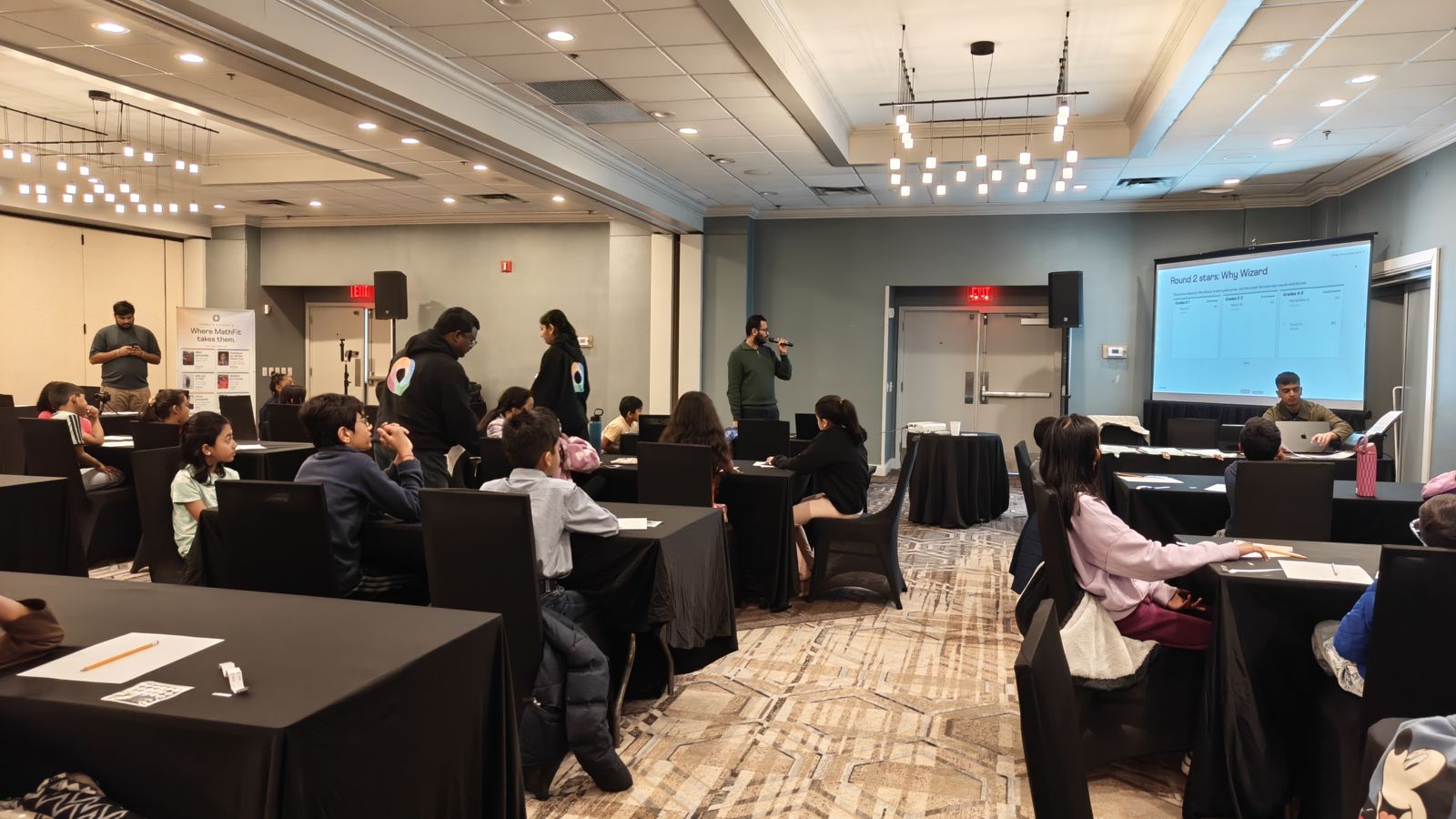
On Sunday, November 15, 2026, the MathFit Open came to the DoubleTree by Hilton in Princeton, New Jersey, a day after Edison. In the morning, 39 children in grades K-5 played the Junior, an elementary math competition where each child plays alone. In the afternoon, 29 teams of middle schoolers played in pairs.
- 39K-5 children in the Junior
- 29teams of two in grades 6-8
- 67families played the parents' quiz
- 400of 400: one perfect Junior score
Junior gold went to Dharvi P. (K-1), Advit M. (grades 2-3, perfect score), and Rudran N. and Tanish Y., tied in grades 4-5. The grades 6-8 champions were Team 603, Team 702 and Team 805.
Arrival and check-in
A desk at the ballroom door checked families in. Each child got a goody bag. Parents took the rows behind the children.
The Junior, round by round
Every child plays alone, ranked only against children in the same grades. Each question has three answers; the child puts a black dot sticker on one, so a kindergartner can play next to a fifth grader.
- 1 · Number NinjaFluency · 50 points
Ten quick questions on number facts.
Room average 87%The best-scored round of the morning.
- 2 · Why WizardUnderstanding · 80 points
Eight questions on why an answer is right.
Room average 80%Steady across all three grade groups.
- 3 · Daily DetectiveApplication · 120 points
Six questions on math in real life.
Room average 80%Grades 2-3 were close to perfect here.
- 4 · Logic LegendReasoning · 150 points
Six puzzles and patterns, worth the most.
Room average 62%The hardest round, and the one that decided the podium, including the tie below.
A perfect score, and a tie for gold
Advit M., in grades 2-3, got every question right in every round: 400 of 400. It was the only perfect score across both New Jersey events.
In grades 4-5, Rudran N. and Tanish Y. finished level on 380, and level on every round too: 50, 80, 100 and 150. No round could separate them, so they tied for gold. The leaderboard shows both as T1.
Just below, three children finished on 325. Annika S. had the best Logic Legend of the three and took bronze.
Grades 6-8, round by round
The afternoon was the team math competition: 29 pairs, 9 in grade 6, 14 in grade 7 and 6 in grade 8.
- 1 · SprintFluency · 80 points
Sixteen calculations, split eight and eight between partners.
Room average 52%Three teams scored 80 of 80: Team 702, Team 805 and North Stars.
- 2 · JuryUnderstanding · 120 points
Twelve items: the answer is given, and the team picks the reason it is true.
Room average 59%The best-scored round of the afternoon.
- 3 · CaseProblem solving · 160 points
Ten questions on real information, using evidence cards.
Room average 51%Team 702 got every Case question right and won grade 7 by 112 points.
- 4 · SummitReasoning · 240 points
Twenty puzzle cards, no formula needed.
Room average 25%The hardest round by far. Math Magicians had the best Summit in grade 8 and reached the podium on it.
Scoring and the leaderboard
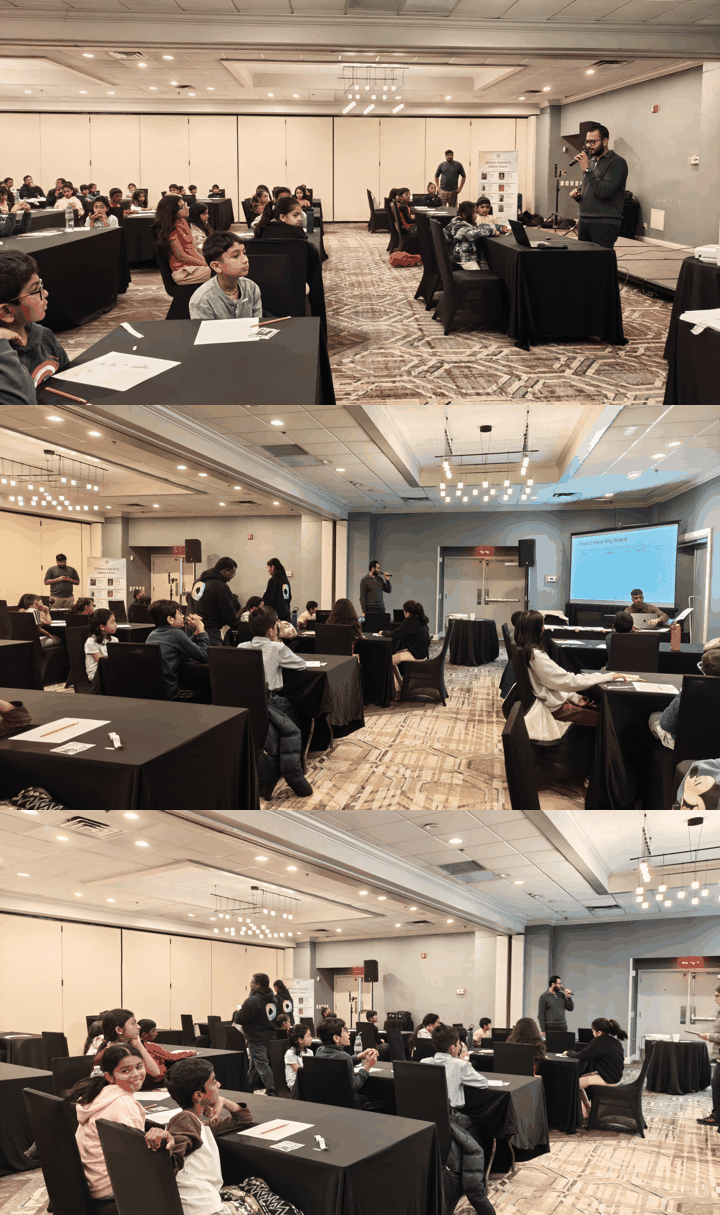
Nobody marks a paper by hand. Sheets go through a scanner, and a staff member checks any handwriting it can't read on a phone. Each round's stars, the top five in each grade, then go up on the big screen. The running total stays hidden.
The awards
After the last round the totals froze. The host revealed the final board one grade at a time, bronze first and gold last, with confetti on the screen for gold. The top three in every grade got medals, and every child got a certificate.
What parents did during the rounds
Parents scanned a code on the screen and played a quiz on their phones, one short set a round: opened when the host said "Go", closed at pencils down. One question asked them to predict their own child's score. Between rounds, the screen showed what the parents said.
What parents told us
67 families in Princeton played the parents' quiz across the two rooms. These are their answers, as a share of the parents who answered each question.
- 89%say puzzles and brain teasers build real thinking
- 84%want math tied to real life, much more than now
- 43%say the best coach is one who makes math fun
Which kind of math matters most for your child right now?
It's a busy weeknight. The math help that would actually work for your family is…
- A coach on a laptop at home22%
- A center nearby16%
- A small group with friends33%
- An app, any time26%
- Me, at the kitchen table2%
How does your child find math at school?
- Just right66%
- Too easy30%
- Too hard2%
- Not sure2%
If you could change one thing about your child's math right now, it would be…
- More of a challenge47%
- More confidence45%
- Nothing8%
- Better grades0%
- Less homework stress0%
Has your child been in a math competition before?
- Never: this was the first48%
- Once or twice27%
- A few times21%
- Regularly5%
After today, what would you most like to know about your child's math?
- Their strengths and gaps62%
- How to help them improve17%
- What challenge to try next13%
- How they did in each round7%
The day at a glance
- 10:45 amJunior families check in with the QR code on their ticket.
- 11:00 amThe Junior starts: K-1 at the front, then grades 2-3 and 4-5, four rounds in one room.
- By 1:00 pmJunior podium, medals and certificates.
- 1:30 pmGrades 6-8 teams check in.
- 2:00 pmFour rounds. After each, that round's stars go up on the big screen.
- 3:40 pmThe final board is revealed, grade by grade. Medals and certificates.
- 4:00 pmDone. Every score is on the public leaderboard.
Every Princeton podium
Names as the public leaderboards show them: first name and last initial, with the team name.
The Junior, K-5 (out of 400)
Grades K-1
9 children- 1Dharvi P.375of 400
- 2Lakshmi Manogna G.370of 400
- 3Aava S.355of 400
Grades 2-3
14 children- 1Advit M.A perfect score.400of 400
- 2Vivaan C.365of 400
- 3Tanvitaa J.355of 400
Grades 4-5
16 children- T1Rudran N.Level with Tanish Y. on every round.380of 400
- T1Tanish Y.Level with Rudran N. on every round.380of 400
- 3Annika S.Level on 325 with two others; ahead on Logic Legend.325of 400
Grades 6-8 (out of 600)
Grade 6
9 teams- 1Team 603Neha M. & Anaya K.396of 600
- 2North StarsBurhanuddin R. & Raghav H.Full marks in Sprint.383of 600
- 3Team 610Prisha S. & Shupanthi D.302of 600
Grade 7
14 teams- 1Team 702Shashvath G. & Aric E.Full marks in Sprint and Case.460of 600
- 2Prime MathletesHridhay S. & Ethan Z.348of 600
- 3Potato Power PrincessesEmma H. & Aarohee D.328of 600
Grade 8
6 teams- 1Team 805Shriyans C. & Gayathri K.Full marks in Sprint.408of 600
- 2Team 806Varanya B. & Anvith M.282of 600
- 3Math MagiciansAnish N. & Pranav K.One point behind silver.281of 600
What's next
More clips from the day are in the Princeton album. Every score is on the leaderboards: Junior, K-5 and grades 6-8. The day before, it began in Edison: read the Edison log.
Questions parents ask
Who won the MathFit Open in Princeton, NJ?
In the Junior: Dharvi P. in K-1 (375 of 400), Advit M. in grades 2-3 with a perfect 400, and Rudran N. and Tanish Y., tied for gold in grades 4-5 on 380. In grades 6-8: Team 603 in grade 6 (396 of 600), Team 702 in grade 7 (460) and Team 805 in grade 8 (408).
How many children took part in Princeton?
39 children played the Junior (9 in K-1, 14 in grades 2-3 and 16 in grades 4-5), and 29 teams played grades 6-8 (9 in grade 6, 14 in grade 7 and 6 in grade 8).
Is there a math competition for elementary school kids?
Yes. The MathFit Open Junior is a math competition for grades K to 5. Each child plays on their own, against children in the same grades (K-1, 2-3 or 4-5), and answers by placing a dot sticker on one of three choices, so even kindergartners can take part.
Is the MathFit Open like a math olympiad?
It shares the hard part: the last and biggest round is reasoning puzzles that need no formula, the kind olympiad-style contests are known for. It differs in format. It is a two-hour event in your own city, there are no qualifying rounds, and the leaderboard moves after every round. No contest experience is needed.
How are ties broken?
Children level on points are separated by the last round, the reasoning round, then by the round before it, and so on back to the first. Children level on every round share the place; the public leaderboard marks it with a T.
What is the MathFit Open?
The MathFit Open is Cuemath's in-person math competition, held in cities across the US. Grades 6, 7 and 8 play in teams of two over four rounds: Sprint (speed), Jury (understanding), Case (problem solving) and Summit (reasoning puzzles), 600 points in all. The MathFit Open Junior is the K-5 level: each child plays alone, in K-1, 2-3 or 4-5, over Number Ninja, Why Wizard, Daily Detective and Logic Legend, 400 points in all. Every score joins a national leaderboard.
When is the next MathFit Open near me?
The season runs from November 2026 to March 2027 in cities across the US, with a National Final in spring 2027 for the top teams. The events page lists every city with open places, for grades 6-8 and for the Junior, K-5.
Play the next one
The MathFit Open comes to cities across the US through March 2027. Middle schoolers enter as a team of two; K-5 children play the Junior on their own.