


Win With Fewer Votes
Can the side with fewer votes still win? Sounds impossible — let's find out.
Concept
Same voters, same votes — but redraw the boundary lines and you can flip who wins. Kid discovers that gerrymandering isn't about changing votes, it's about changing how they're grouped.
The Experience
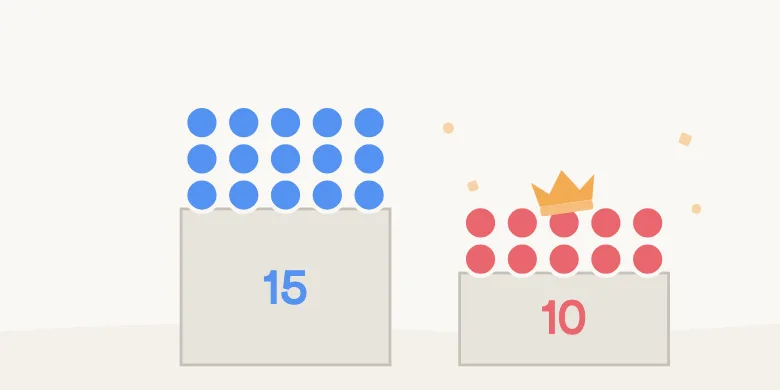
Kid starts with a 5×5 grid of 25 voters — 15 blue, 10 red — and is told blue should obviously win. They draw 5 districts of 5 voters each, and by packing almost all the blue voters into just 2 of the districts, red ends up winning 3 districts to 2 — despite having fewer total votes.
In round two, the same 25 voters are redrawn into new districts that flip the result the other way, with blue now winning 4 districts to 1 — nothing about the voters changed, only the boundary lines.
Round three asks the kid to draw "fair" districts instead, and runs straight into the real difficulty: what does fair even mean — equal population per district, compact shapes, or a result proportional to the overall vote? These goals can pull against each other, and no single map satisfies all of them at once.
Real, actual gerrymandered district maps are shown alongside the kid's own drawings — genuinely strange, contorted shapes that only make sense once you see what boundary they're built to produce.
The final transfer task hands the kid a new problem with the same structure: draw 4 "fair" school zones for a set of neighborhoods.
What Math Does The Kid Do?
- Partitions a fixed set of data points into equal-sized groups.
- Discovers how the same underlying data can produce different aggregate outcomes depending on how it's grouped.
- Compares competing definitions of "fair" (equal population, compact shape, proportional outcome) and finds they can conflict.
- Reads and interprets real district-map data.
- Transfers a districting structure to a new real-world grouping problem.
Why This Matters
You'll understand how a fair-looking outcome can hide an unfair map — the same votes can lose or win depending only on how the lines are drawn.
Frequently asked questions
Win With Fewer Votes is tagged for Grades 6-12.
No — Win With Fewer Votes plays directly in the browser, right on this page. No login, no download.
Weigh a real decision where the obvious choice isn't always the smart one.
No — Win With Fewer Votes is free to play, no sign-up needed.