Cuemath's Dubai Parent Summit: A Way Forward for Math Education in an AI World
Seventy families, 200 guests and one theme: the future of math education. What was argued on stage in Dubai on 13 September, how 67 children taught math back to the room, and every student recognized that night.
Artificial intelligence has made parents, schools and employers rethink what education is actually for. What should children learn now? Which skills still hold their value? What careers are they being prepared for?
Cuemath used its Parent Summit in Dubai to put forward an answer.
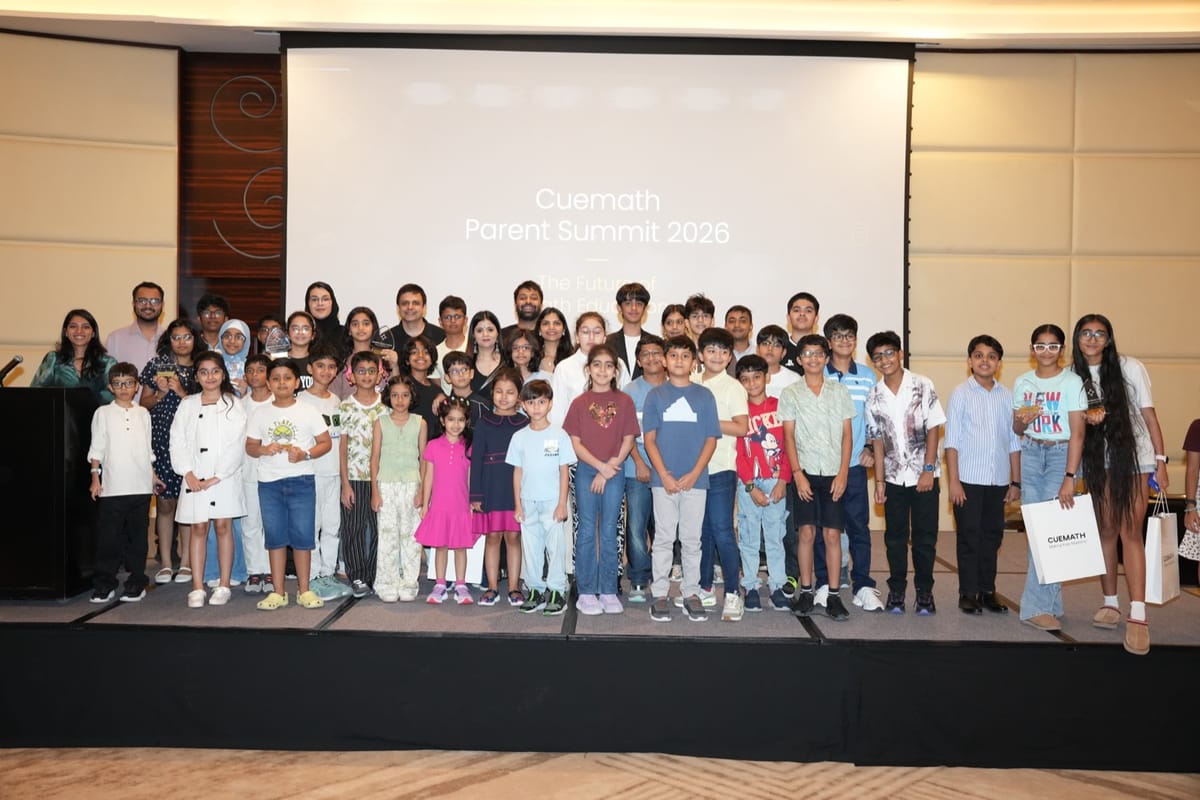
The summit was held on 13 September 2026 at The Westin Dubai Mina Seyahi Beach Resort & Marina, under the theme The Future of Math Education. Around 70 families attended — more than 200 people in total — for an evening that paired three talks on where math education needs to go with an awards ceremony for results earned over the past academic year.
By the end of the night, 100 awards had been presented, 18 more students had been named MathFit Rising Stars, and four children had won a contest for teaching math back to the room.
Key takeaways
- The Cuemath Parent Summit 2026 was held in Dubai on 13 September, with 70+ families and 200+ guests.
- 100 awards were presented: 56 for school mathematics, 27 for national competitions and 17 for international competitions. A further 18 students were named MathFit Rising Stars.
- The talks made one argument: as AI absorbs procedural work, the skills that hold their value are judgment and reasoning — and math is how children build them.
- 67 children entered the Teach-It-Back contest, recording themselves teaching a piece of math across 53 topics, from kindergarten to Grade 10.
- Every award winner is listed at the end of this post, with the tutor who worked with them.
The opening talk: what AI changed
Divykriti Madaan, who leads the brand team at Cuemath, opened the evening by setting out the evidence.
In August 2026, the Stanford Digital Economy Lab published a study called Canaries in the Coal Mine. Erik Brynjolfsson, Bharat Chandar and Ruyu Chen went through payroll records for millions of workers, from the month ChatGPT launched through June 2026.
Miners once carried a canary underground. The bird could not stop the danger; it registered the danger first. The study asked which group of workers plays that role now.
It turned out to be the youngest. In the 40% of jobs most exposed to AI, employment for 22-to-25-year-olds fell 11%. There were no redundancy rounds, and starting salaries held steady. The jobs were simply never offered again — while every older age group in those same fields continued to grow.
“If someone can train you to do it, they can train AI to do it.”
The explanation offered on stage was straightforward. An entry-level hire was traditionally asked to learn the system, follow the guidelines, use the template and apply the process. Each of those is a training instruction — and anything that can be written into a training document can now be written into a machine. Employers once paid for people who followed well; that capability is now available at no cost and at unlimited scale.
What remains, the talk argued, is judgment. It set the distinction out in three pairs.
| AI can | Only a human can |
|---|---|
| Follow instructions | Write the instructions in the first place |
| Find thousands of patterns | Decide which patterns matter |
| Solve a problem | Choose which problem is worth solving at all |
Every item in the right-hand column is a judgment rather than a procedure. That kind of thinking — clear, logical, creative — is what math builds, not as a school subject but as a habit of mind.
Demis Hassabis, who runs Google DeepMind and won the Nobel Prize in Chemistry in 2024, made a similar point: “If I were a student today, I would study mathematics. It will power the AI revolution.”
What being MathFit actually looks like
Karan Singla, who leads math and learning at Cuemath, addressed the follow-up: what that goal looks like in an individual child.
MathFit, in plain words: it's Cuemath's term for mathematical fitness — a child's ability to reason through a problem, stay with it when it gets hard, and feel genuinely at ease with numbers. It is deliberately not about speed, memorization or marks. Cuemath's free MathFit evaluation measures exactly these things.
The signs he described are ordinary enough for a parent to observe at home:
- The child asks why a rule works, not just what it is.
- They stay with a hard problem instead of stopping at the first wrong turn.
- They can explain their thinking out loud — and often end up teaching someone else.
- They break a big, confusing problem into steps they can handle.
- They notice patterns, and they notice when an answer doesn't look right.
None of those appear on a report card, and all of them can be trained. That was the premise of the next part of his talk: Cuemath's new Enrichment Math courses, built around the skills that hold their value in an AI world.
The courses teach children to spot misleading information, reason through choices when the answers are not clean, find the strategy in their own moves, and make sense of the world around them. The underlying capabilities are judgment, reasoning, strategic thinking, sense-making and abstract thinking. Some of the same material — real-world explorations, strategy games and puzzles — is openly available.
Try the puzzles the kids in that room work on
Real-world explorations, strategy games and math puzzles. Free, no sign-up, no pressure.
Explore free math puzzlesThe case for productive struggle
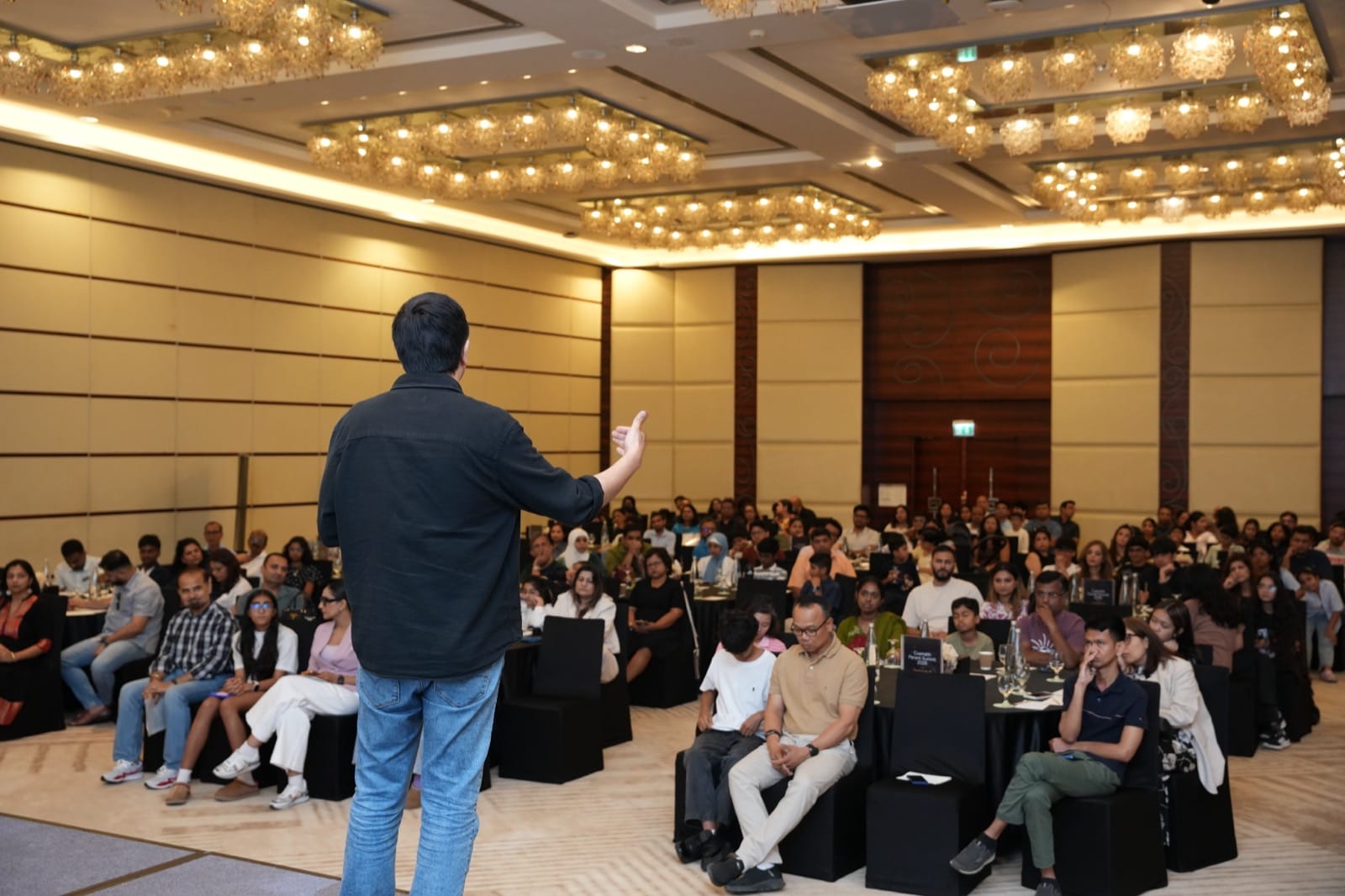
Manan Khurma, Cuemath's founder and CEO, gave the keynote and spent it on the idea he has built the company around: productive struggle.
The phrase describes the zone where a problem is hard enough to demand real effort but not so hard that a child abandons it. That is where the learning happens. A child who only meets problems they can already do is rehearsing math rather than learning it.
On that view, the measure of a good math session is not how many answers came out right, but how long a child stayed in the struggle before one did.
“True mathematical capability isn't just about speed or memorisation; it is about building the mental stamina to tackle unfamiliar challenges with confidence.”
The framing also explained the awards that followed. Few of the citations read that evening described a child as naturally gifted. Most described effort sustained across a full academic year.
100 awards, three categories
Nancy Sharma, who leads Cuemath's teacher community, read the citations. One hundred awards, split three ways.
| Category | Awards | What it recognized |
|---|---|---|
| Distinction in School Mathematics | 56 | The strongest mathematicians in their own classrooms and year groups |
| Distinction in National Competition | 27 | Students measured against a whole country, and placing near the top of it |
| Distinction in International Competition | 17 | Students who competed against the world, and placed |
A further 18 students were named MathFit Rising Stars — a special mention for effort and progress rather than a final score. That category included a Grade 9 student who took her mathematics result from 40 percent to 85, and a kindergartener who finished the Grade 0 curriculum in three months.
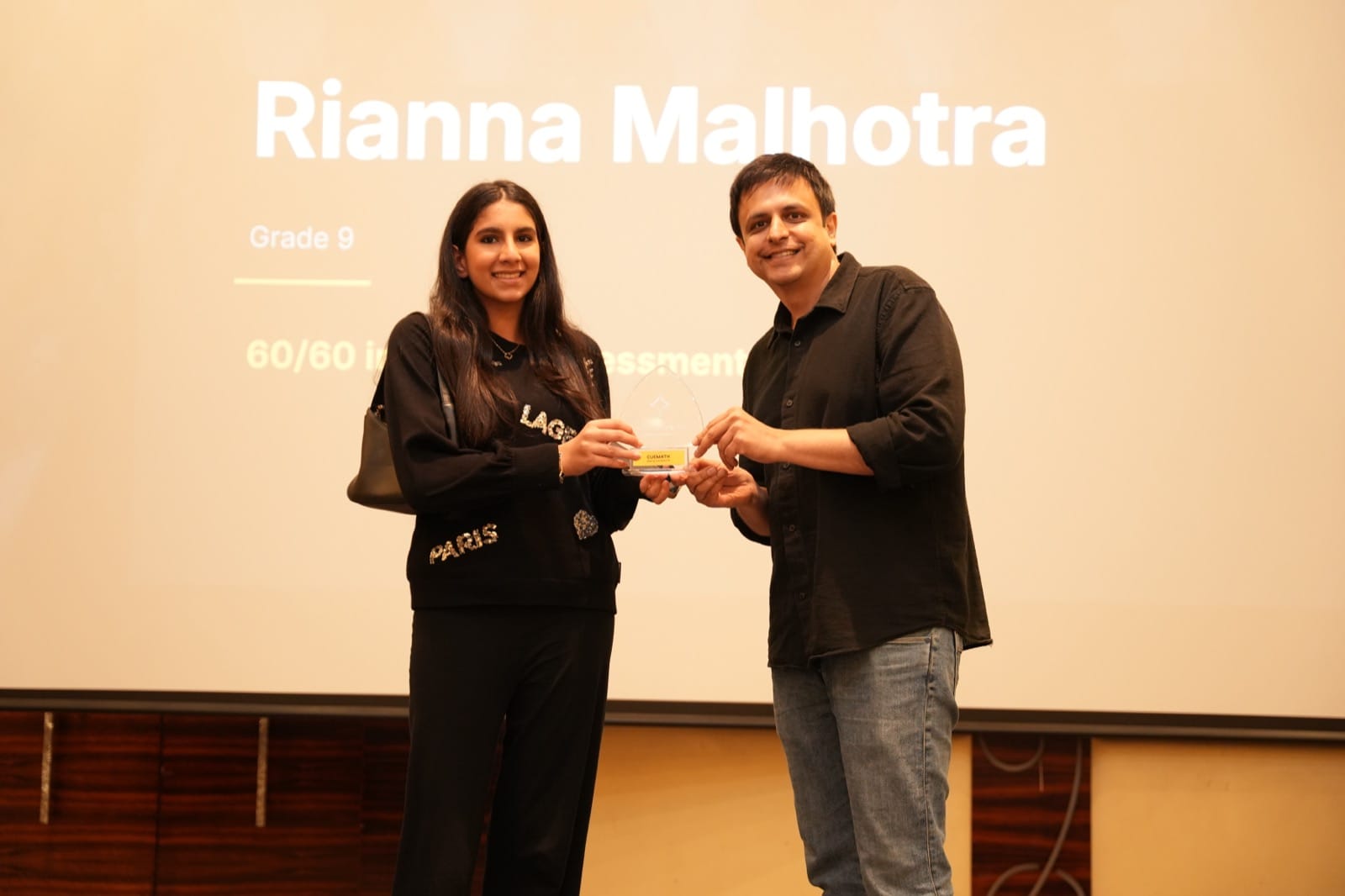
Some of the international results were remarkable by any standard:
- Revaan Birla, Grade 4 — ranked first in the world in the SOF International Mathematics Olympiad, which reaches students through 99,499 registered schools across 72 countries.
- Maahi Batra, Grade 6 — national gold and first place at Germany's Mathematik-Olympiade, competing in German, which is not her first language.
- Hritika Somani, Grade 7 — two golds at the Mathematik-Olympiade in Frankfurt.
- Krishiv Binoi Nair, Grade 4 — gold in Math Kangaroo, a competition entered by more than six million children across 90 countries.
Pooja Purohit, one of the Cuemath tutors in the room, summed up the purpose of the evening: “Online learning involves weeks of consistent, quiet focus from a child. The Parent Summit is meaningful because it brings that journey into the light. Hearing their name recognised in front of their families validates those hours of perseverance.”
67 children became the teachers
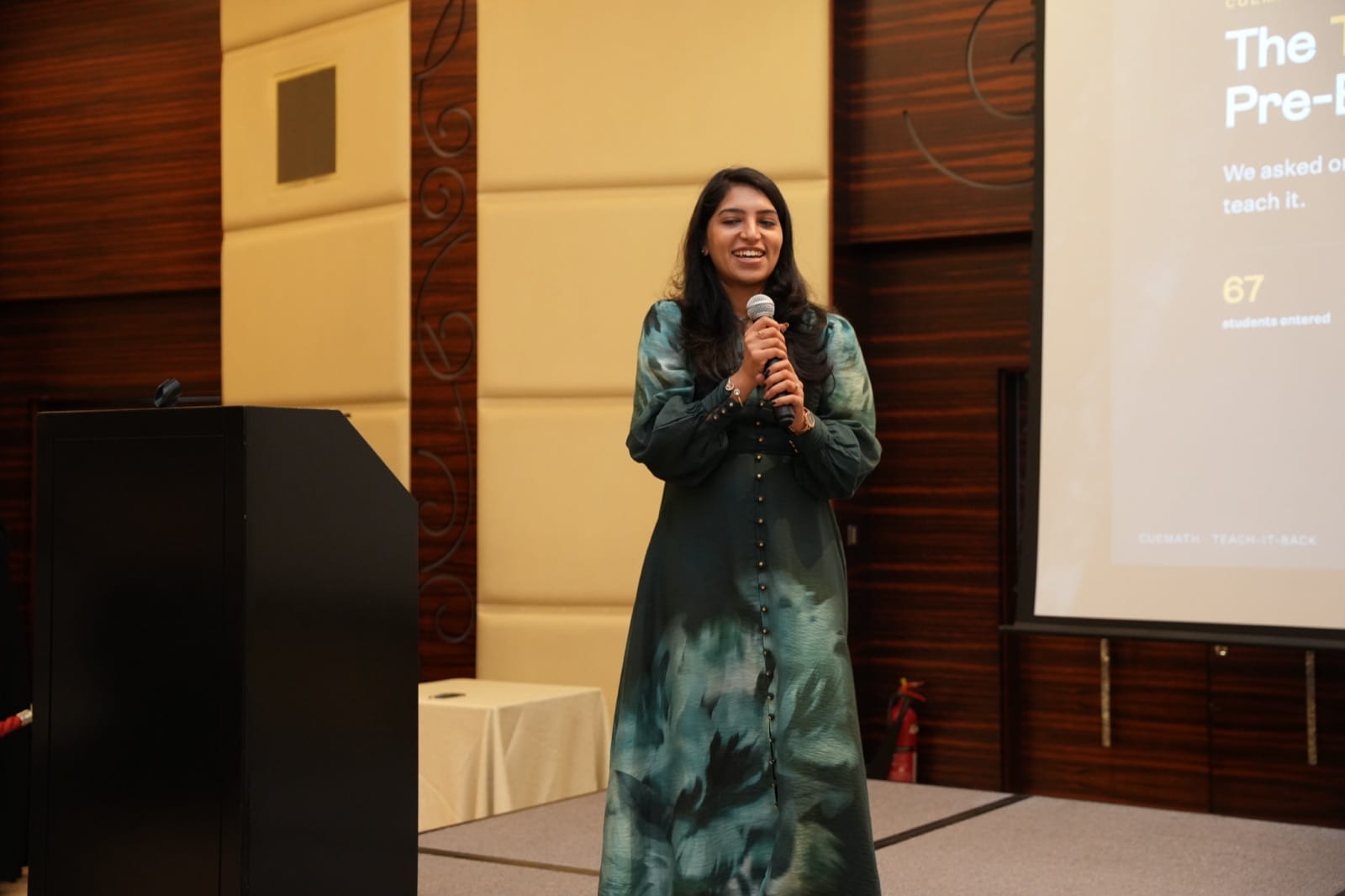
The final segment of the evening was the Teach-It-Back contest.
Ahead of the summit, children were asked to pick a piece of math they cared about and teach it to camera. Sixty-seven did, across 53 different topics, from kindergarten to Grade 10. Behind most of those recordings was a parent running lines, listening to a practice take or holding the phone.
Getting an answer right is a starting point. Explaining why it is right asks more. Teaching it to someone else asks the most, because it requires thinking about the listener — which example will help, which words make the reasoning clear, where to slow down.
Entries were judged on three criteria, in order:
- Did the child explain the why, not just the what? The reason underneath the rule — why an idea works, or where it is actually used.
- Did the logic hold? Could the explanation be followed step by step, without gaps.
- Was it a joy to watch? A good example, a drawing, thoughtful pacing, a little humor.
Four children were recognized.
| Award | Student | What they taught |
|---|---|---|
| First prize | Nevaeh Halder Kumar Grade 3 | Data and graphs. A hundred passengers, each with a meal order, and the question of what food to load onto the plane. She solved it with tally marks and a graph, and showed where it is used and why it is worth learning. |
| Second prize | Viyaan Sengupta Grade 5 | Carl Gauss' adding technique. He took a problem that looks impossible, found the pattern hiding inside it, and named the lesson himself: math is breaking something complex into something simpler by spotting patterns. |
| Third prize | Mohamad Kanaan Grade 8 | Percentages. He showed a shortcut — divide both numbers by ten, then multiply what is left — but did not stop there. He explained why it works and tested it on easy numbers and hard ones. |
| Special mention | Mustafa Farrukh Grade 4 | That the angles in a triangle add up to 180 degrees — proved by cutting a paper triangle into three pieces and bringing the corners together into a straight line. |
What the evening was actually about
The evening could be read simply as a prize-giving: a hundred trophies, a photo on stage, a night at a hotel by the marina.
What connects its two halves is more telling. The talks argued that the skills holding their value are reasoning and judgment — making sense of a problem, finding the pattern, deciding what is worth doing. The contest then handed the microphone to 67 children and asked them to demonstrate exactly that, out loud, for someone else.
Mathematical reasoning lets a child make sense of a problem. Strong communication lets them bring another person into the solution. Together they produce a child who can solve something and take people along — a reasonable description of what the coming decades will ask of them.
Cuemath runs free math events like this one in cities around the world. The Dubai summit was the largest of them so far.
The full roll of honor
Every student recognized on 13 September, and the tutor who worked with them.
Distinction in School Mathematics (56)
The strongest mathematicians in their own classrooms and year groups.
| Student | Achievement | Tutor |
|---|---|---|
| Aryaan Roy Grade 2 | 9 of 10 in Mathematics · Highest in class | Sunita Bhatia |
| Prisha Sharma Grade 2 | 19 of 20 in Mathematics | Kusum Yadav |
| Amira Grade 2 | Third in class in Mathematics | Kusum Yadav |
| Sarah Bhambhani Grade 3 | 100 percent in Mathematics | Lynn S. Santhosh |
| Tanav Jayanth Grade 3 | Full marks in Mathematics | Manjit Baweja |
| Dhruv Kaushik Grade 3 | Excelling and Extending in Mathematics | Seema Ahluwalia |
| Rianna Deepak Thawani Grade 3 | Second in Mathematics · School award, 2025-26 | Yatheesha |
| Nalan Ramanandh Year 3 | Math Superstar · School times-tables champion | Rimmy Nayyar |
| Aimee Jeby Grade 4 | 90 of 100 in Mathematics | Durga Bhavani |
| Mahika Srivastava Grade 4 | 96 percent in Mathematics · Overall Grade 1 | Anam Khan |
| Vidyuth Ug Grade 4 | 22 of 25 in Mathematics | Sunita Agarwal |
| Dharshini Naresh Grade 4 | A* in Mathematics | Saumyata Kumar |
| Nehema Ann Bonny Grade 4 | Grade A in Mathematics | Saumyata Kumar |
| Malika Grade 4 | Grade A in Mathematics | Deepa Asuri |
| Amaira Bhagat Grade 4 | Marvelous Mathematician award, won three times in one year | Jasmeet Kohli |
| Myrah Grade 5 | 100 percent in the school Mathematics evaluation | Timci Goyal |
| Deshna Surana Grade 5 | Mathematics 8 of 9 · School toppers' band | Agalya C |
| Viyaan Sengupta Grade 5 | Highest marks in Mathematics | Preeti Mishra |
| Nirvaan Gauriar Grade 5 | Exceeding attainment in Mathematics, all three terms | Pooja Gupta |
| Qusai Kader Rasiya Grade 5 | Super Mathematician Award, 2025-26 | Nivedita Choudhury |
| Vedhika Hemkumar Grade 5 | Subject Excellence Award in Mathematics | Agalya C |
| Fathima Zahra Ali Grade 6 | 29.5 of 30 in Mathematics · Highest in class | Sananda Nanda |
| Venkata Srinika Kosuri Grade 6 | Mathematics 98 of 100 · Grade A1 | Pooja Gupta |
| Elena Jain Year 6 | Highest grade in Mathematics — grade M | Rajiv Kumar |
| Liv Sethi Grade 6 | Mathematics 8 of 9 · School appreciation certificate | Nidhi Jain |
| Veer Mudgal Grade 6 | Mathematics grade raised from 7 to 8 of 9 | Richa Jalan |
| Aarush Sudhish Grade 7 | Between 99 and 100 percent in Mathematics | Nivedita Choudhury |
| Yusuf Omar Qazi Grade 7 | 48 of 50 in Mathematics · First in class | Taruna Malik |
| Tej Jayanth Grade 7 | Full marks in Mathematics · First in class | Manjit Baweja |
| Avneesh Banerjee Grade 7 | Exceeding attainment and progress in Mathematics | Makarand Wable |
| Ayaan Hussain Siddique Grade 7 | Grade A in Mathematics | Sujoy Mukherjee |
| Joanna Bejoy Grade 7 | Grade A in Mathematics, two years running | Jeevitha Saragadam |
| Kabir Lalwani Grade 7 | Mathematics grade 7, against a target of 6 | Manjiri Date |
| Vaanya Somani Grade 7 | First in Mathematics in her school · Quiz winner | Anuradha Sadani |
| Savya Dakhera Grade 7 | Math Excellence Award, 2025-26 | Apoorva Mehta |
| Vivaan Nair Grade 8 | Mathematics 9 of 9 throughout Grade 7 | Ashima Malhotra |
| Atharva Malik Grade 8 | Mathematics Band 8, against a target of Band 5 | Saurabh Singhal |
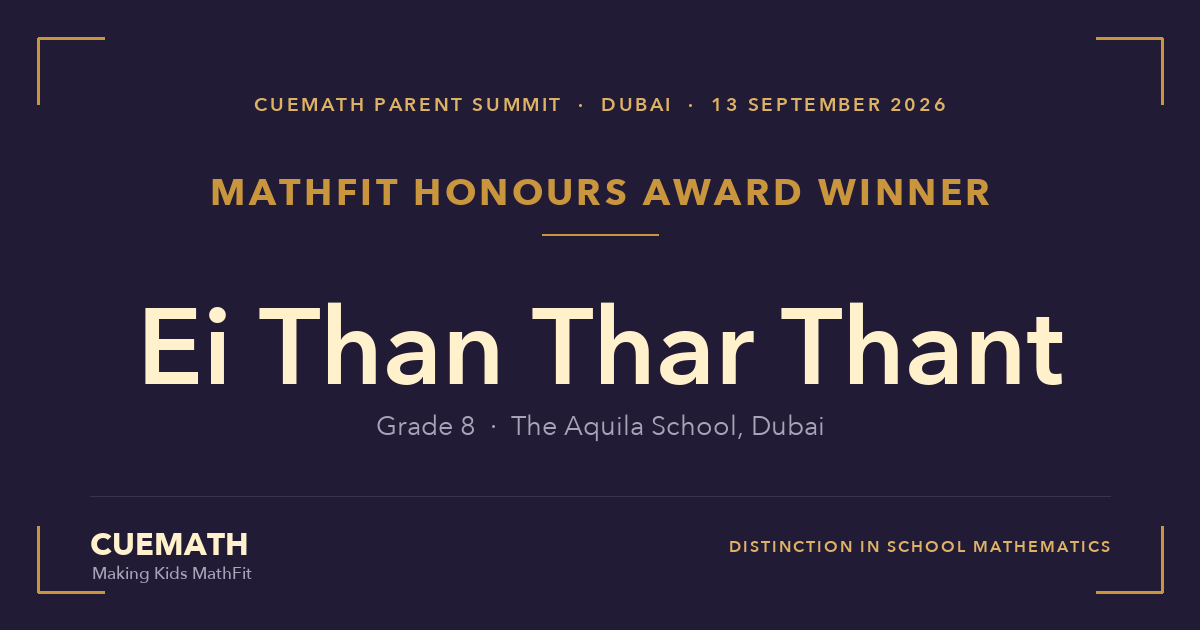
| Ei Than Thar Thant Grade 8 | Excelling in Mathematics | Lokeshwari K |
| Gaurrika Somani Grade 8 | First in Mathematics across all sections | Anuradha Sadani |
| Kavana H Kedlaya Grade 8 | Grade A2 in Mathematics · Grade 7 final examination | Kajal Ahuja |
| Miraya Singh Grade 8 | Mathematics 8 of 9 | Rajiv Kumar |
| Mohamad Kanaan Grade 8 | First in the school mental mathematics examination | Maruti Nandan Jha |
| Thea Jenifer Youssef Grade 8 | Mathematics A-, up from C+ | Taruna Malik |
| Liyana Umair Grade 8 | Certificate of Excellence in Mathematics, Grade 7 | Insia Bohra |
| Rumaysa Khan Grade 9 | Full marks in Mathematics, Grades 7 and 8 | Saumyata Kumar |
| Yug Shetty Grade 9 | 100 percent in Mathematics | Rajiv Kumar |
| Malak Adel Grade 9 | Mathematics raised from 70 to 100 percent, and sustained | Saumyata Kumar |
| Advay Kumat Grade 9 | Top MYP grade 7 in Mathematics, all year | Deepti Jain |
| Ibrahim Ghani Grade 9 | Mathematics 8 of 9 | Rajiv Kumar |
| Ryan Goudarzian Year 9 | Mathematics grade 6, against a target of 5 | Rajiv Kumar |
| Saswath Ravishankar Grade 9 | A* in Mathematics | Sujatha Shankar |
| Vivaan Daga Grade 9 | MYP Mathematics · Grade 6 of 7 | Deepti Jain |
| Vansh Lalwani Grade 9 | Mathematics 9 of 9 · Selected for Further Mathematics | Manjiri Date |
| Ayaan Naithani Grade 10 | Grade A in Mathematics — the highest awarded | Saumyata Kumar |
| Snigdha Princy Arun Grade 10 | Top three in Mathematics in her school | Swati Kumar |
| Diya Dinesh Grade 11 | Academic Scholarship in Mathematics, 2026-27 | Archana Bhide |
Distinction in National Competition (27)
Students measured against a whole country, and standing near the top of it.
| Student | Achievement | Tutor |
|---|---|---|
| Shivaay Sreenivasan Grade 8 | UK Junior Mathematical Challenge · Gold Certificate | Agalya C |
| Riaana Malhotra Grade 9 | UK Junior Mathematical Challenge 2024 · Gold Certificate | Nisha Shah |
| Aarya Bondugulapati Grade 7 | UK Junior Mathematical Challenge 2026 · Silver Medal | Shilpa Sekhri |
| Arin Adya Grade 7 | UK Junior Mathematical Challenge 2026 · Silver Certificate | Rehana |
| Arhaan Shah Grade 7 | UK Junior Mathematical Challenge · Bronze Medal | Agalya C |
| Samir Grade 7 | UK Mathematical Challenge · Bronze Certificate | Richa Jalan |
| Arianna More Grade 7 | UKMT Junior Mathematical Challenge · Bronze Certificate | Nisha Shah |
| Avyaan Kapoor Grade 6 | Selected through the Doon School entrance examination | Prashant Soudri |
| Riaan Anurag Sachdeva Grade 5 | GL Progress Test in Math · SAS 141, stanine 9 | Neha Bhatnagar |
| Nyan Htet Grade 6 | GL Progress Test in Math · SAS 135 | Lokeshwari K |
| Yousaf Shahzad Grade 5 | GL Progress Test in Math · SAS 134, stanine 9 | Rimmy Nayyar |
| Tharun Karthick Grade 9 | CAT4 · mean SAS 131 | Agalya C |
| Josef-Alexander Reinl Year 5 | GL Progress Test in Math · SAS 129, stanine 9 | Sanjay A V |
| Tharun Sahasranam Grade 4 | GL Progress Test in Math · SAS 129, stanine 9 | Priyadarshini V |
| Yashvi Tyagi Grade 5 | GL Progress Test in Math · SAS 129 | Parul Goel |
| Aaren Tandon Grade 5 | GL Progress Test in Math · stanine 9 | Sirisha PM |
| Prisha Jain Grade 5 | GL Progress Test in Math · stanine 9 | Manjiri Date |
| Kartikey Goel Grade 6 | GL Progress Test in Math · stanine 9, five years running | Anita Gadodia |
| Ethan Lalwani Grade 9 | GL Progress Test in Math · SAS 126, stanine 8 | Manjiri Date |
| Mia Neb Grade 4 | GL Progress Test in Math · SAS 120, stanine 8 | Anita Gadodia |
| Delisa Lysandra Pind Grade 5 | GL Progress Test in Math · stanine 8 | Paromita Pal |
| Nakul Kaushik Grade 3 | GL Progress Test in Math · stanine 8 | Manjit Baweja |
| Nevaeh Halder Kumar Grade 2 | NWEA MAP Growth · 98th percentile | Sowmya Sundar |
| Rakan Nasib Grade 8 | NWEA MAP Growth · 98th percentile | Abhishek Choudhery |
| Mouna Alsamsam Grade 4 | NWEA MAP Growth · RIT 228, first in her grade | Preeti Khandelwal |
| Dhruv Vimal Grade 10 | IGCSE Additional Mathematics · Grade 9 | Kalpana Edulapally |
| Shriyansh Das Grade 10 | GCSE Mathematics · Grade 9 | Sasi Reka G. |
Distinction in International Competition (17)
Students who competed against the world, and placed.
| Student | Achievement | Tutor |
|---|---|---|
| Revaan Birla Grade 4 | SOF International Mathematics Olympiad · Rank 1 worldwide | Rohini Gupta |
| Anaika Gupta Grade 3 | SOF International Mathematics Olympiad · Gold, International Rank 53 | Prasanthi |
| Dhruv Gupta Grade 3 | SOF International Mathematics Olympiad · Gold, International Rank 73 | Prasanthi |
| Hritika Somani Grade 7 | Mathematik-Olympiade, Frankfurt, 2 May 2026 · Two Golds | Anuradha Sadani |
| Maahi Batra Grade 6 | Mathematik-Olympiade 2026 · National Gold, First Place | Shilpa Shah |
| Krishiv Binoi Nair Grade 4 | Math Kangaroo 2026 · Gold | Durga Bhavani |
| Nathania Pradeep Grade 4 | Math Kangaroo 2026 · Silver Award | Dhriti K. Sahoo |
| Vihann Duttagupta Grade 7 | IOF International Math Olympiad · 10th in the UAE | Nandini Harnathka |
| Dhruva Murlidhar Ginka Grade 4 | International Math Challenge 2025 · Global Rank 92 | Swati Khara |
| Arhaan Saxena Grade 10 | KAUST Mathematics Competition 2026, Saudi Arabia · Bronze Medal | Gokilavani Mylswamy |
| Shania Faith Antao Grade 5 | World Maths Championship 2024 · Bronze Medal | Varsha Jain |
| Kairav Jain Grade 7 | Challenge ME Math Championship · Top 100 | Dipal Shah |
| Vidhan Surana Grade 10 | Challenge ME [Middle East] Math Championship · Top 100 | Swati Kumar |
| Rishabh Adya Grade 7 | Challenge ME Math Championship 2025-26 · Top 100 | Deepti Jain |
| Arjun Inani Grade 5 | Challenge ME Math Championship · Finalist, Top 100 in the UAE | Vinni Hooda |
| Aira Anand Grade 6 | Challenge ME Math Championship · Semi-finalist | Shiny Jacob |
| Tuna Onder Grade 7 | Challenge ME Math Championship · Finalist | Shiny Jacob |
MathFit Rising Stars (18)
Special mentions for effort and progress across the year.
| Student | Grade | Achievement |
|---|---|---|
| Miraan Badlani | Grade 1 | Stellar in his Grade 1 evaluations |
| Navya Badlani | Grade 2 | Outstanding in the Grade 1 examination |
| Mishita Midha | KG | Finished the Grade 0 curriculum in three months |
| Aarika George | Grade 3 | Working a full grade ahead of her year |
| Fatima | Grade 4 | Strong scores in mathematics olympiads |
| Avira | Grade 4 | Two years of growth in reasoning |
| Delisa | Grade 5 | 8 points, up from 7 |
| Akshara | Grade 5 | A clear upward trajectory |
| Shlok | Grade 5 | Working beyond the Grade 5 curriculum |
| Ananya Rajoli | Grade 6 | Tops her class in Mathematics |
| Ruhika | Grade 7 | Integers mastered in her first month |
| Enoch | Grade 7 | Beyond his previous benchmarks |
| Rose Mohd Fadi Todmari | Grade 8 | 80 of 100, up from 75 |
| Tarun | Grade 8 | Grade B, up from Grade C |
| Thea | Grade 8 | Strong in the school examination |
| Anay | Grade 8 | Consistently exceeding expectations |
| Mahira | Grade 9 | 85 percent in Mathematics, up from 40 |
| Baani S | Grade 9 | World Scholar's Cup · 5th, Global Round |
Congratulations to every one of them — and to the tutors who got them there.
See where your child actually stands in math
A free 1:1 class and a written evaluation of their reasoning, fluency, understanding and application. No credit card needed.
Book a free trial classFrequently Asked Questions
What was the Cuemath Parent Summit 2026 in Dubai?
It was an evening for Cuemath families in the UAE, held on 13 September 2026 at The Westin Dubai Mina Seyahi Beach Resort & Marina. Around 70 families attended, more than 200 people in total. The theme was “The Future of Math Education.” The evening combined three short talks on what math education needs to become in an AI world with an awards ceremony recognising students for results earned over the past academic year.
How many students were recognized, and in which categories?
One hundred awards were presented across three categories: 56 Distinctions in School Mathematics, 27 Distinctions in National Competition and 17 Distinctions in International Competition. A further 18 students received MathFit Rising Star special mentions, which recognise effort and progress rather than a final score. Every name is listed in the roll of honor in this post, alongside the Cuemath tutor who worked with that student.
What does “MathFit” mean?
MathFit is Cuemath's term for mathematical fitness. A MathFit child can reason through an unfamiliar problem, stay with it when it gets difficult, explain their thinking to someone else, and feel genuinely at ease with numbers. It is deliberately not about calculating fast, memorising formulas or scoring full marks. Cuemath measures it across four areas: fluency, understanding, application and reasoning.
What was the Teach-It-Back contest?
It was a pre-event contest. Children chose a piece of math they cared about and recorded themselves teaching it. Sixty-seven children entered, covering 53 topics from kindergarten to Grade 10. Entries were judged on whether the child explained why an idea works, whether the logic held up step by step, and whether the explanation was engaging to watch. Four children were recognised at the summit.
Which international competitions did students win awards in?
Students were recognised for results in the SOF International Mathematics Olympiad, Germany's Mathematik-Olympiade, Math Kangaroo, the World Maths Championship, the KAUST Mathematics Competition in Saudi Arabia, the International Math Challenge and the Challenge ME Math Championship. Grade 4 student Revaan Birla ranked first worldwide in the SOF International Mathematics Olympiad.
What is the Stanford study the summit referred to?
It is called Canaries in the Coal Mine, published by the Stanford Digital Economy Lab in August 2026 by Erik Brynjolfsson, Bharat Chandar and Ruyu Chen. The researchers examined payroll records for millions of workers through June 2026. They found that in the 40% of jobs most exposed to AI, employment for 22-to-25-year-olds fell 11%, while older age groups in the same fields grew.
What are Cuemath's Enrichment Math courses?
They are courses built around the reasoning skills that matter most in an AI world, rather than around exam syllabus. Children learn to spot misleading information, reason through choices when the answer isn't clean, find strategy in their own moves, and make sense of the world around them. The aim is to build judgment, reasoning, strategic thinking, sense-making and abstract thinking.
How can my child take part in something like this?
Cuemath runs free math events and contests for families around the world, and students who learn with Cuemath are invited to regional summits like the Dubai one. The usual starting point is a free trial class, which includes a written evaluation showing where your child currently stands in reasoning, fluency, understanding and application. No credit card is required to book one.