Fun Math Activities for 3rd Grade
A collection of fun, easy to play math games for 3rd grade, covering a variety of skills and topics because math doesn't have to be boring!

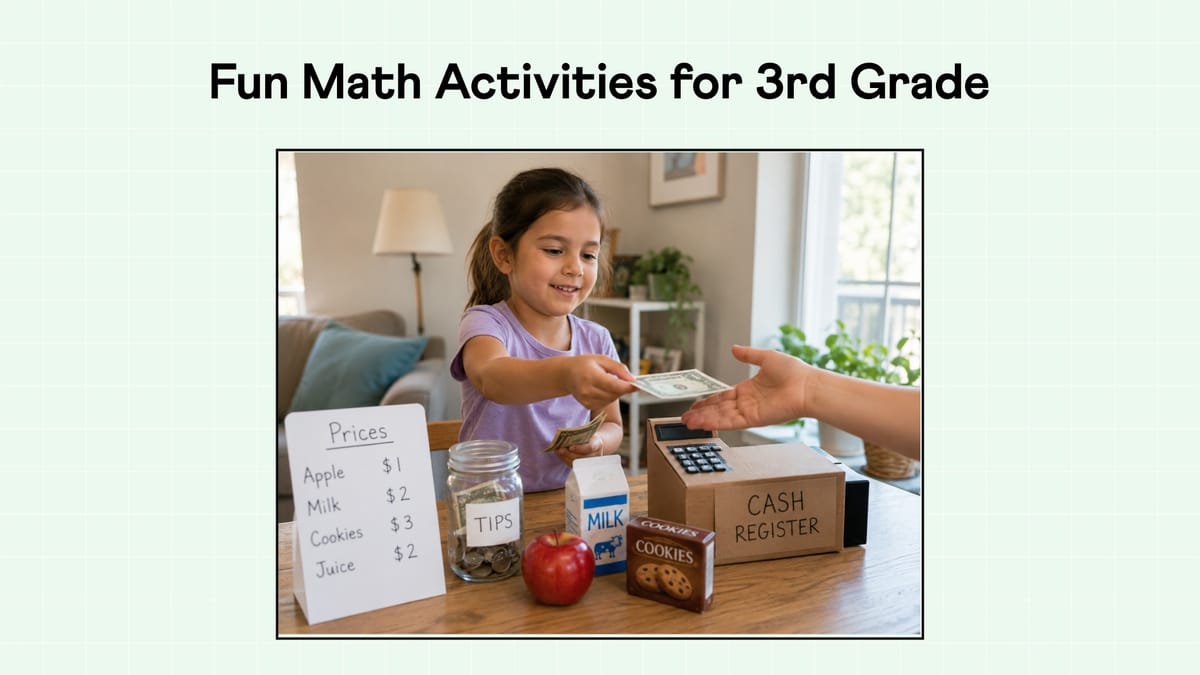
When your child says, "I hate math!" or "Math is too hard!" you may find yourself wondering, “How can I make math more fun?”
The good news is, you don't need special tools, expensive resource kits or advanced math knowledge to help your child succeed in math. You just need to make everyday moments fun, creative and engaging for them to start loving math.
Math is already part of your child's world. It is in the grocery store when you compare the prices, in the kitchen when you measure ingredients, on the playground when you keep score, and even at home when you divide snacks among your kids.
With the right activities, these everyday moments can become opportunities to practice important math skills, without making learning feel like another worksheet or homework assignment.
In this blog, you'll find 15 easy, fun math activities for 3rd grade, from multiplication and fractions to geometry, measurement, problem-solving and more. Each activity is designed to help your child practice math while having fun!
So the next time you hear, "I hate math!", try turning it into: "Let's play a math game!" Because math doesn't have to be boring. It can be something your child plays, explores, discovers and enjoys.
- ✓Math sticks better through play than through worksheets — the activities in this blog use everyday moments (the grocery store, the kitchen, the playground) your child already experiences.
- ✓Together, they cover the core 3rd grade skills: multiplication, fractions, geometry, measurement, and problem-solving.
- ✓No special tools, expensive kits, or advanced math knowledge are required — just everyday objects and a little creativity.
- ✓Reframing practice as play ("Let's play a math game!" instead of "Do your worksheet") reduces resistance and builds genuine interest.
- ✓Short, playful, and consistent practice builds more lasting confidence than long or occasional sessions.
15 Fun Math Activities for 3rd Grade (That Feel Like Play, Not Practice!)
If you've ever heard "do I have to do math?" at home, don't worry. The secret isn't more math, it's more fun math.
These math activities for 3rd grade are designed to feel like games, challenges, and little adventures you and your child can enjoy together. No pressure, no worksheets; just playful learning that actually sticks.
Let's turn your home into a math playground!
1. Multiplication War 🃏
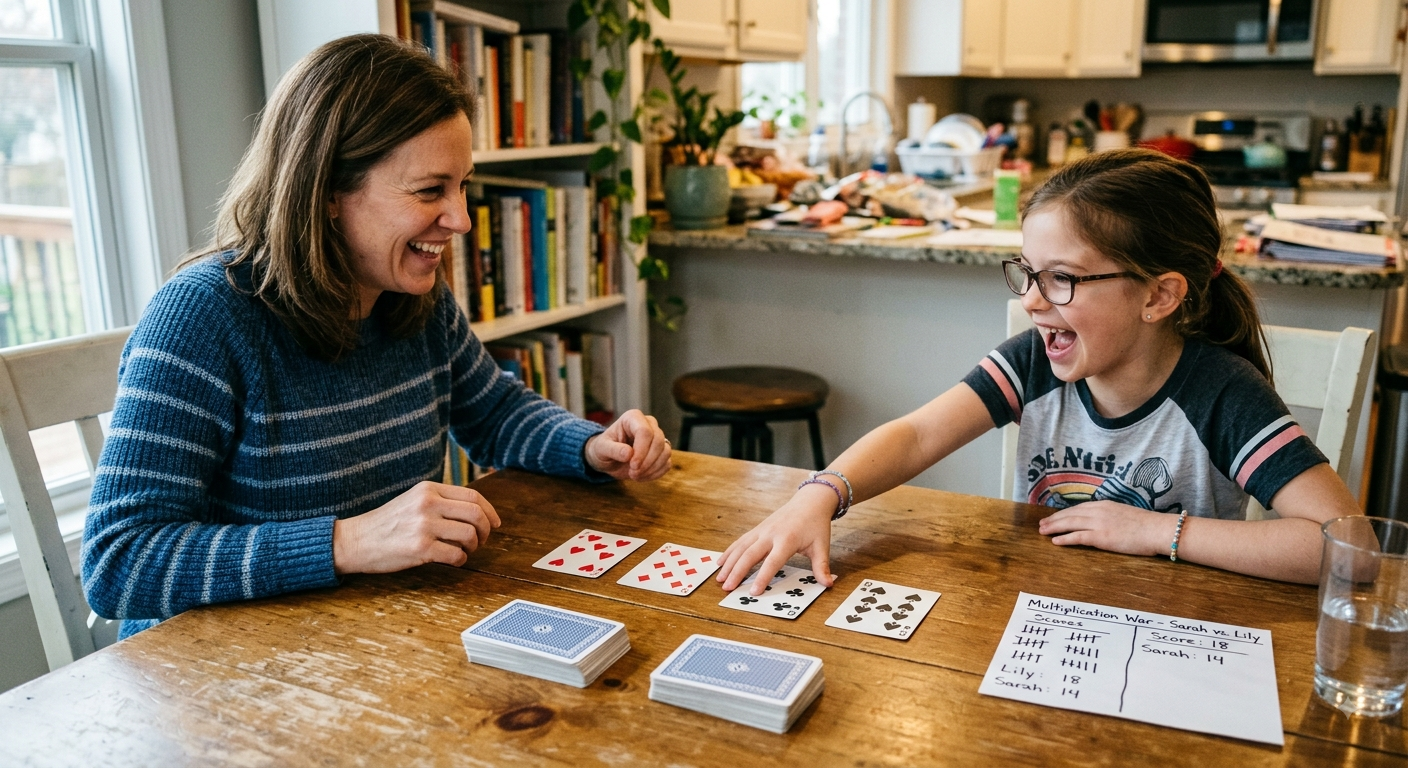
Skill: Multiplication facts You'll need: A deck of cards (face cards removed)
Each player flips two cards and multiplies them. Whoever calls out the correct product first keeps the cards. Play until the deck runs out — most cards wins!
💡 Twist: Turn each product into a division fact too: 6 × 4 = 24, so 24 ÷ 4 = 6.
- Easier: Use only cards 1 to 5.
- Harder: Keep only the 6s, 7s, 8s and 9s in the deck.
2. Array City 🏙️
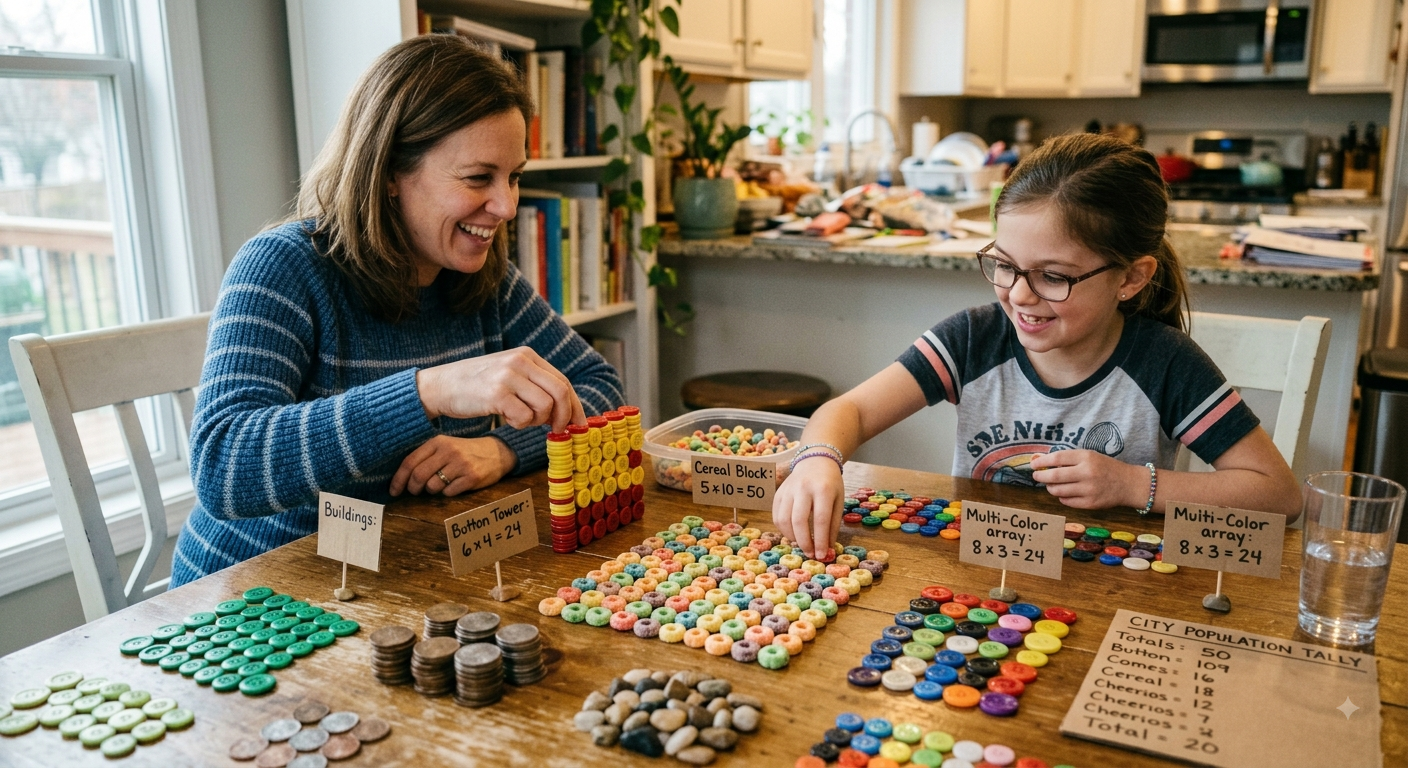
Skill: Multiplication as arrays You'll need: Small objects like buttons, coins, or cereal pieces
Ask your child to arrange objects into rows and columns — say, 4 rows of 6. Then ask: "How many in total? What multiplication fact does this show?"
Build a "city" of different arrays and compare which "building" has the most.
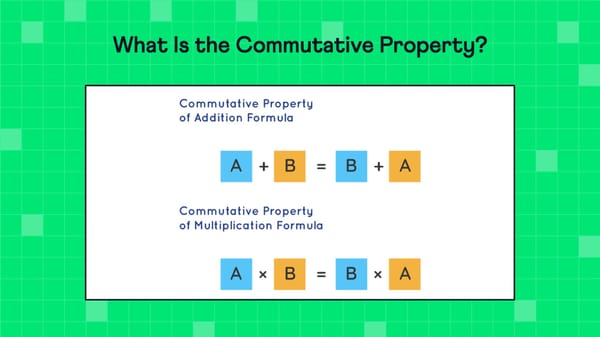
Splitting an array into two smaller ones is the distributive property. Here is how schools teach the distributive property.
- Easier: Start with arrays of 2 rows or 5 rows.
- Harder: Split one array into two smaller ones: 4 × 6 is the same as 4 × 2 plus 4 × 4.
3. Division Pizza Party 🍕
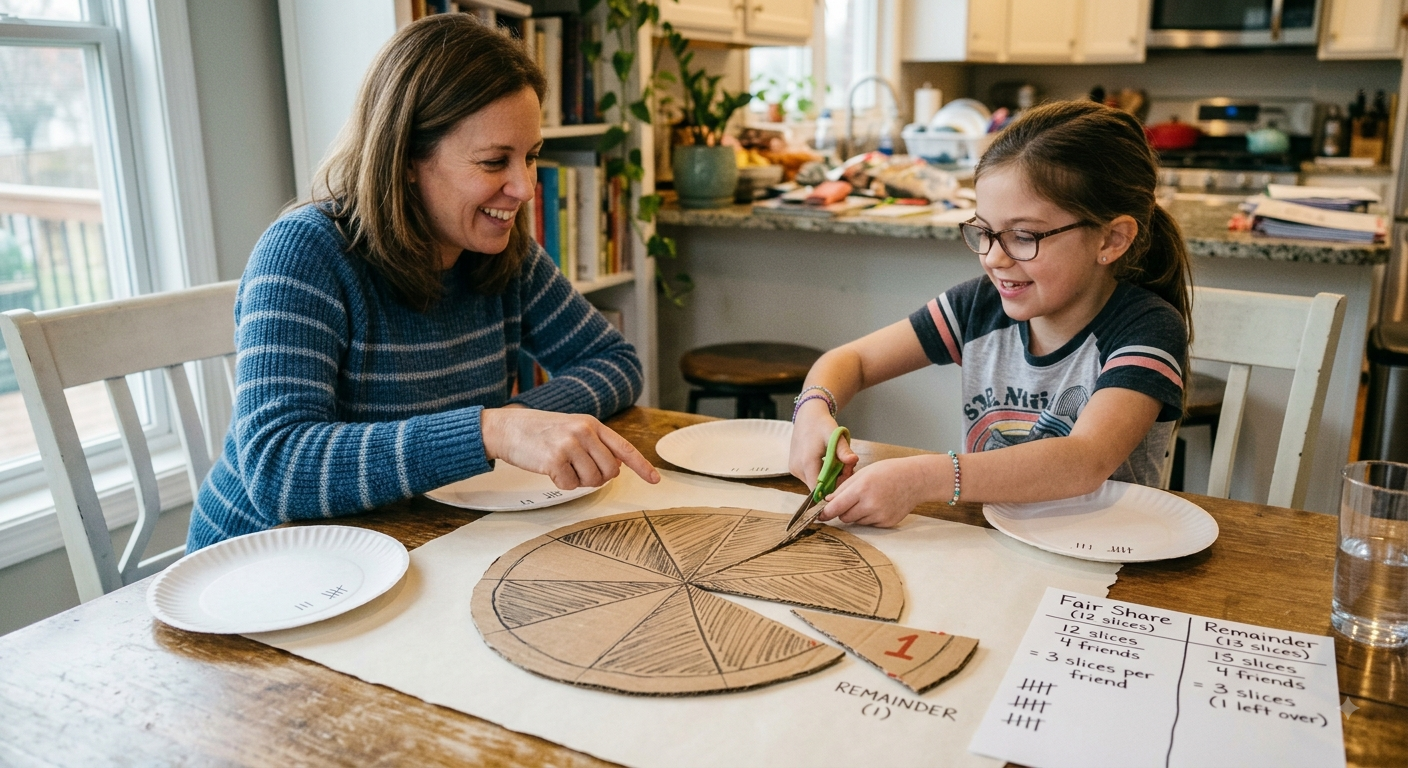
Skill: Division and fair sharing You'll need: Paper circles or an actual snack
Draw a pizza and ask: "We have 12 slices and 4 friends. How many slices does each person get?" Cut, share, and check the math with real pieces.
🎯 Bonus: Keep the 12 slices and change the number of friends. "What if there were 3 friends? What about 6?"
- Easier: Share 6 or 8 slices between 2 people.
- Harder: Write the matching multiplication fact: 12 ÷ 4 = 3 because 4 × 3 = 12.
4. Fraction Strips with Paper 📏
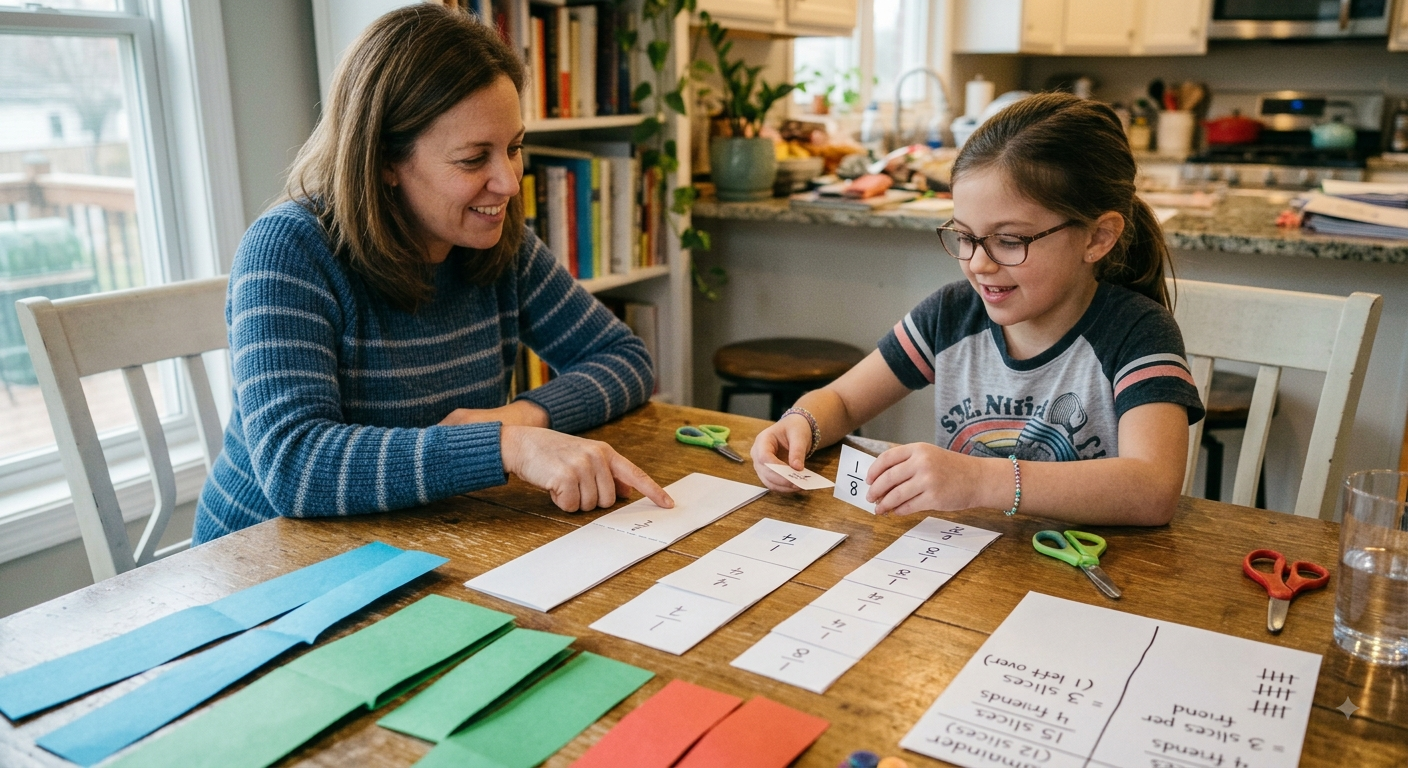
Skill: Fractions You'll need: Strips of paper, scissors
Fold one strip in half, another into fourths, another into eighths. Compare them side by side and ask: "Which piece is bigger, 1/4 or 1/8? How do you know?"
This hands-on visual makes fraction comparisons click much faster than numbers on a page.
- Easier: Compare halves and fourths only.
- Harder: Fold strips into thirds and sixths too, and find pieces that match, like 2/6 and 1/3.
5. Grocery Store Estimation Challenge 🛒
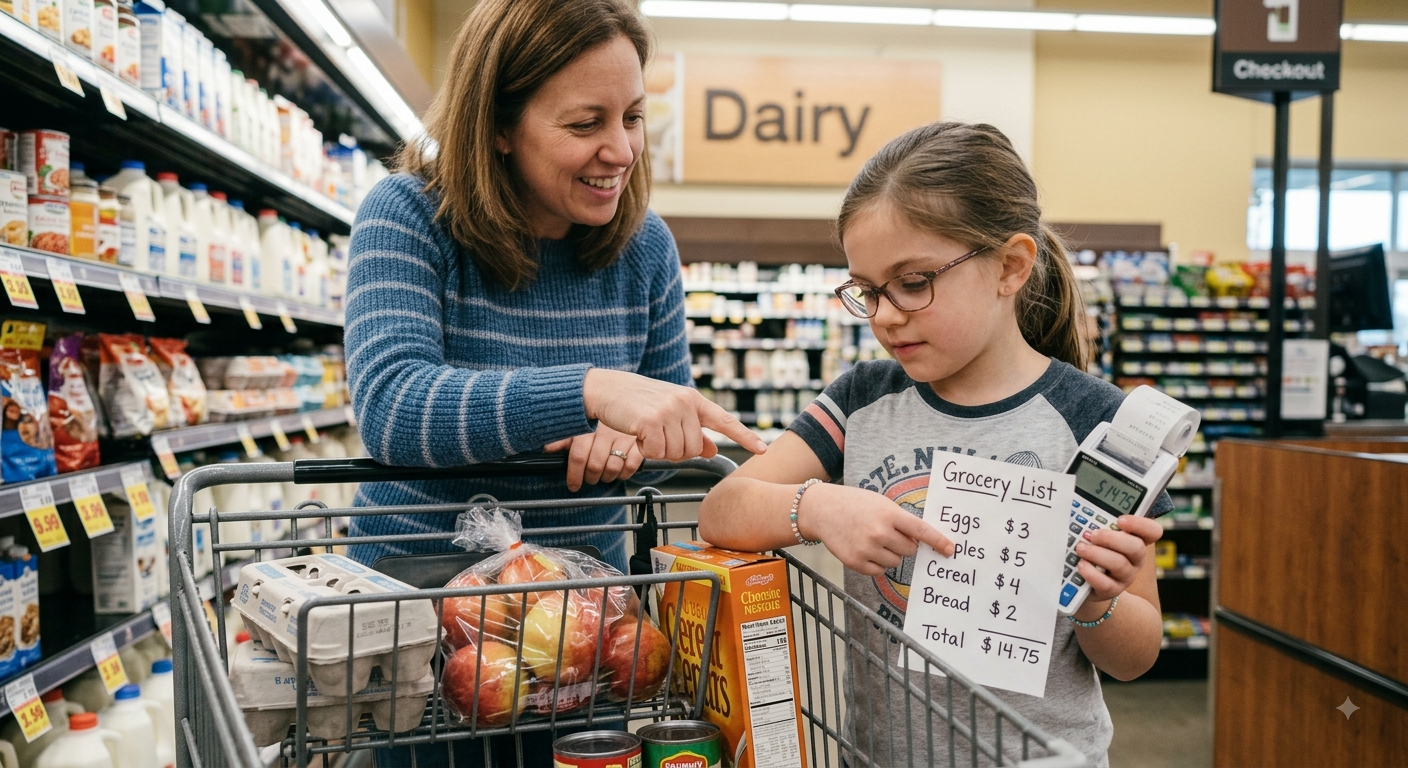
Skill: Estimation, addition, money
You'll need: A shopping list and a calculator (for checking)
Before checkout, ask your child to estimate the total cost of a few items. Then compare the guess to the actual receipt total.
Extra challenge: "If we had a $20 budget, what could we buy?"
- Easier: Estimate the total of just two items.
- Harder: Round each price to the nearest dollar before adding, then see how close the estimate was.
6. Area and Perimeter Room Hunt 📐
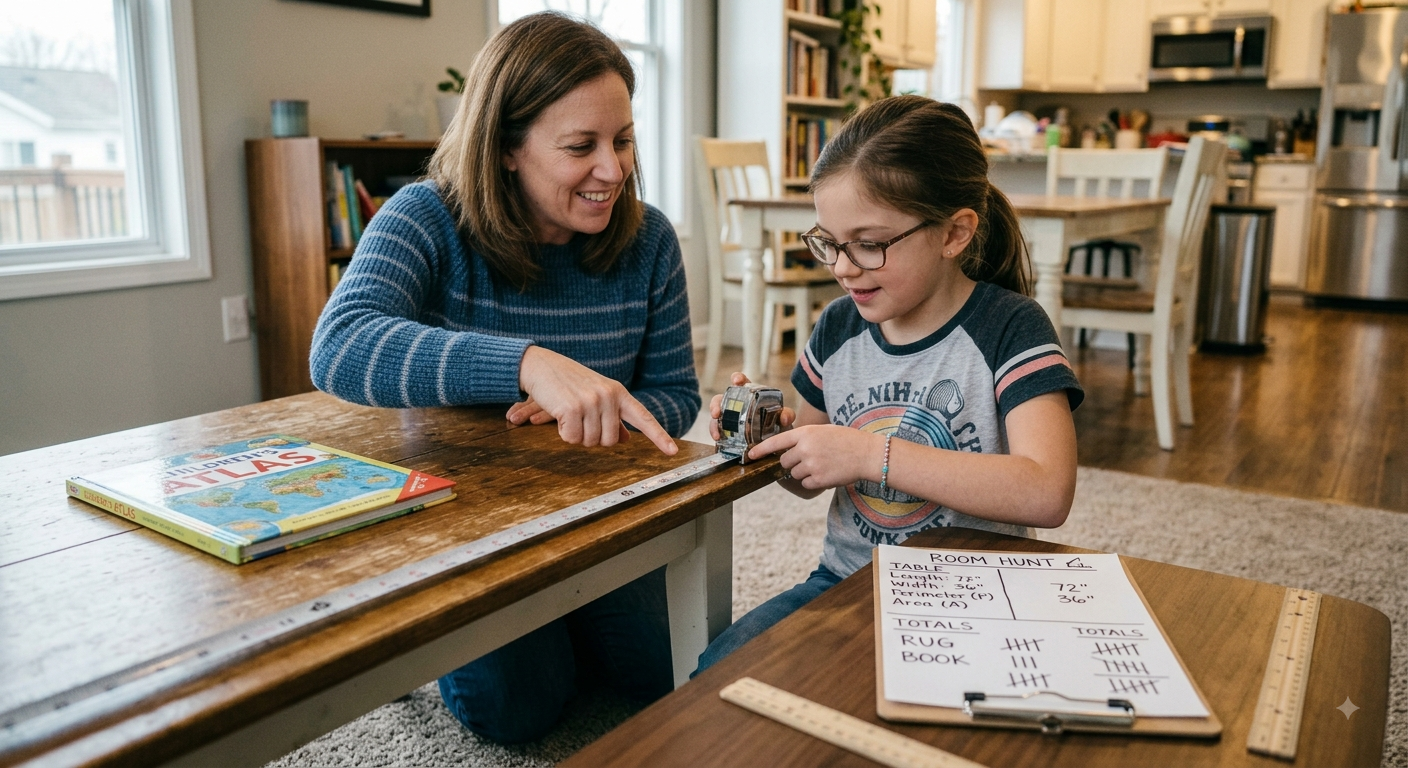
Skill: Area and perimeter You'll need: A measuring tape or ruler
Pick a room and measure its length and width. Calculate the perimeter (add all sides) and the area (length × width). Write the area in square units, like 120 square feet. Then try it with a rug, a table, or a book cover.
🏆 Challenge: Which object in the house has the biggest area?
- Easier: Count the square tiles on a floor instead of multiplying.
- Harder: Find two rectangles with the same perimeter but different areas.
7. Roll and Multiply 🎲
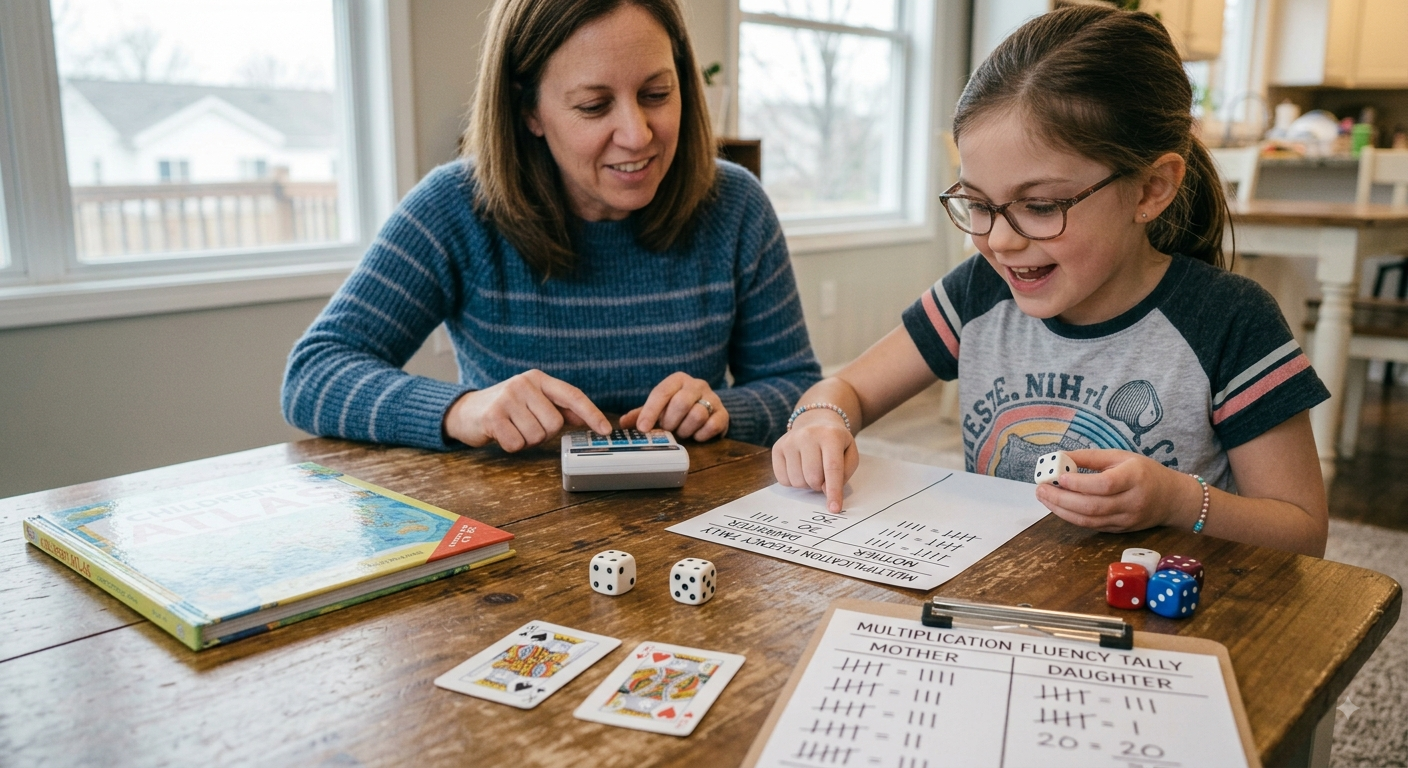
Skill: Multiplication fluency You'll need: Two dice
Roll both dice and multiply the numbers. Keep a running tally of points. First to reach 100 wins!
💥 Twist: Roll three dice and multiply all three for a bigger challenge.
- Easier: Race to 50 instead of 100.
- Harder: Roll one die and multiply it by 7, 8 or 9 every turn.
8. Skip Counting Hopscotch 🦶
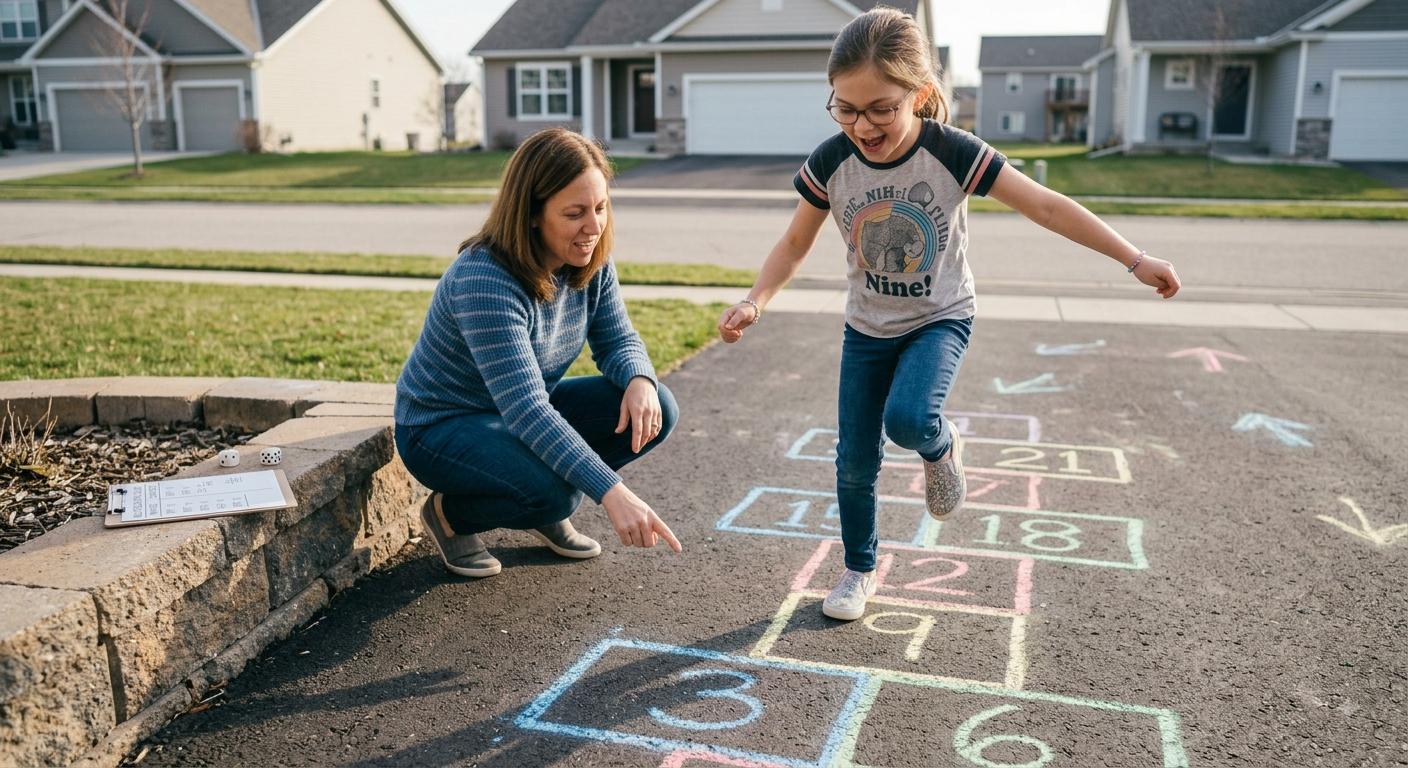
Skill: Multiplication patterns You'll need: Chalk or tape, an outdoor or hallway space
Draw a hopscotch grid and label squares with multiples of a number (like 3, 6, 9, 12...). As your child hops, they say the number out loud, reinforcing multiplication patterns through movement.
- Easier: Skip count by 2s, 5s and 10s.
- Harder: Count by 6s, 7s or 8s, or hop the grid backward.
9. Build-a-Budget Game 💰
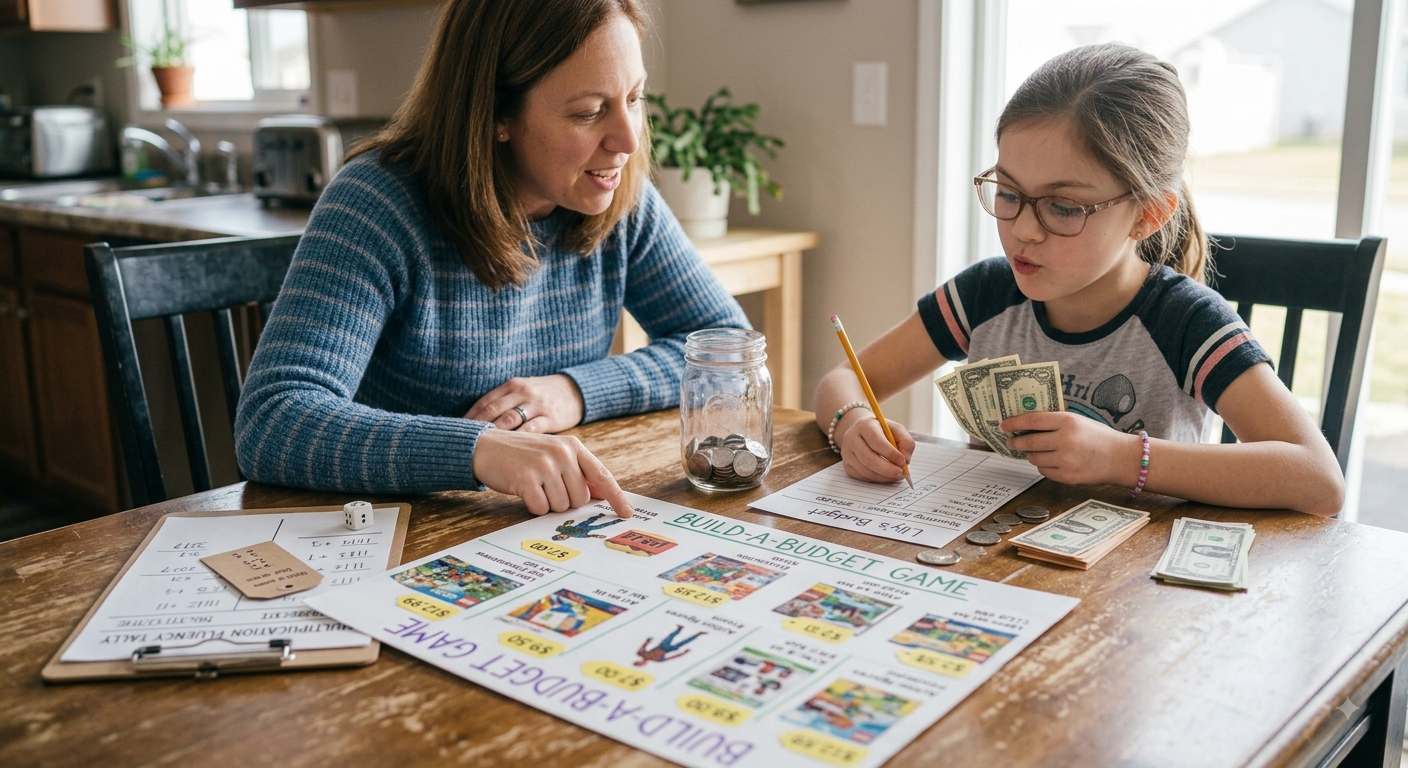
Skill: Money, addition, subtraction You'll need: Play money or coins, a toy "catalog" (or ads from a newspaper/flyer)
Give your child a set amount, say $25, and let them "shop" from a list of items with prices. They must add up their choices and stay within budget.
🎯 Bonus: "What's the most items you can buy without going over?"
- Easier: Use a $10 budget and whole-dollar prices.
- Harder: Notebooks cost $4 each. How much do 3 cost, and how much is left from $25? ($12, $13 left)
10. Mystery Number Puzzles 🔍
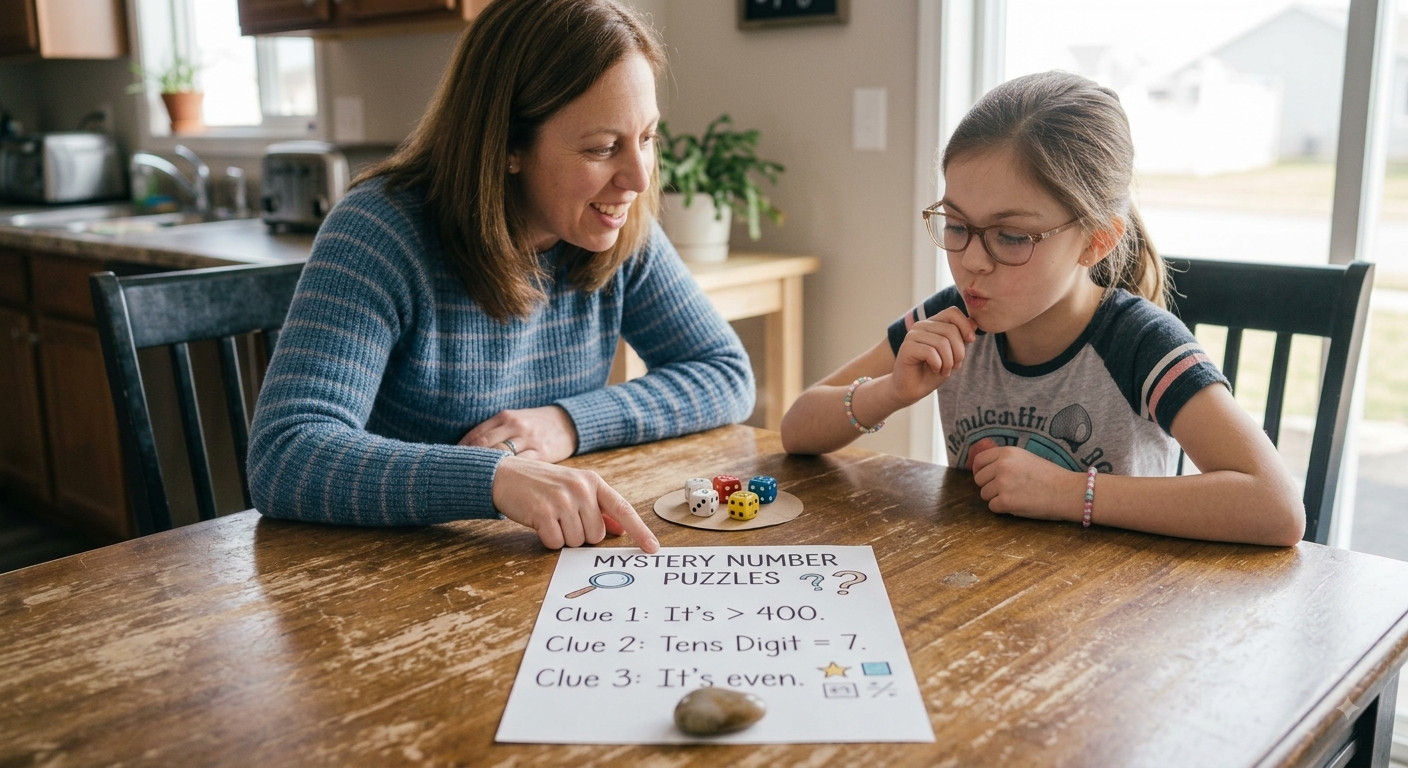
Skill: Place value and number sense You'll need: Just your imagination
Think of a 3-digit number and give clues:
- "It's greater than 400."
- "Rounded to the nearest hundred, it's 500."
- "The digit in the tens place is 7."
- "It's an even number."
- "Its digits add up to 15."
Let your child guess, then switch roles so they create the clues for you.
(For these clues, the only answer is 474.)
- Easier: Use 2-digit numbers.
- Harder: Have your child write clues that lead to only one number.
11. Time Word Problems with a Real Clock ⏰
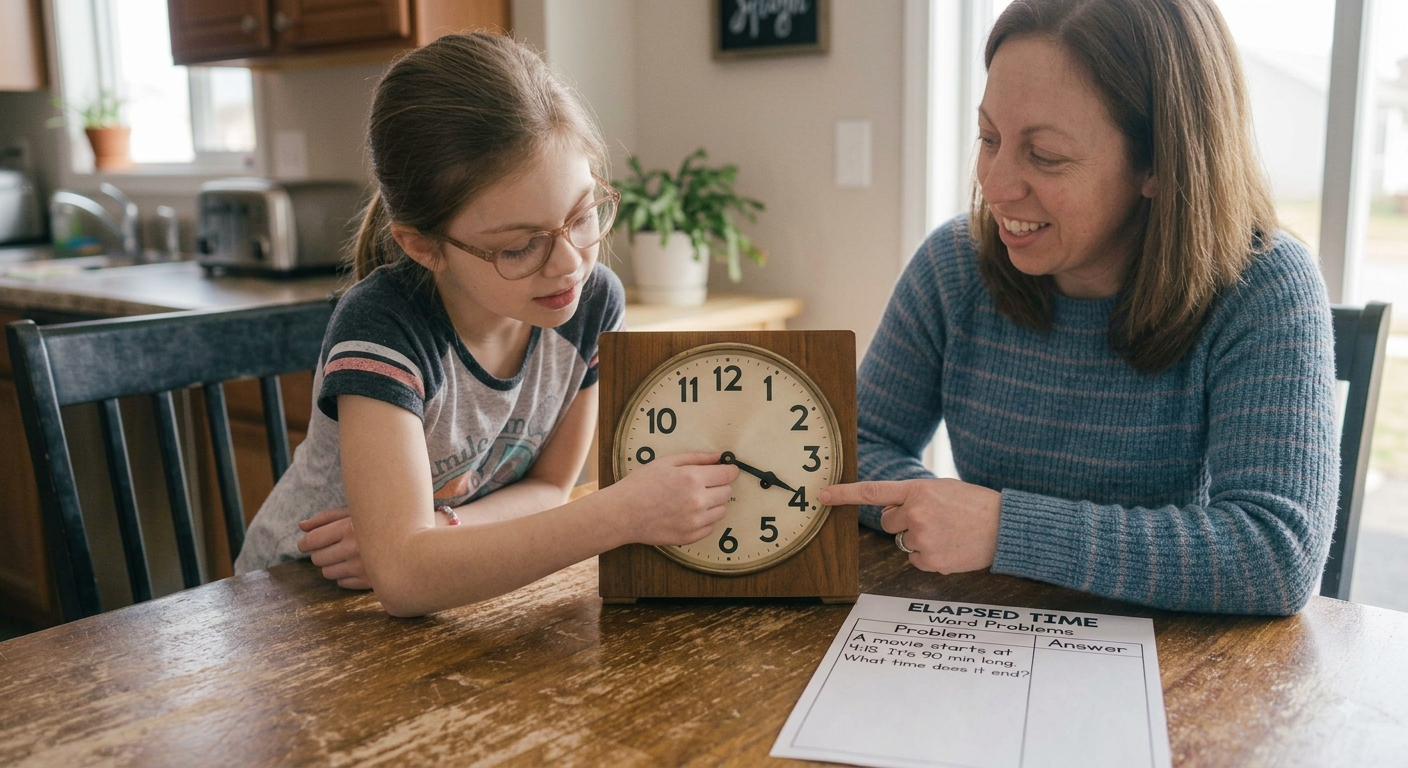
Skill: Elapsed time You'll need: An analog clock (or a paper one)
Ask real-life questions: "If we start a movie at 4:15 and it's 90 minutes long, what time does it end?" (5:45) Move the clock hands together to find the answer.
- Easier: Jump in whole hours or half hours.
- Harder: Cross the hour: what time is 25 minutes after 3:50? (4:15)
12. Dice Fraction Race 🎯
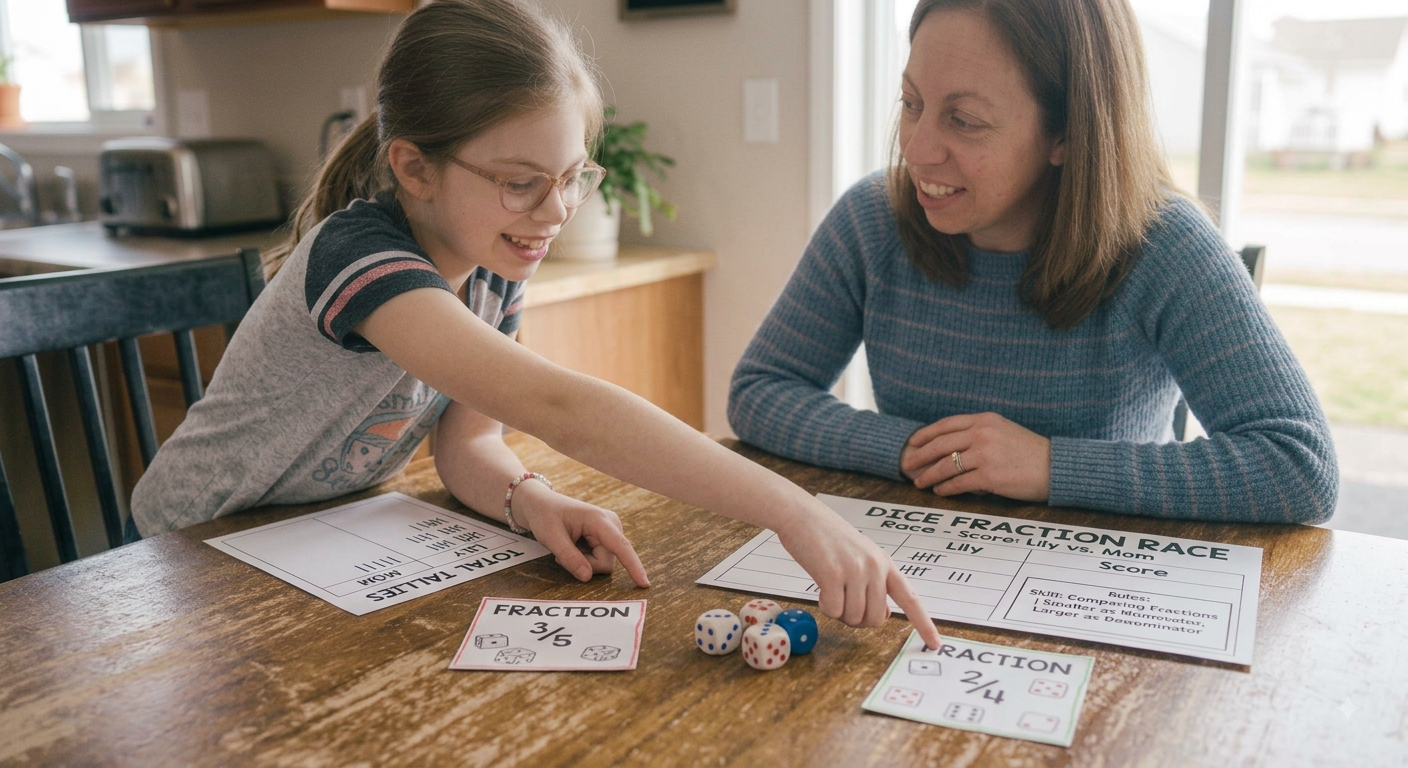
Skill: Comparing fractions You'll need: One die, paper
Pick a bottom number (denominator) for the round, like 6 for sixths. Each player rolls the die, and the number rolled goes on top: a 4 makes 4/6. The bigger fraction scores a point.
In 3rd grade, children compare fractions that have the same bottom number or the same top number. Comparing fractions like 2/3 and 3/4 comes in 4th grade.
- Easier: Draw each fraction as a shaded bar before comparing.
- Harder: Keep the top number at 1 and roll for the bottom number. Which is bigger, 1/3 or 1/6?
13. Family Data Survey 📊
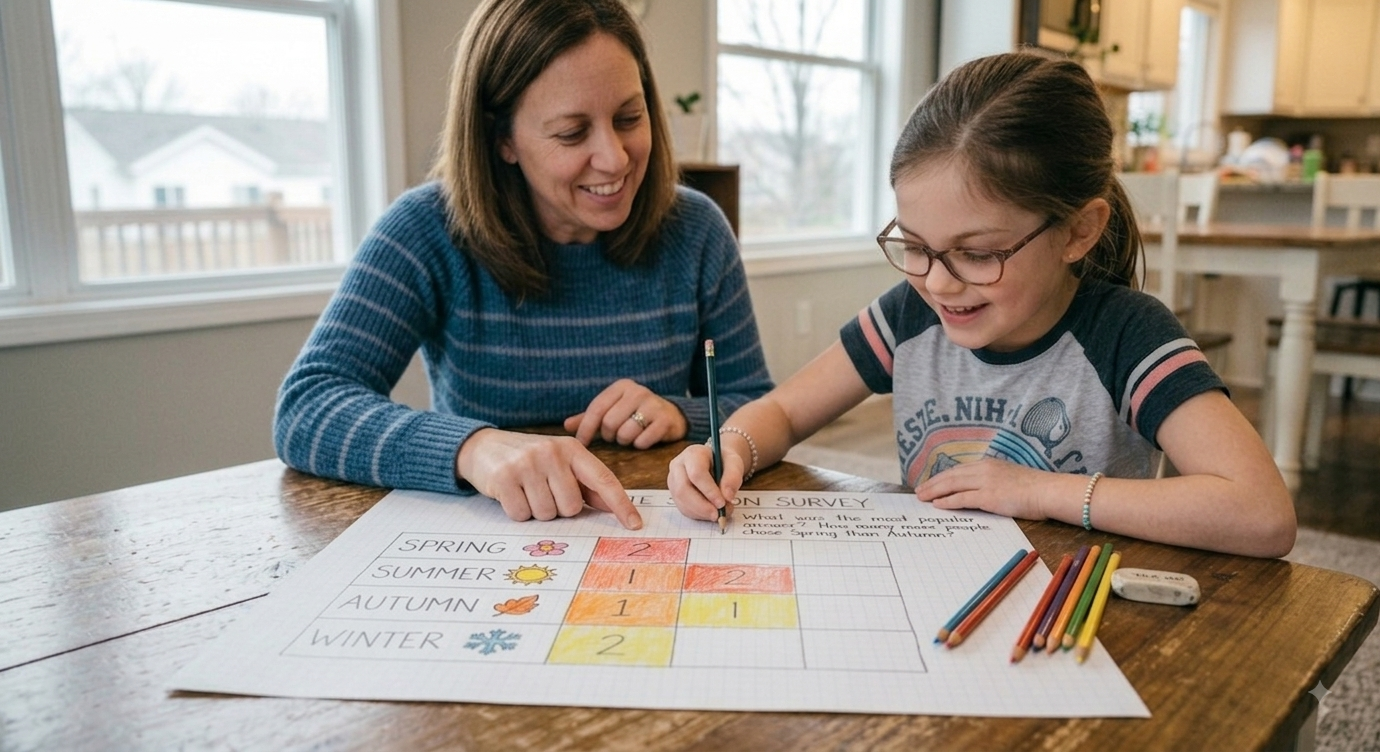
Skill: Data and graphing You'll need: Paper, pencil
Pick a fun question - "What's your favorite season?", and survey family members. Create a bar graph together and ask: "What was the most popular answer? How many more people chose X than Y?"
- Easier: Make a picture graph with one picture per person.
- Harder: Make a bar graph where each square stands for 2 people.
14. Shape and Fraction Pizza Design 🎨
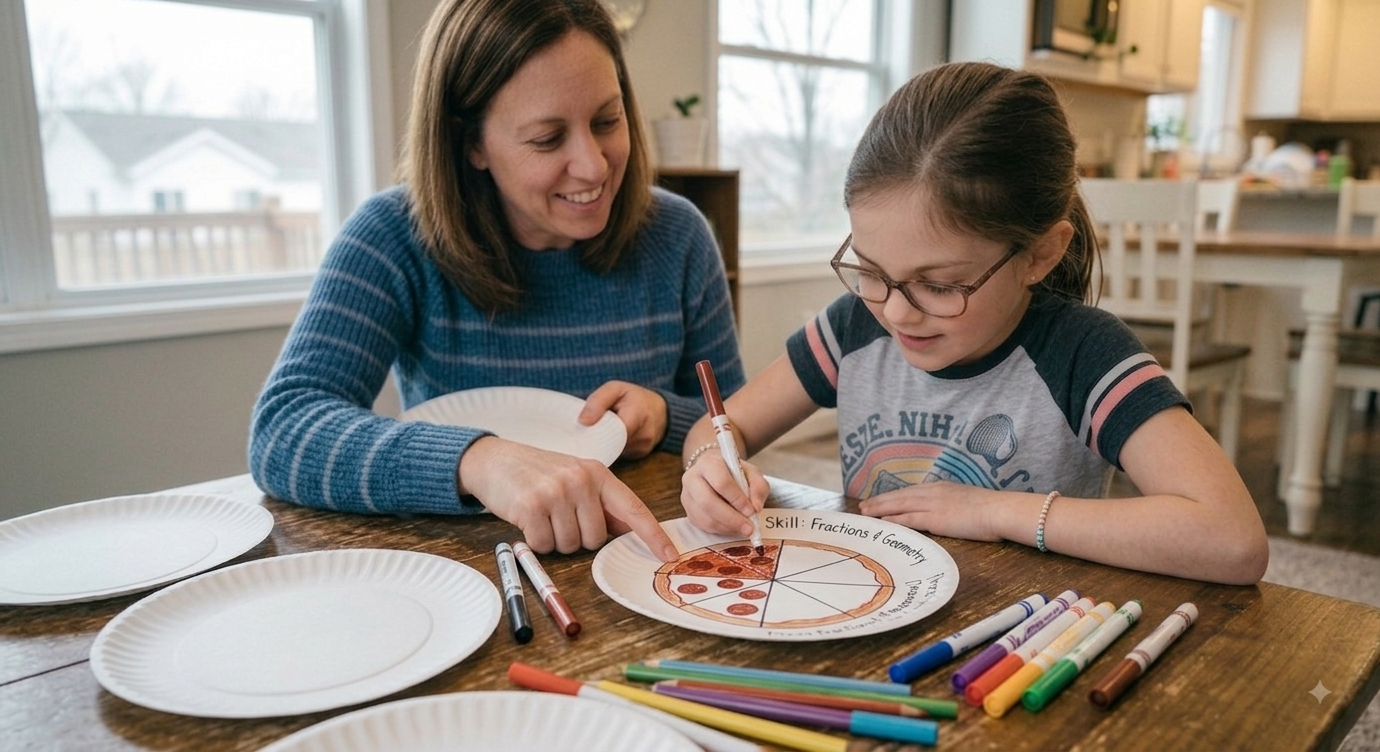
Skill: Fractions and geometry You'll need: Paper plates, markers
Draw a pizza and divide it into equal slices. Ask your child to color a fraction of it; "Color 3/8 pepperoni and the rest cheese." This blends geometry (equal parts) with fraction understanding.
- Easier: Use halves and fourths.
- Harder: Color 2/8 of the pizza and ask which other fraction is the same amount. (1/4)
15. Beat the Clock Math Sprint 🏃
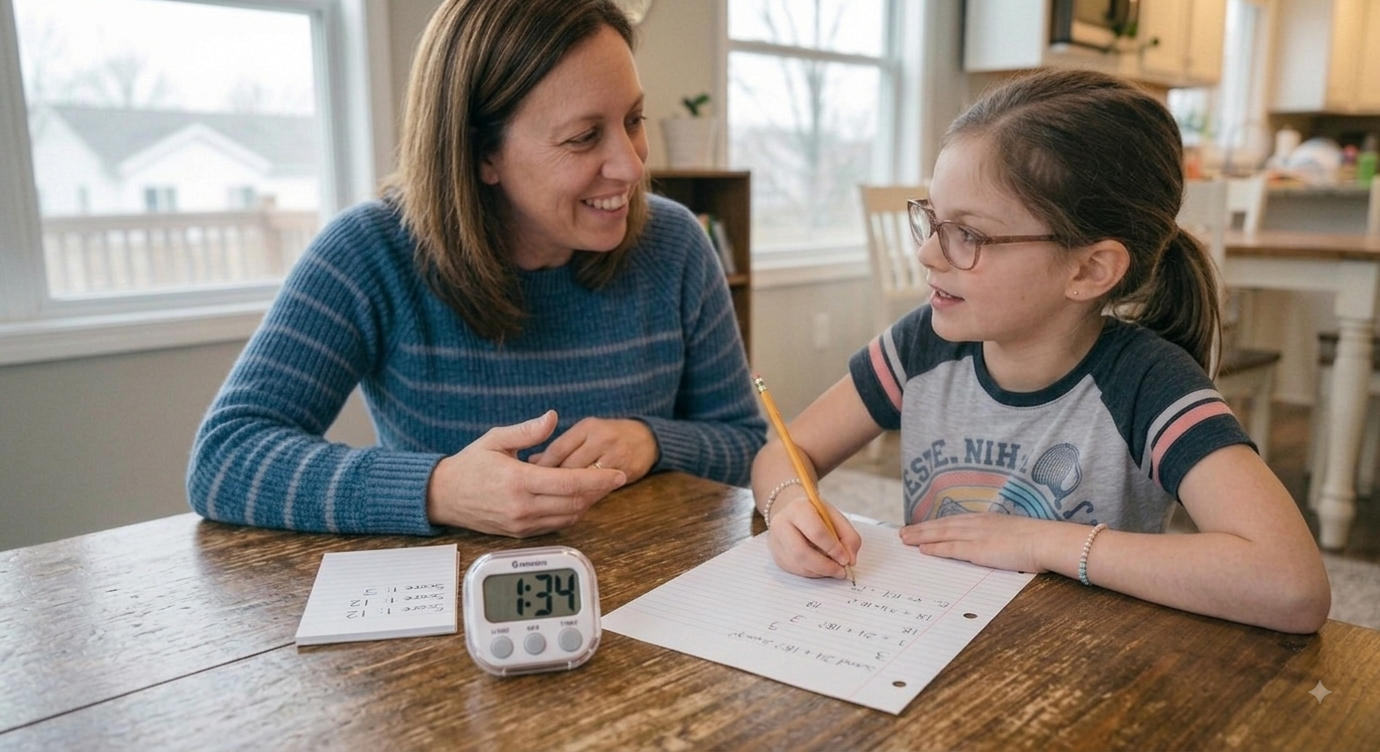
Skill: Mixed review (multiplication, division, addition, subtraction) You'll need: A timer, paper and pencil (or verbal questions)
Set a timer for 2 minutes and rapid-fire a mix of problems: "6 × 3? 15 ÷ 5? 24 + 18?" Track how many your child answers correctly, and try to beat the previous score next time; not against a sibling or friend, but against themselves.
- Easier: Stick to one kind of problem, like the 2s and 5s facts.
- Harder: Add two-step questions, like "3 × 4, plus 10?" (22)
What Should a 3rd Grader Know by the End of the Year?
These are the main 3rd grade math goals from the Common Core State Standards, which most US states use or base their own standards on. Each one lists the activities above that practice it.
- ✓Know all multiplication facts from memory (two one-digit numbers) and multiply and divide within 100 (3.OA.7)
Practice it: 1. Multiplication War 🃏 · 7. Roll and Multiply 🎲 · 8. Skip Counting Hopscotch 🦶 - ✓Understand multiplication as equal groups and arrays, and division as sharing equally (3.OA.1, 3.OA.2)
Practice it: 2. Array City 🏙️ · 3. Division Pizza Party 🍕 - ✓Solve two-step word problems with all four operations, and check answers by estimating (3.OA.8)
Practice it: 9. Build-a-Budget Game 💰 · 15. Beat the Clock Math Sprint 🏃 - ✓Round numbers to the nearest 10 or 100, and add and subtract within 1,000 (3.NBT.1, 3.NBT.2)
Practice it: 5. Grocery Store Estimation Challenge 🛒 · 10. Mystery Number Puzzles 🔍 - ✓Understand fractions as equal parts of a whole, and compare fractions with the same top or bottom number (3.NF.1, 3.NF.3)
Practice it: 4. Fraction Strips with Paper 📏 · 12. Dice Fraction Race 🎯 · 14. Shape and Fraction Pizza Design 🎨 - ✓Tell time to the nearest minute and solve elapsed time problems (3.MD.1)
Practice it: 11. Time Word Problems with a Real Clock ⏰ - ✓Find the area and perimeter of rectangles (3.MD.7, 3.MD.8)
Practice it: 6. Area and Perimeter Room Hunt 📐 - ✓Make and read scaled picture graphs and bar graphs (3.MD.3)
Practice it: 13. Family Data Survey 📊
For written practice, see these 3rd grade math problems with worked examples, or try these free 3rd grade math games.
One App, Every Angle Your Child Needs for 3rd Grade Math
Liked these games? The Cuemath app has a new math workout every day, plus puzzles and 1v1 math battles your 3rd grader can play between activities. Free to try, no card needed.
100% Free • No Card Needed • A Few Minutes a Day
How to Make Math Practice More Fun?
- Let your child pick the activity. Offer two or three choices and let them decide; ownership makes a huge difference in motivation.
- Keep sessions short. 15–20 minutes of focused play is often more effective than an hour of forced practice.
- Ask "how did you figure that out?" instead of just checking the answer. This builds reasoning skills and reveals their thinking process.
- Connect math to real life. Cooking, allowance, sports scores, and travel time are all everyday math opportunities.
- Praise the strategy, not just the score. "I love how you broke that problem into smaller steps" builds more confidence than "You got it right!"
For a real example of short, steady practice, read how Mihir, a 3rd grader, practices a little every day.
Turning "I Have to Do Math" Into "Can We Play Again?"
The goal isn't more worksheets; it's helping your child see that math is already woven into daily life. A deck of cards becomes a multiplication game. A pizza becomes a fraction lesson. A grocery list becomes a budgeting challenge.
When math feels like something kids do instead of something they merely finish, curiosity has room to grow; and that curiosity is what carries them through harder math down the road.
Pick one activity tonight, grab what you already have around the house, and give it a try.
Want a Tutor Who Teaches Math This Way Every Week?
A free 1:1 evaluation shows which 3rd grade skills your child has down and which need work, from multiplication facts to fractions.
Book a Free Evaluation100% free • No credit card needed • Grades K–12
Frequently Asked Questions
What are the best math activities for 3rd grade at home?
Card games for multiplication, hands-on fraction activities, grocery store estimation, area/perimeter measuring, and data surveys are all great options that reinforce core 3rd grade skills in playful ways.
How can I make 3rd grade math more engaging?
Tie math to things your child already enjoys; games, snacks, shopping, or building. Turning practice into a challenge or a race (against themselves, not just others) often makes it feel less like a chore.
How long should a 3rd grader practice math at home?
Around 15–20 minutes of focused, engaged practice is generally enough. Consistency across the week matters more than long, infrequent sessions.
What math skills should a 3rd grader be practicing?
Key focus areas include multiplication and division facts, place value, fractions, area and perimeter, time, graphs, and two-step word problems.
Can these activities be adjusted for different skill levels?
Yes. Use smaller numbers or simpler steps for kids who need more support, and add extra rules, bigger numbers, or timed challenges for kids ready for more.
When should a 3rd grader know the multiplication facts?
By the end of 3rd grade. The Common Core standards expect children to know all products of two one-digit numbers from memory by then, so short daily games like Multiplication War help.
Do these activities match what 3rd graders learn in school?
Yes. Each activity lines up with a 3rd grade Common Core standard, listed in the table at the top: multiplication and division within 100, fractions, rounding, elapsed time, area and perimeter, and bar graphs.
What should I do if my child gets frustrated during a math game?
Make it easier and slow down. Use the "Easier" version under each activity, such as cards 1 to 5 in Multiplication War, and stop while your child is still enjoying it.
Sources
- Common Core State Standards, Grade 3 Operations & Algebraic Thinking: multiplication, division and two-step word problems
- Common Core State Standards, Grade 3 Number & Operations in Base Ten: rounding, adding and subtracting within 1,000
- Common Core State Standards, Grade 3 Number & Operations—Fractions: fractions as equal parts, comparing fractions
- Common Core State Standards, Grade 3 Measurement & Data: elapsed time, graphs, area and perimeter

I was never the kid who loved math. I was much more interested in books, stories, and writing—and, somewhere along the way, I became even more curious about people. Why do we learn differently? Why does something make sense to one child but not another? And what makes a student feel confident enough to keep trying?
That curiosity led me to study Applied Psychology, where I learned more about how children think, learn, and make sense of the world around them.
My love for writing did the rest. What started as something I simply enjoyed became a career. Over the past five years, I've worked as a freelance writer across edtech, SaaS, B2B, travel, lifestyle, and healthcare, learning how to write for very different audiences without losing the human side of the story.
Today, I'm an SEO Content Writer & Editor at Cuemath, where I get to bring many of these interests together. Working in education—and especially around math—has made me even more curious about what happens behind the screen or textbook: what parents worry about, what students struggle with, and what actually helps them learn.
That's also how I like to research. I don't just look at search results and call it a day. I go where parents and students actually talk—forums, reviews, communities, and conversations with real families. Because sometimes the most useful insight isn't hiding in a keyword; it's in a parent's question, a student's frustration, or a small detail someone shares about their learning experience.
I write because I'm curious. I research because I want to understand. And I love turning what I learn into content that feels genuinely useful to the people reading it.