Homeschooling a Child Who Struggles With Math: A Working Order
Your child is in tears over the workbook, and still counts on fingers for the basic facts. You are the teacher, so no report card is going to arrive with a diagnosis on it.

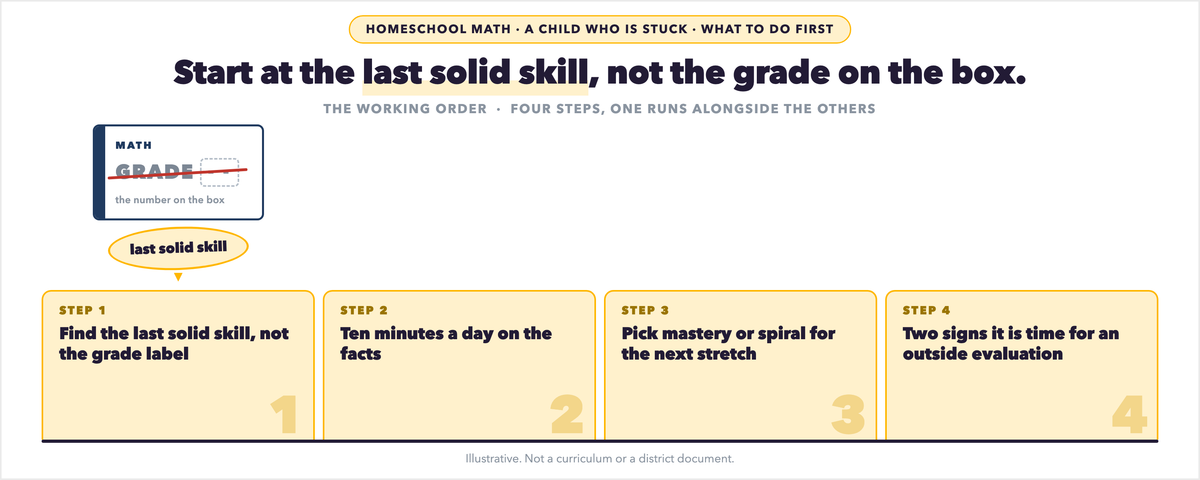
Your child is in tears over the workbook, and still counts on fingers for the basic facts. You are the teacher, so no report card is going to arrive with a diagnosis on it. The fingers are step 2's job. The tears are why step 1 starts below the grade label, and why the daily work stops before frustration.
The order below has four steps. First, find the last skill your child owns, using the free placement tests the curriculum makers publish, and ignore the grade printed on the box. Alongside that, ten minutes a day on the basic facts, separate from the lesson. Third, decide how the next stretch is taught: one topic until it holds, or a little of everything each week. Fourth, watch for the two signs that mean an outside evaluation is due. The month is laid out at the end.
Step 1: Find the last solid skill, not the grade label
A struggling child is often stuck on a skill from an earlier year, and the grade label hides it. The makers' own placement tests are built to find that skill. Math Mammoth's free tests cover grades 1 to 8, and the maker says they work equally well as a general math assessment. The questions are grouped by topic, so a weak section shows the gap by name. The maker's instruction is to start with the highest test you think your child will pass. The score table then sends you down a level under 50 percent and up a level at 90 percent or more. Singapore Math Inc.'s tests exist to find gaps and "should not be scored." Math-U-See's placement tool starts from an evaluation of what the child has already mastered, RightStart's tool places by level rather than grade, and Beast Academy (a homeschool math curriculum) picks the test by the child's age. BookShark hosts four makers' tests free on one page.
Two things follow. Give more than one test: Math Mammoth says outright that one test may not show what a child has mastered. Give one test per sitting, on separate days. BookShark says most take less than an hour, with the parent sitting beside the child. A child who is crying does not sit two tests in one day. And read the result as a map, not a verdict. A fifth grader who lands on a third-grade test has not failed anything. You have found where to start.
If the tests land your child at a lower level, the grade 5 book you already bought waits. You start at the level the tests name and work up to it. Math Mammoth also publishes books on specific math topics for grades 1 to 8. Its own page lists them as remedial material for a student who is behind. So one missing topic does not always mean a whole lower level.
Step 2: Ten minutes a day on the facts
A child can have the method right and still be slowed to a crawl, because each basic fact in the problem costs a pause. Our page on a child who is behind in math shows how to tell that case from a missing building block at your own table. The fix for it is short and daily. The What Works Clearinghouse, part of the US Department of Education, released a practice guide in March 2021 on students struggling with mathematics in the elementary grades. It names six practices. Two of them are the ones this page uses. One is timed activities "as one way to build fluency," which is the facts work. The other is deliberate teaching of word problems, which belongs in the lesson. Ten minutes is our suggestion for the timed part, not the guide's: long enough for a timed set, short enough to stop before frustration. Keep it separate from the lesson.
Step 3: Pick mastery or spiral for the next stretch
Once you know the skill, decide how the next month teaches it. Mastery means one topic until it holds. Spiral means a little of everything each week. Math Mammoth calls itself "mastery-oriented and organized into chapters by topics." Math-U-See focuses on mastering a concept "before moving on to a new topic." Saxon's publisher describes a different shape, "distributing skills across the year." The Good and the Beautiful says its math "continually reviews previously learned concepts," and Abeka calls its approach a spiral. None of that ranks them. If the placement test found one missing topic, a mastery stretch goes straight at it. If it found shakiness across every section, a spiral keeps every piece in play. The full curriculum decision, with parent time and where each program ends, is on our homeschool math curriculum page, and the math inside boxed programs is on the all-in-one page.
Step 4: Two signs it is time for an outside evaluation
The first sign is in the tests. Two or three placement tests land your child well below grade level, and the gaps run across every section rather than one topic. At that point paper tests have reached their limit. In a one-on-one evaluation, someone works problems with your child and adjusts the level as the child answers, which shows which piece is missing.
The second sign is in how your child handles quantity itself. Your child still counts every set one by one, week after week, and cannot tell which of two groups is bigger. That is a different errand: a professional evaluation for a possible learning disability. It is the pattern the Learning Disabilities Association of America describes under dyscalculia, and the FAQ below quotes it. Start with your local district's special education office. A federal special-education rule, 34 CFR 300.111, is known as the child find rule. It requires each state to identify, locate, and evaluate "all children with disabilities residing in the State," including children attending private schools. The rule's text does not use the word homeschool, and how a homeschooled child fits depends on your state.
The month on one page
- Weeks 1 to 4: ten minutes of facts every day, timed, separate from the lesson. It runs alongside steps 1 to 3, not after them.
- Week 4: re-test the failed sections only. Up means keep going. Flat, or either sign above, means get an outside evaluation.
Where Cuemath fits
We do not sell a homeschool curriculum. A free Cuemath MathFit evaluation is a live, one-on-one session that shows where your child is solid and where a gap sits. It does not replace your main curriculum.
Find the last solid skill in one live session
A free Cuemath MathFit evaluation is a live, one-on-one session that shows where your child is solid and where a gap sits, so your homeschool lesson starts at the right level.
Book a Free EvaluationFor students in Grades K to 12 worldwide.
FAQs
Should I move my child back a grade level in math?
Yes, if the placement test says so. A lower level is a level, not a grade. Math-U-See labels its levels with Greek letters, not with an age or a grade. RightStart's homeschool program is set up with levels rather than grades. Re-test the failed sections after four weeks to see whether the level still fits. The grade label on the box is a shelf tag, not a diagnosis.
How long should daily math practice be for a struggling child?
Short and daily. The What Works Clearinghouse guide names timed activities as one of six practices for struggling students, not the whole plan. Keep the timed facts work to about ten minutes. Put the rest of the time into the lesson, at the level the placement test gave you, and stop before frustration. The facts work is also a piece a child can do alone first.
Which placement test should I use if we have not picked a curriculum yet?
Use the maker whose books you already own, or the maker you are considering. Then give more than one test. BookShark hosts the Math-U-See, Singapore, Saxon, and RightStart tests free on one page, so more than one is easy to reach. Expect different tests to place your child at different points, because each one places within its own sequence. Two results that disagree are both telling you something.
How do I know if it is a gap or dyscalculia?
Watch the signs over several weeks, then ask for a professional evaluation. A placement test cannot tell you; it shows what is missing, not why. The Learning Disabilities Association of America describes dyscalculia as difficulty understanding numbers and learning math facts. It names trouble "quantifying sets without counting" and "estimating relative magnitudes of sets." In plain words: your child counts every set one by one, and cannot tell which of two groups is bigger. It also lists mental math and remembering steps in a sequence. Start with your local district's special education office. How homeschooled children are covered depends on your state.
Mastery or spiral for a child who is behind?
It depends on the shape of the gap. One missing topic points to a mastery stretch on that topic, the shape Math-U-See describes. Shakiness across every section points to a shape that keeps each piece in play. Saxon's publisher describes skills distributed across the year, and The Good and the Beautiful calls its math a spiral.
My child will not do math unless I sit right next to them. Is that a problem?
Not by itself, and the makers differ on it. Math Mammoth describes its books as nearly self-teaching for many children, Math-U-See has the instructor present each lesson, and RightStart's lessons guide the teacher day by day. Match the main curriculum to the coaching your child needs this year. Let the daily facts work be the first thing your child does alone.
My middle schooler hates math and worries about falling behind. Where do I start?
Start with the placement test, because it turns "behind" from a fear into a level with a name. Math Mammoth's placement tests run through grade 8. Singapore Math Inc. says it does not currently offer tests for grades 6 to 8, and uses a start rule there. Then run the ten-minute facts work. Our page on a child behind in math separates a missing skill from lost confidence.