What Does Your Child's Kumon Level Actually Mean?
A Kumon level is a position in a worksheet sequence, not a grade. How to read it against your child's grade, and what to ask the instructor.

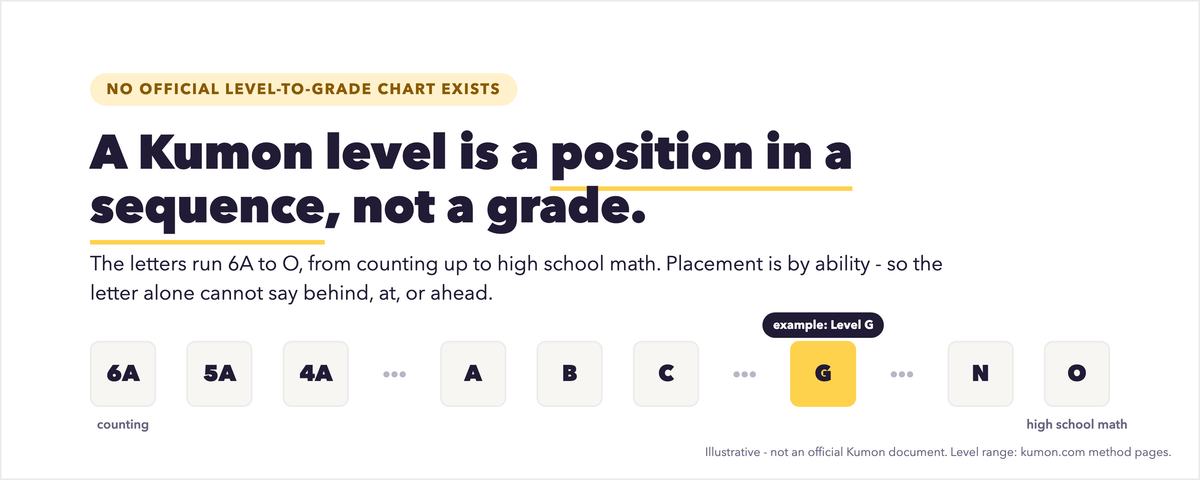
Your child comes home from Kumon and says they moved up a level. Or the instructor emails that a new level starts next week. The next question is the one Kumon parents ask sooner or later: what does that level mean against the grade my child is in at school?
Here is the short answer. A Kumon level is a position in Kumon's own worksheet sequence, not a school grade. Kumon publishes no level-to-grade chart on its US pages, and those same pages say a child's study level is set by ability, not grade. So the letter on the folder tells you where your child sits in Kumon's sequence. It does not tell you, by itself, whether they are behind, at, or ahead of grade level. Every Kumon fact here comes from Kumon's own published pages.
How the Kumon level system works
Kumon is a worksheet program. Kumon's method pages describe the international version of the math program - that is Kumon's own name for it, on its US pages - as 20 levels, running from Level 6A up to Level O, plus four elective levels. Together they hold 4,390 double-sided worksheets. The numbered levels come first and count down as your child climbs, 6A at the start, down to Level A; after that the letters rise from B to O. So a move from 3A to 2A is a move up, not a slip. The sequence starts at counting and ends at advanced math, with difficulty rising in small steps, "ultimately, to the study of high school level material."
Three facts matter most for reading a level.
First, placement is by ability, not age or grade. Every child takes a placement test, at no cost, and the instructor uses the result to pick the starting point. Enrollment runs from age three through high school.
Second, the starting point is deliberately easy. Kumon states that students begin "at a level that they can easily handle, which is often lower than the level of material they are studying at school." A start below school level is the design, not a warning sign.
Third, a level can also run ahead of school. Kumon's own example: a student in fifth, sixth, or even seventh grade may begin with addition if needed, and an elementary student is not prevented from advancing into high school material.
Kumon describes one rhythm for the whole program. Daily practice takes about 30 minutes. Students attend class twice a week at a Kumon Center and complete the assignments at home the other five days.
What the levels cover, in order
Kumon's US site does not publish a table showing which topics sit in which lettered level. What it does publish is the order of the whole program. Under the heading "What concepts are covered in the Kumon Math Program?" the math program page lists, in this order: counting and number sequencing, addition and subtraction, multiplication and division, fractions, order of operations, positive and negative numbers, solving equations, graphs, algebra from elementary to advanced, trigonometry and logarithms, and probability and statistics. That is the ladder your child is climbing, whatever letter they are on.
The endpoint is stated plainly. The program "sets out to enable learners to master high school level mathematics through self-learning," and the worksheets are structured around what high school calculus requires - elements such as the four operations, equations, factorization, and functions and graphs.
Looking for a Kumon level chart? Use the grade ladder instead
If you searched for a Kumon level chart: Kumon's US pages do not print one. Its pages state the study level is set by ability, not grade. Charts that map letters to grades circulate online, but they are not from Kumon's published US pages.
You can still place your child. It takes a different question. Not "what grade is this level," but "what topic is my child working on right now, and which grade expects that topic at school?" The worksheet in the folder tells you the topic. For the grade, use the anchors below, quoted from the Common Core State Standards for Mathematics:
- Kindergarten: "Count to 100 by ones and by tens."
- Grade 3: "By the end of Grade 3, know from memory all products of two one-digit numbers." Grade 3 also introduces fractions as quantities.
- Grade 4: "Fluently add and subtract multi-digit whole numbers using the standard algorithm."
- Grade 5: "Add and subtract fractions with unlike denominators (including mixed numbers)."
- Grade 6: solve problems "by writing and solving equations of the form x + p = q and px = q."
- Grade 8: "Solve linear equations in one variable," and understand a function as a rule that assigns each input exactly one output.
Now match the worksheet to the ladder. A third grader drilling single-digit multiplication is working right at their grade's fluency target. A fifth grader adding unlike-denominator fractions is on grade. A fourth grader solving equations with variables is working ahead. A child working below these anchors may simply be early in the climb, because Kumon starts every student where the work is easy on purpose.
One caution. Kumon's topic list and the school sequence cover much of the same ground, but they are different documents with different orders. The ladder above places a topic, not a child. For the child, ask the person who holds the placement data.
What to ask the instructor
The level-to-grade answer is not on Kumon's US pages, but your center's instructor has it. The instructor sets the starting point from the placement test and sees your child's worksheets every week. Six questions get you a real answer:
- What topic is my child's current level working on, and what topic comes next?
- Where did the placement test start them, and how far below their school material was that start?
- When do you expect them to reach the topics their school grade is covering this year?
- What has to happen before they move up a level?
- Is my child's pace typical for this level, and what usually decides it?
- What does the path from the current level to algebra look like at their current pace?
If cost is on your list too, ask at the same meeting. Kumon's corporate site does not publish tuition. Most centers are individually owned and operated, and Kumon's own FAQ directs parents to their local center for tuition and fees. For what tutoring formats cost more broadly, see how much math tutoring costs.
Want a grade-level answer that does not depend on the letter?
A free Cuemath MathFit evaluation is a one-session skills check: it measures your child's reasoning, fluency, application, and understanding against their own grade's standards, so you see exactly where they stand.
Book a Free EvaluationFor students in Grades K to 12 worldwide.
FAQs
Is there an official Kumon level chart?
No. Kumon publishes no level-to-grade chart on its US pages - its method pages say each child studies at the level suited to their ability, regardless of age or school grade. The charts that circulate on parenting forums and blogs are unofficial reconstructions, not from Kumon's US pages. The reliable source for your child's position is the center's instructor, who sets the level from the placement test and sees the worksheets every week.
What are the Kumon math levels in order?
In sequence: the numbered levels come first and count down as your child climbs - 6A at the start, down to Level A - then the letters rise from B to O. That is 20 levels plus four electives, 4,390 double-sided worksheets, from counting up to advanced math. Kumon's US pages name the range but describe no single level's content, so the letter alone does not tell you the topic. The worksheet in your child's folder does.
What does a specific level, like Kumon Level G, cover?
Kumon's US pages do not describe any single level's content. They name the range, Level 6A through Level O, but publish no per-level topic list. To learn what your child's exact level covers, read the worksheet in their folder or ask the instructor for that level's topic. Per-level descriptions you find elsewhere online are not from Kumon's US pages.
Why is my child's Kumon level below their school grade?
Because the start is designed that way. Kumon states students begin "at a level that they can easily handle, which is often lower than the level of material they are studying at school." A below-grade level early on is the program working as described, not a red flag. If months pass without movement, ask the instructor when they expect your child to reach the topics their school grade covers this year.
How high do Kumon levels go?
The lettered sequence runs through Level O, plus four elective levels, and the material runs to high school math - Kumon says the worksheets are structured around what high school calculus requires. Kumon's pages print a last level but no final grade, and enrollment runs from age three through high school.
How much does Kumon cost per month?
Kumon's corporate site publishes no tuition. Most centers are individually owned and operated, and Kumon's own FAQ directs parents to their local center for tuition and fees - so the monthly fee is a local question and can differ from center to center. Ask at the same meeting where you ask about levels.
Does a Kumon level change my child's placement at school?
No. A Kumon level is a position in Kumon's own worksheet sequence, and schools and districts generally make placement decisions with their own tests and criteria. If your real question is school placement, bring your district's published criteria to that conversation, not the Kumon letter.