15 Math Activities for 2nd Grade
15 fun, no-prep math activities for 2nd graders using dice, coins, cards, and things you already have at home - covering addition, place value, money, geometry, fractions, time, and data.

Who says math has to mean sitting at a desk? For a 2nd grader, math can happen almost anywhere; a handful of coins can become a money game, a trip to the grocery store can turn into a quick addition challenge, and a pile of toys can become a lesson in counting, sorting, or shapes.
If your child groans at the words “It’s time for math,” try changing the game instead of pushing harder. The right math activities for 2nd grade can turn addition, subtraction, place value, measurement, shapes, money, and problem-solving into little challenges that feel more like play than practice.
And you don’t need a cupboard full of learning supplies to make it happen. Grab some dice, cards, coins, paper, blocks, or whatever you already have around the house. A little imagination can turn everyday objects into a whole lot of math fun!
In this blog, you'll find 15 fun and easy 2nd grade math activities that you can try at home using things you probably already have. From rolling dice and building numbers to playing with fractions, telling time, and going on a math treasure hunt, these activities are designed to make math feel less like homework and more like play.
- ✓Math sticks better through play than through worksheets — the 15 activities below use dice, coins, cards, and household items you already have.
- ✓Together, they cover the core 2nd grade skills: addition and subtraction, place value, number sense, money, geometry, fractions, measurement, time, and data.
- ✓Short and consistent works better than long and rare — 10 to 20 focused minutes a day is enough.
- ✓Letting your child pick the activity and explain their thinking builds more confidence than pushing for speed or a "win."
- ✓Not sure where to start? The simple 5-day plan further down gives you one activity a day.
Why Try Math Activities at Home?
Math practice doesn’t have to mean sitting down with a worksheet. When kids can play with numbers, use everyday objects, and solve little challenges, math starts to feel more like something they do naturally.
Instead of asking your child to solve 20 problems on a worksheet, try questions like:
- “Can you build a number using these blocks?”
- “How much would three apples cost?”
- “Can you find five rectangles around the house?”
- “If we have 24 crackers and share them, how many does each person get?”
- “Which pile has more?”
These simple moments give kids a chance to use math in real situations, explain their thinking, and have fun along the way.
And when practice feels like a game rather than homework, kids are often much more eager to give it a try.
15 Math Activities for 2nd Grade (That Feel Like Play, Not Practice!)
If you’ve ever heard “Math is boring!” at home, don’t worry—you’re not alone. The secret isn’t more math, it’s more fun math.
These math activities for 2nd grade are designed to feel like games, challenges, and little adventures you and your child can enjoy together. No pressure, no worksheets—just playful learning that actually sticks.
Let’s turn your home into a math playground!
1. Roll, Add, and Race 🏁
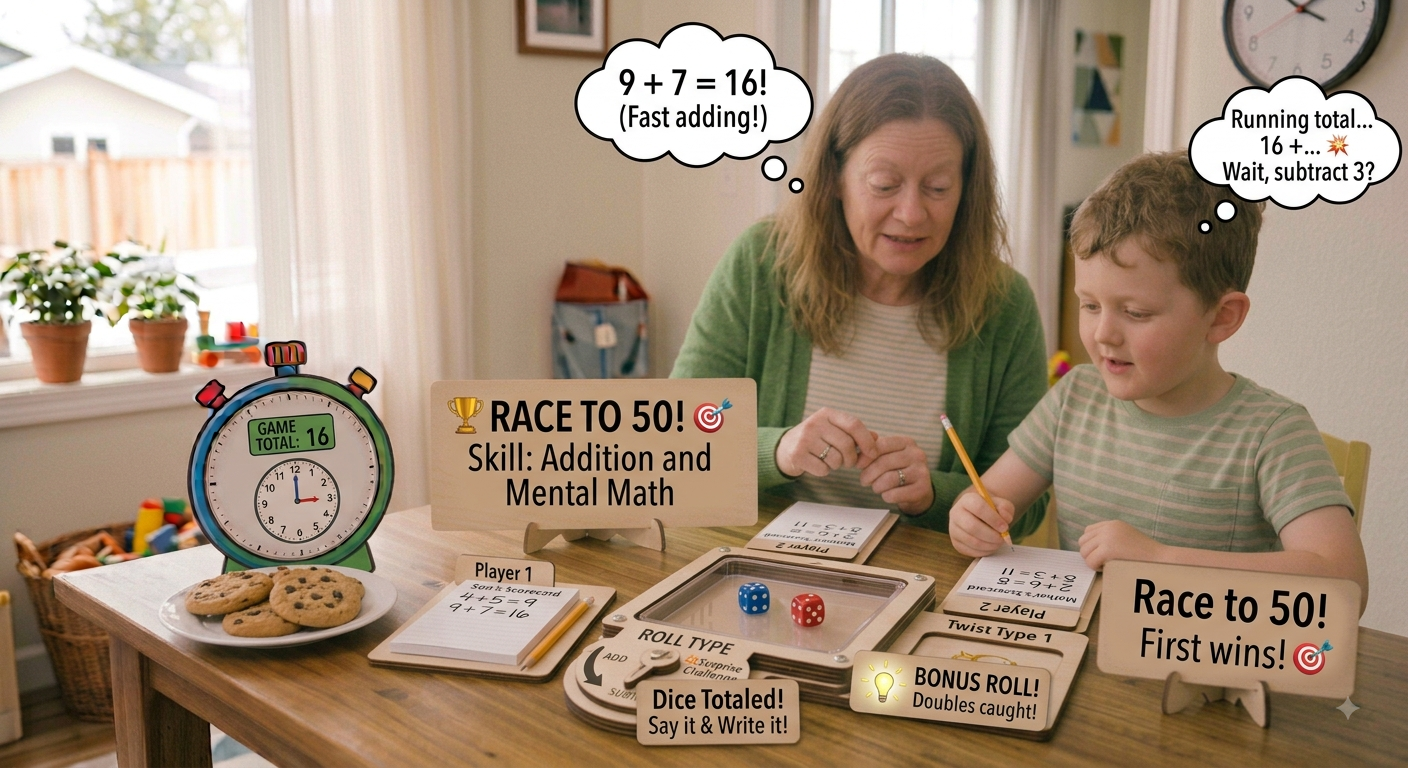
Skill: Addition and mental math
You’ll need: Two dice, paper, and a pencil
This is one of those 2nd grade math activities that instantly feels like a game night challenge.
How to play:
- Each player rolls two dice.
- Add the numbers as fast as you can.
- Say the answer out loud and write it down.
- Keep a running total.
Example:
4 + 5 = 9
9 + 7 = 16
🎯 Goal twist: Race to 50! First one to reach it wins.
💥 Make it exciting:
- Add a “bonus roll” if you get doubles
- Or subtract instead of add for a surprise challenge
- Easier: Race to 20 instead of 50.
- Harder: Roll three dice and add all three numbers.
2. Build My Number 🧱
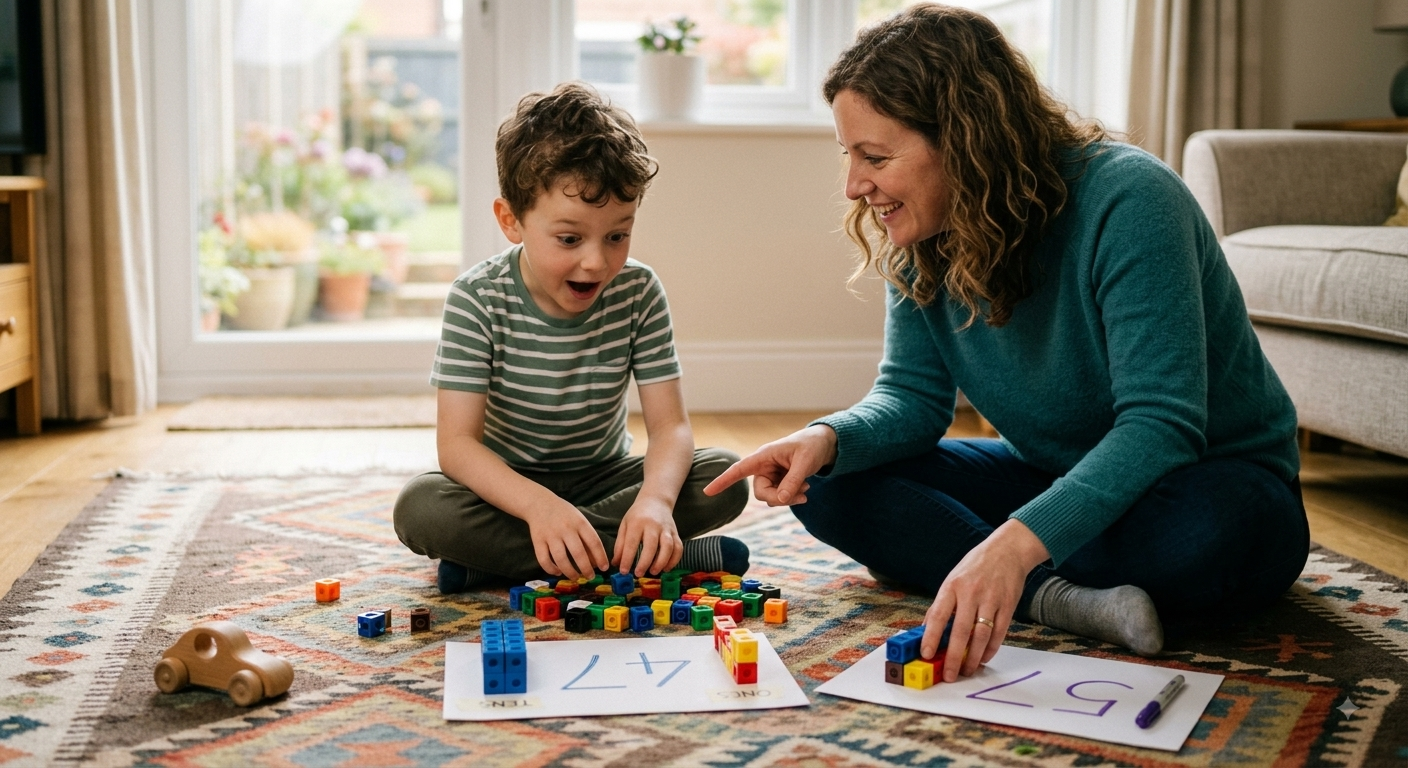
Skill: Place value
You’ll need: Blocks, coins, buttons, or anything you can stack
This activity feels like building a secret code!
Write a number like 47 and ask:
“Can you build this using tens and ones?”
Your child will physically see math:
4 tens + 7 ones = 47
Try fun numbers like 25, 63, 81, 94.
🎉 Then switch roles—let your child “trap” you with a number to build!
💡 Parent magic moment:
Ask, “What happens if I add one more ten?”
Watch their eyes light up when 47 becomes 57!
- Easier: Stick to numbers under 50.
- Harder: Build 3-digit numbers with hundreds, tens and ones, like 235.
3. The Mystery Number Game 🕵️♀️
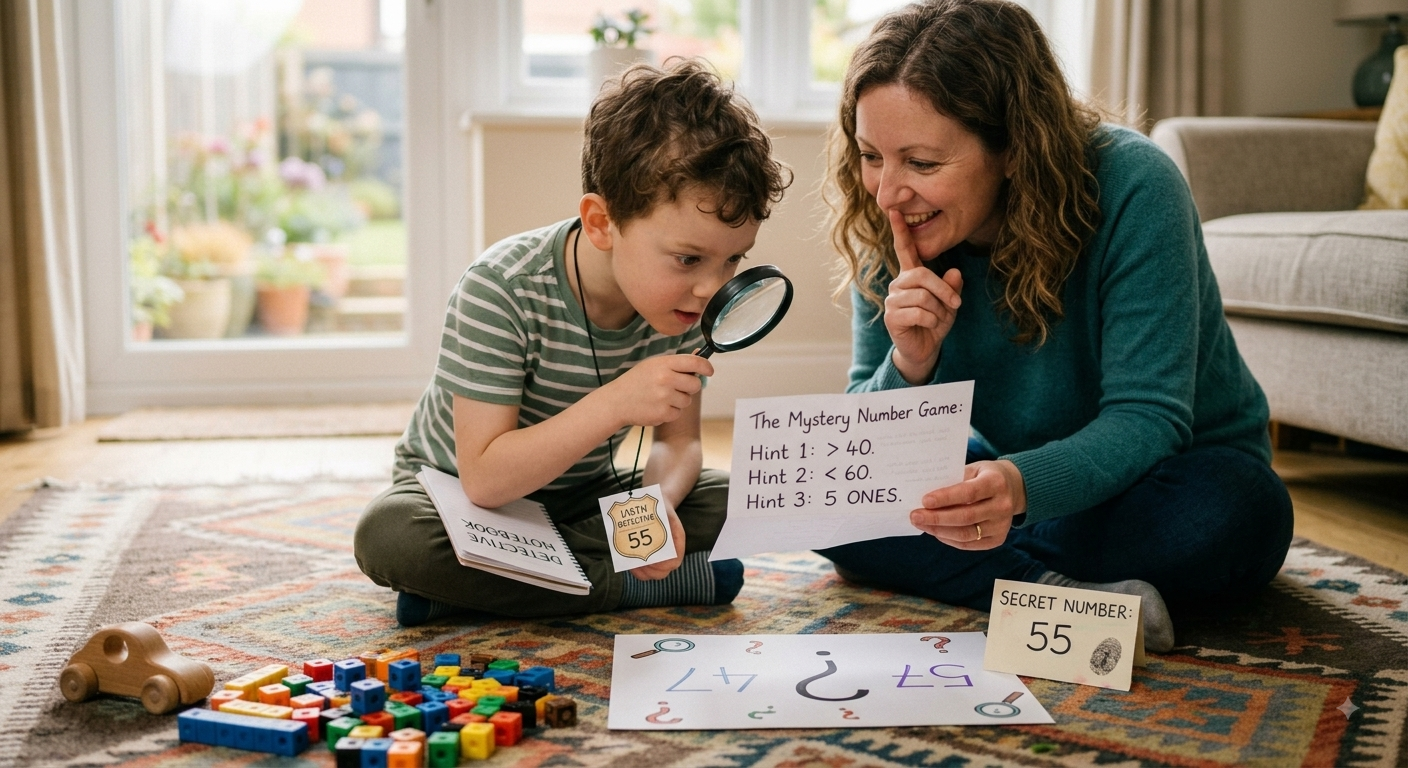
Skill: Number sense
You’ll need: Just your imagination
This turns your child into a real math detective.
Think of a number between 1 and 100 and give clues like:
- “It’s more than 40.”
- “It’s less than 60.”
- “It has 5 ones.”
Can they crack the case?
🎯 Let your child be the clue-giver too—you’ll be surprised how clever they get!
- Easier: Pick a number under 20 and give two clues.
- Harder: Go up to 1,000 with clues like "It has 3 hundreds."
4. Math Treasure Hunt 🗺️
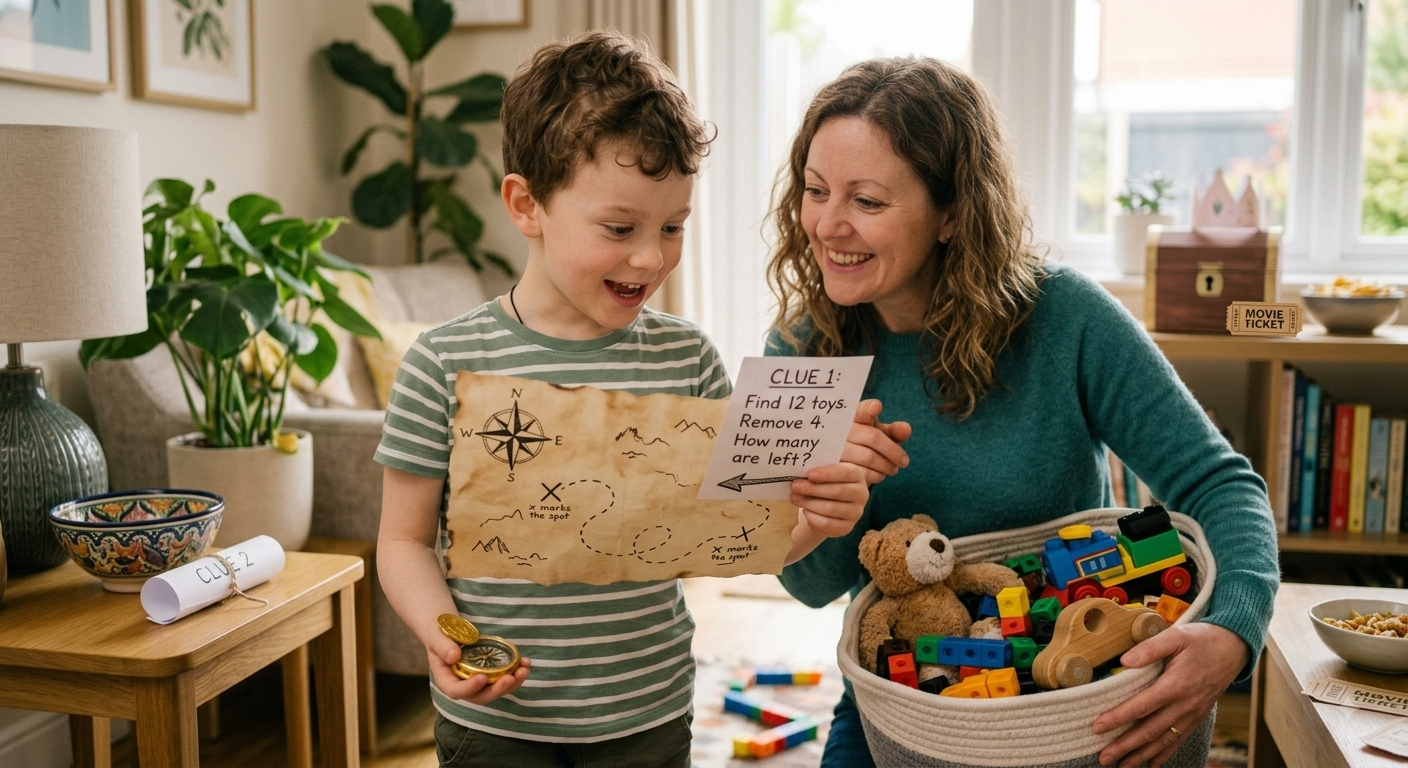
Skill: Mixed math skills
You’ll need: Paper clues + household items
Turn your home into a treasure map!
Hide clues around the house with mini math challenges:
Clue 1:
“Find 12 toys. Remove 4. How many are left?”
Clue 2:
“Find something shaped like a rectangle.”
Clue 3:
“Take 3 steps forward, 2 steps left.”
🏆 Final reward idea: choose movie night or snack of the day!
Kids LOVE this because it feels like an adventure, not homework.
If written word problems are where your child gets stuck, try this step-by-step method for word problems.
- Easier: Use one-step clues with numbers under 10.
- Harder: Use two-step clues, like "Find 15 toys, take away 6, then add 3." (12)
5. Grocery Store Math 🛒
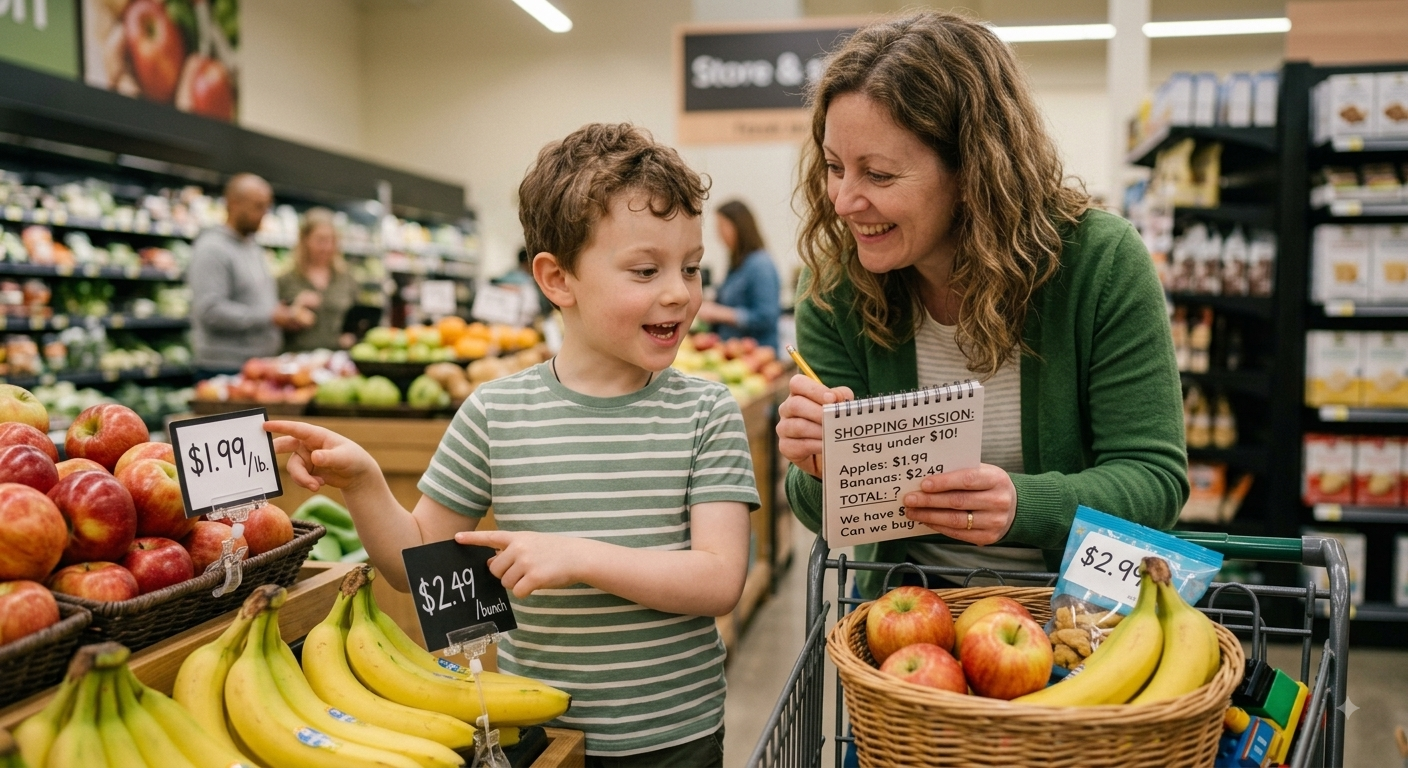
Skill: Money + addition + subtraction
Next shopping trip = math mission!
Ask fun questions like:
“If apples are $1 and bananas are $2, what’s the total?”
Or:
“We have $10—can we buy this and still have money left?”
💡 At home version: create a pretend store with toys and snacks.
🎯 Challenge: “Stay under $10!”
🪙 Coin version: "How many cents are 2 quarters and 3 dimes?" (80 cents)
- Easier: Use whole-dollar prices under $5.
- Harder: Set a $20 budget for two items that cost $8 and $7, and ask how much change you get back. ($5)
6. Shape Detective 🔺
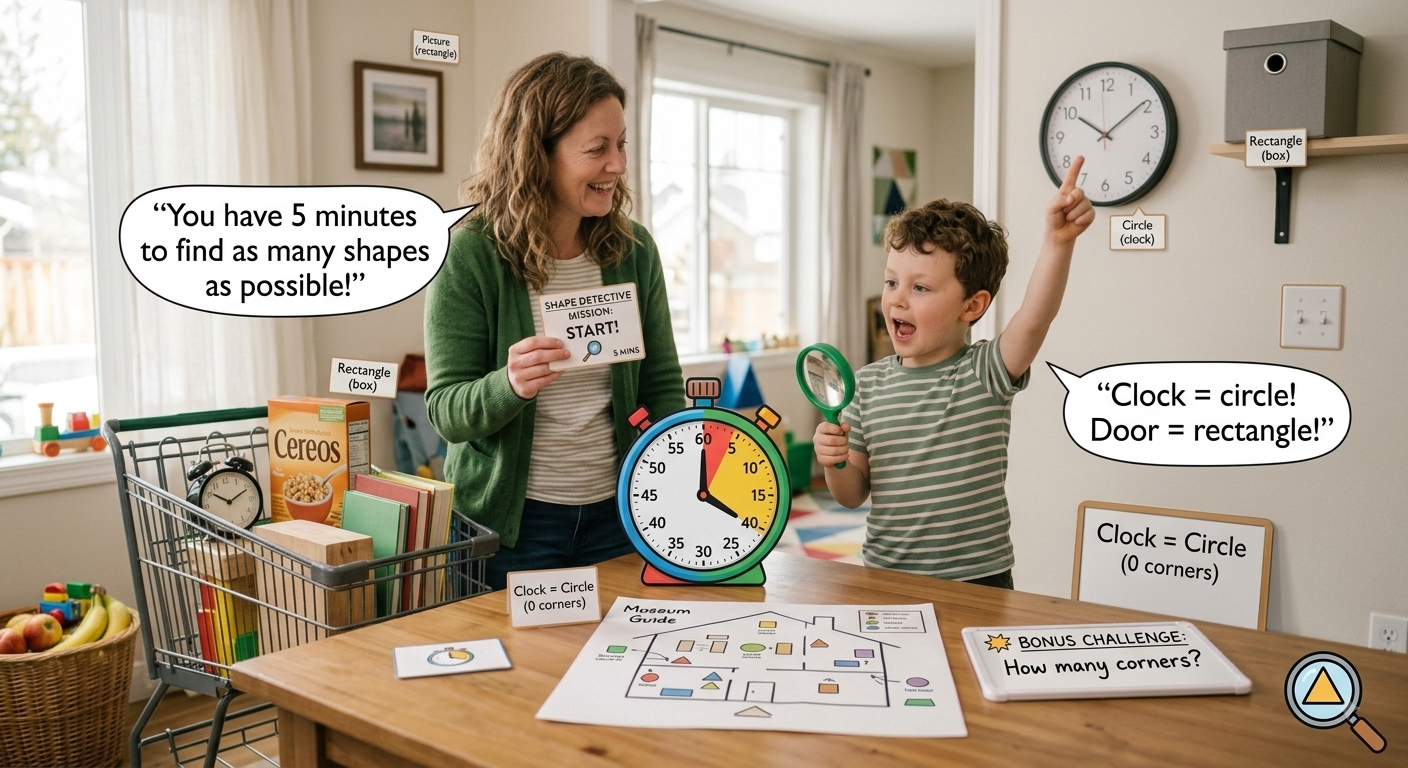
Skill: Geometry
Say:
“You have 5 minutes to find as many shapes as possible!”
Let your child explore the house like a shape explorer.
- Clock = circle
- Door = rectangle
- Dice = cube
💥 Bonus challenge:
“How many corners does it have?”
Suddenly, your home becomes a geometry museum!
- Easier: Hunt for circles, squares and triangles only.
- Harder: Count the sides and corners of each shape, and look for a pentagon or a hexagon.
7. Make 100 🎯
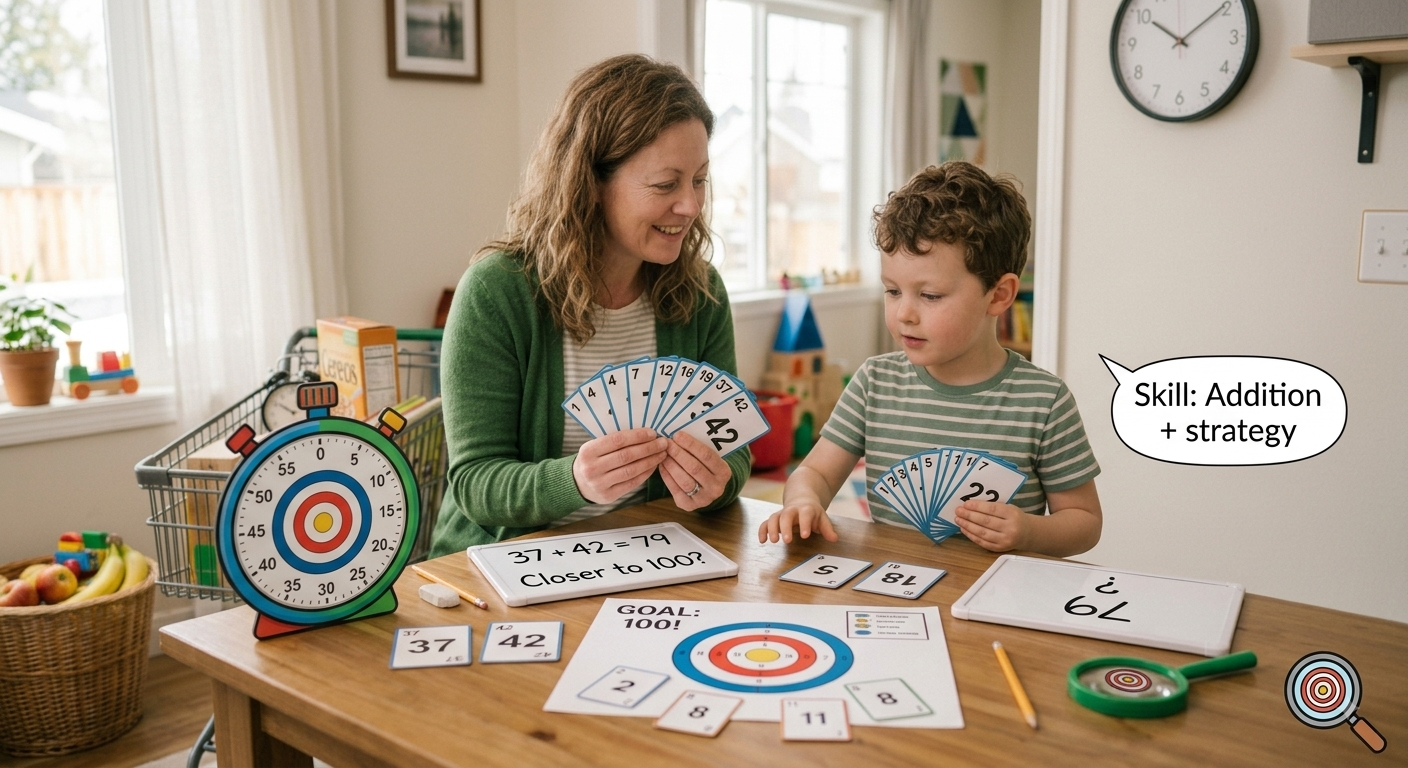
Skill: Addition + strategy
You’ll need: Number cards 0–9 (or a deck with the face cards removed)
Draw four cards and arrange them into two 2-digit numbers. Add them, and try to get as close to 100 as possible!
Example:
Cards 3, 7, 4 and 2 can make 37 + 42 = 79.
Rearrange the same cards: 73 + 24 = 97, which is only 3 away from 100.
💡 This feels like a strategy game—not math practice.
- Easier: Draw two cards, make one 2-digit number, and try to get close to 50.
- Harder: Draw six cards, make two 3-digit numbers, and try to get close to 1,000.
8. Snack-Time Fractions 🍕
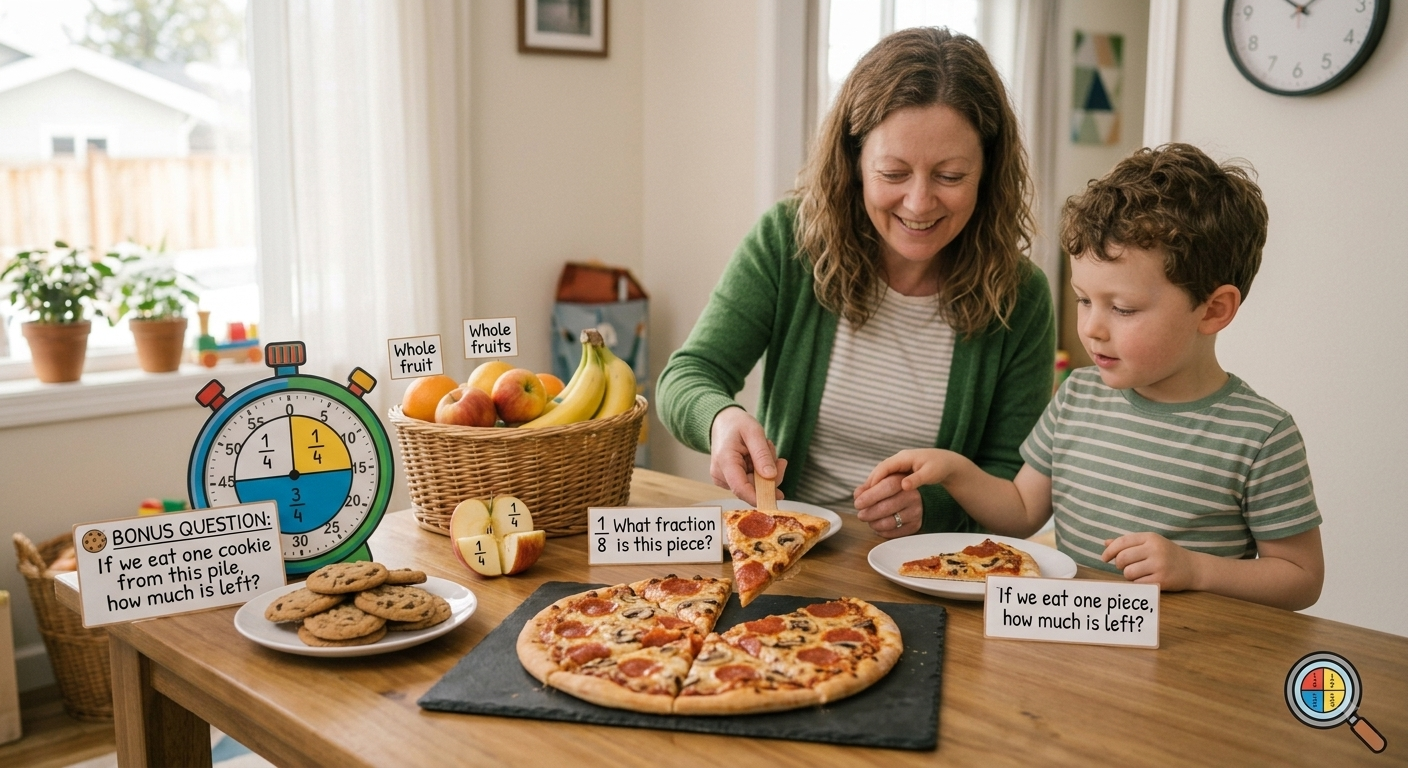
Skill: Fractions (the delicious way!)
Pizza, cookies, fruit—everything becomes math.
Cut food and ask:
“What fraction is this piece?”
- Half of a sandwich
- A third of a pizza
- A fourth (a quarter) of an apple
🍪 Bonus question:
“If we eat one piece, how much is left?”
In 2nd grade, children name equal shares as halves, thirds and fourths. Writing them as 1/2 or 1/4 starts in 3rd grade, so say the words instead of writing the numbers.
Learning + snacking = perfect combo.
- Easier: Start with halves only.
- Harder: Ask how many fourths make the whole sandwich. (Four fourths)
9. Dice Number Builder 🎲
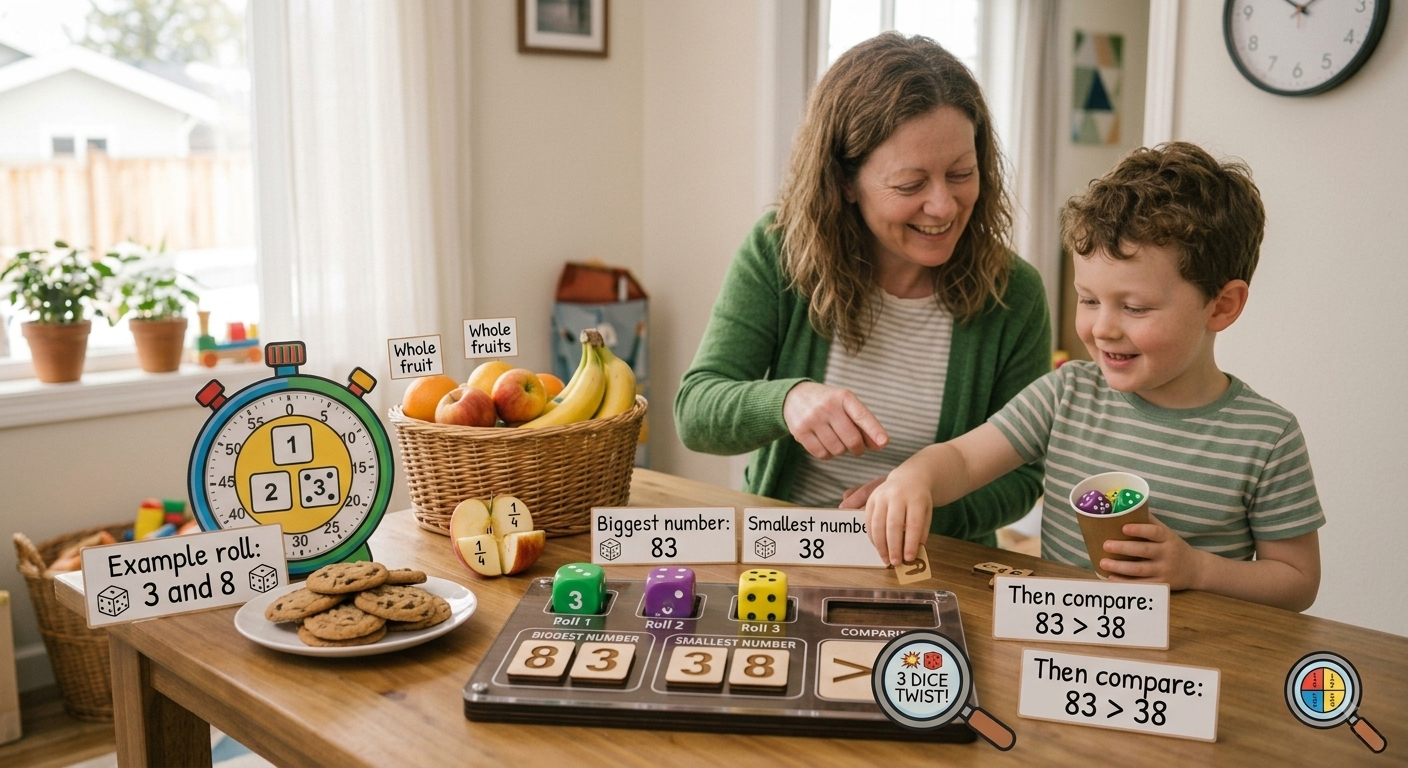
Skill: Place value
Roll dice and build numbers!
Example roll: 3 and 8
- Biggest number: 83
- Smallest number: 38
Then compare:
83 > 38
💥 Add a twist: use 3 dice for bigger numbers!
- Easier: Just say which of the two numbers is bigger.
- Harder: With three dice, subtract the smallest number from the biggest.
10. Measure Your World 📏
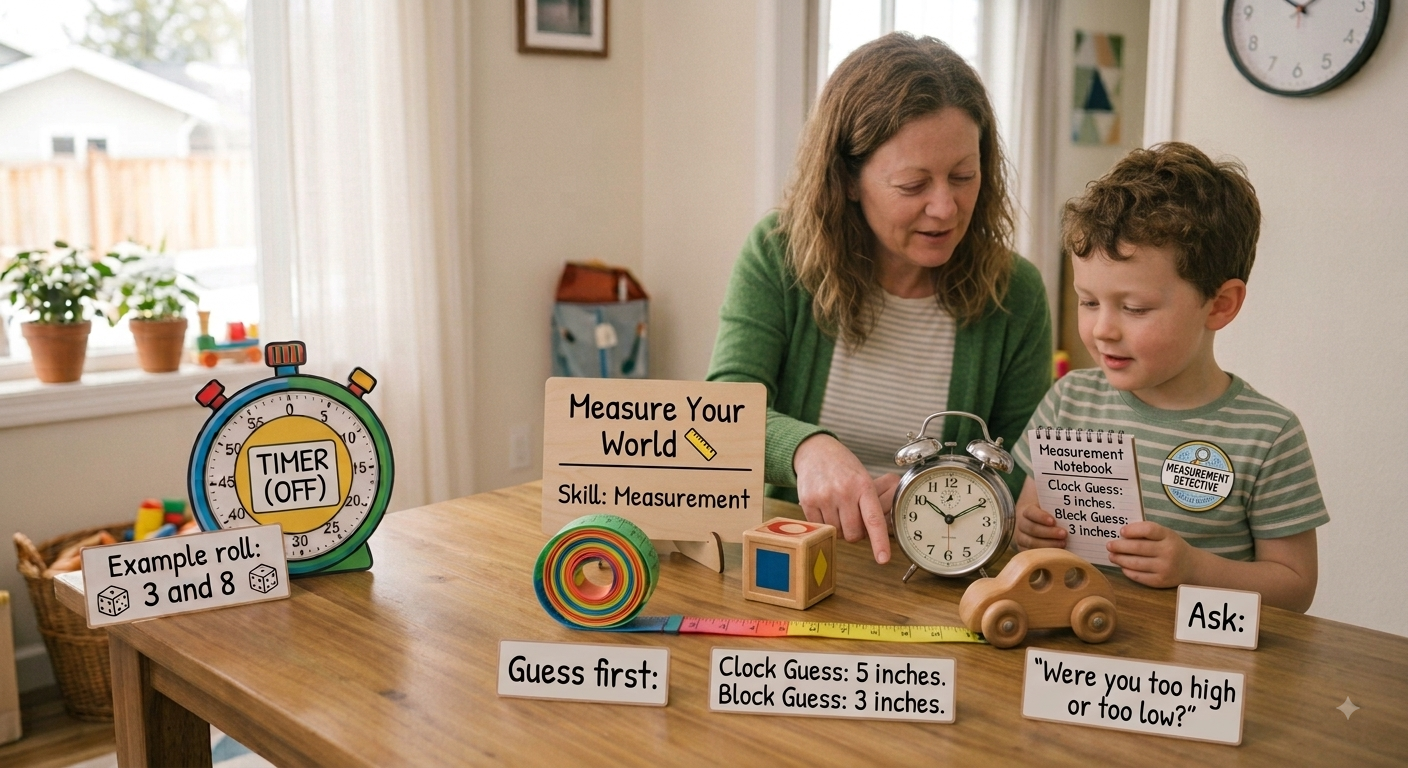
Skill: Measurement
Pick objects around the house and guess first:
| Object | Guess | Actual |
|---|---|---|
| Pencil | 5 inches | 7 inches |
Ask:
“Were you too high or too low?”
Kids love being “measurement detectives.”
- Easier: Measure with paper clips or blocks instead of a ruler.
- Harder: Measure two objects and work out how much longer one is than the other.
11. Math Bingo 🎉
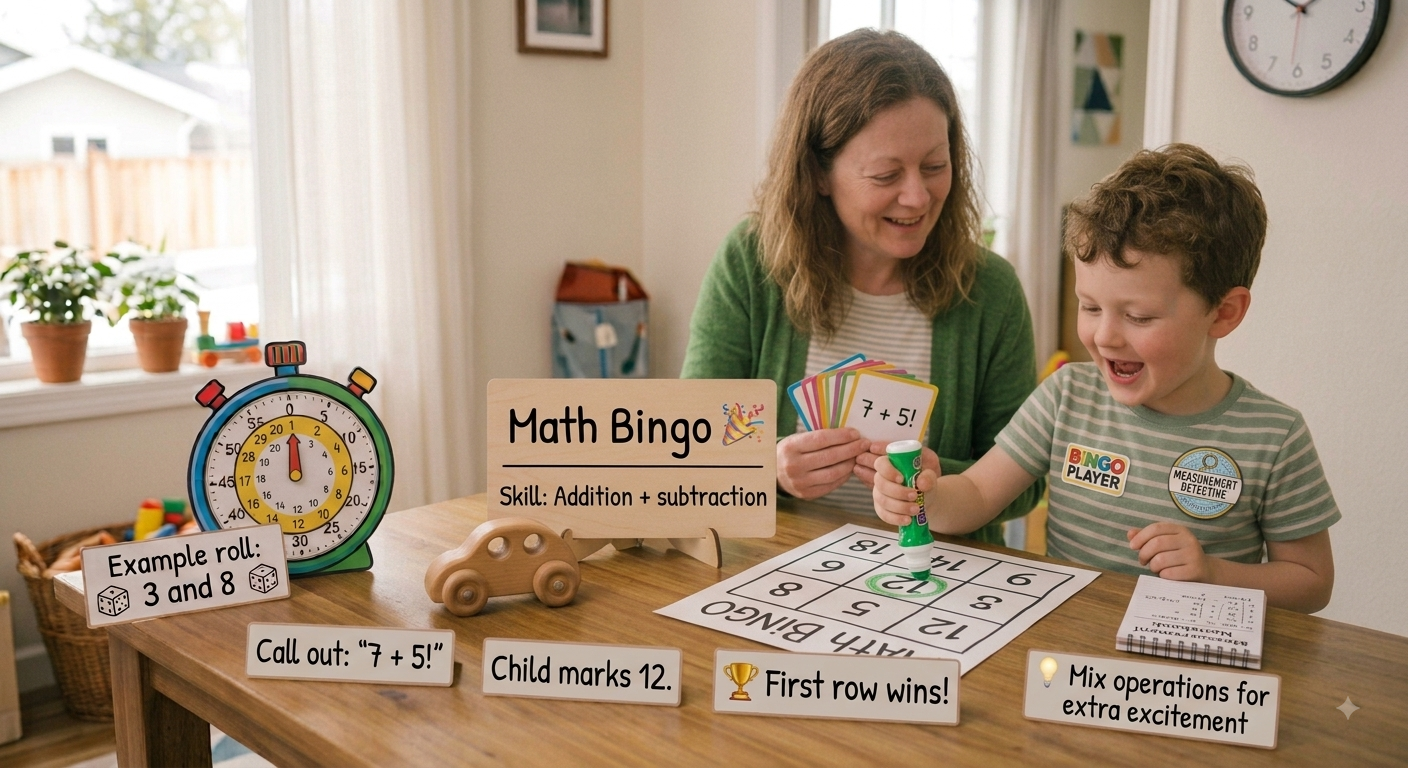
Skill: Addition + subtraction
Make a bingo board with answers.
Call out:
“7 + 5!”
Child marks 12.
🏆 First row wins!
💡 Mix operations for extra excitement.
- Easier: Call out facts within 10, like 4 + 3.
- Harder: Call out problems like 34 + 20 or 15 − 8.
12. Missing Number Detective 🧩
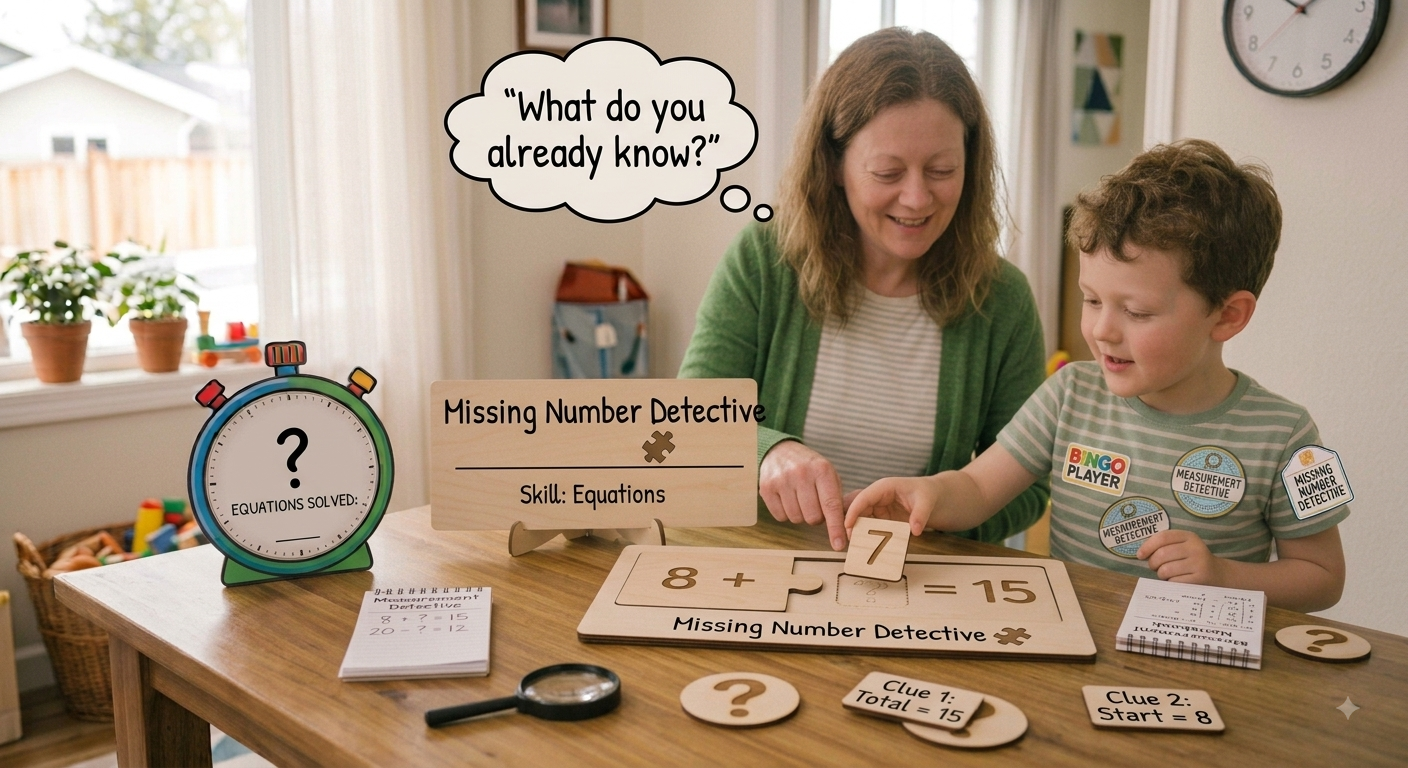
Skill: Equations
Solve puzzles like:
8 + ___ = 15
Instead of telling answers, ask:
“What do you already know?”
Kids feel like real problem-solvers.
Finding the missing number uses the same thinking as number bonds. Here is how number bonds work.
- Easier: Keep totals under 10, like 3 + ___ = 7.
- Harder: Use subtraction and bigger numbers, like 50 − ___ = 32. (18)
13. Family Graph 📊
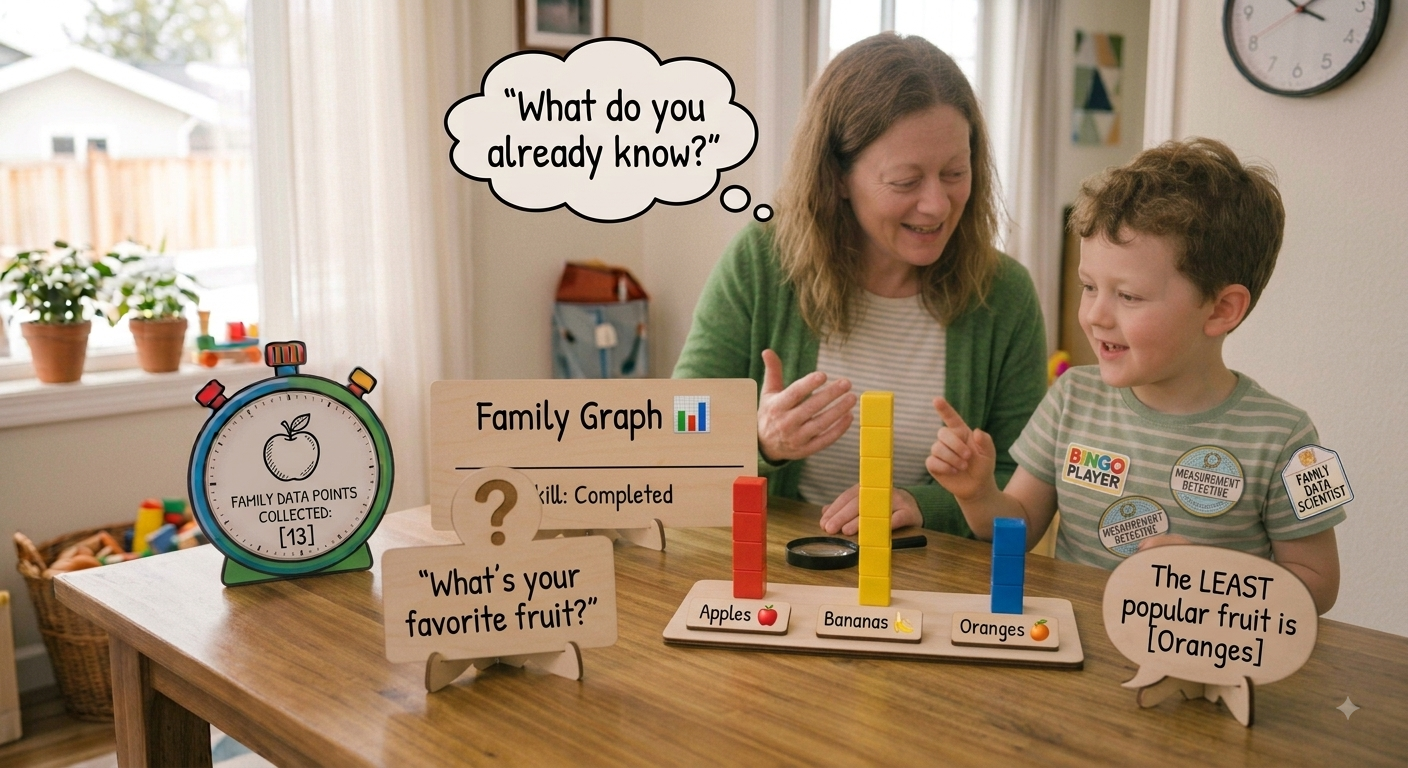
Skill: Data + graphs
Ask a fun question:
“What’s your favorite fruit?”
Make a bar graph together.
Then ask:
- What’s the most popular?
- What’s the least?
🎯 Suddenly, your family becomes a data set!
- Easier: Use tally marks or stack one block per vote.
- Harder: Ask "How many more people chose apples than bananas?"
14. Paper Plate Clock ⏰
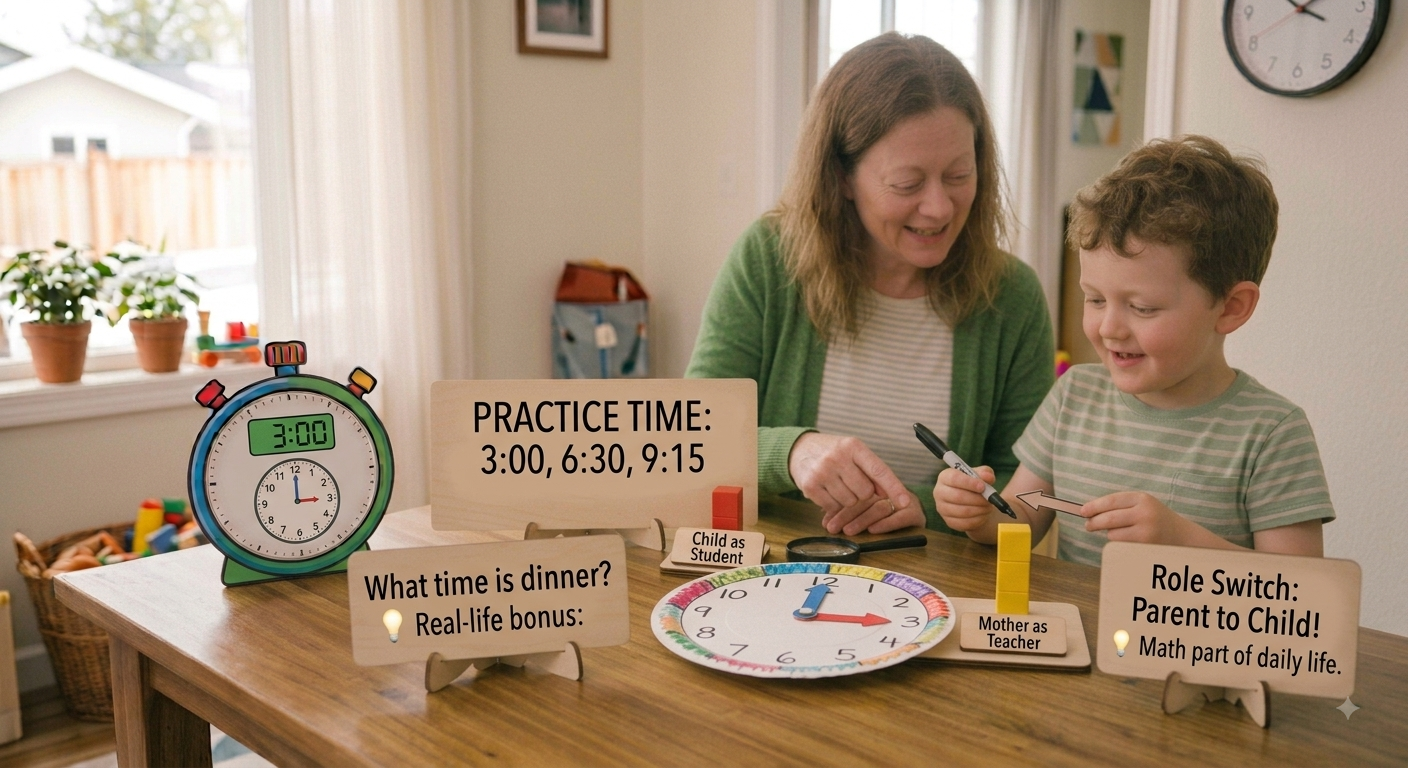
Skill: Time
Make a DIY clock and practice:
- 3:00
- 6:30
- 9:15
When those are easy, move to the nearest five minutes, like 4:25. That is the 2nd grade goal.
Then switch roles—your child becomes the teacher!
💡 Real-life bonus:
“What time is dinner?”
Math becomes part of daily life.
- Easier: Stick to o'clock and half past.
- Harder: Read clocks around the house and say whether it is a.m. or p.m.
15. Beat the Parent! 🏆
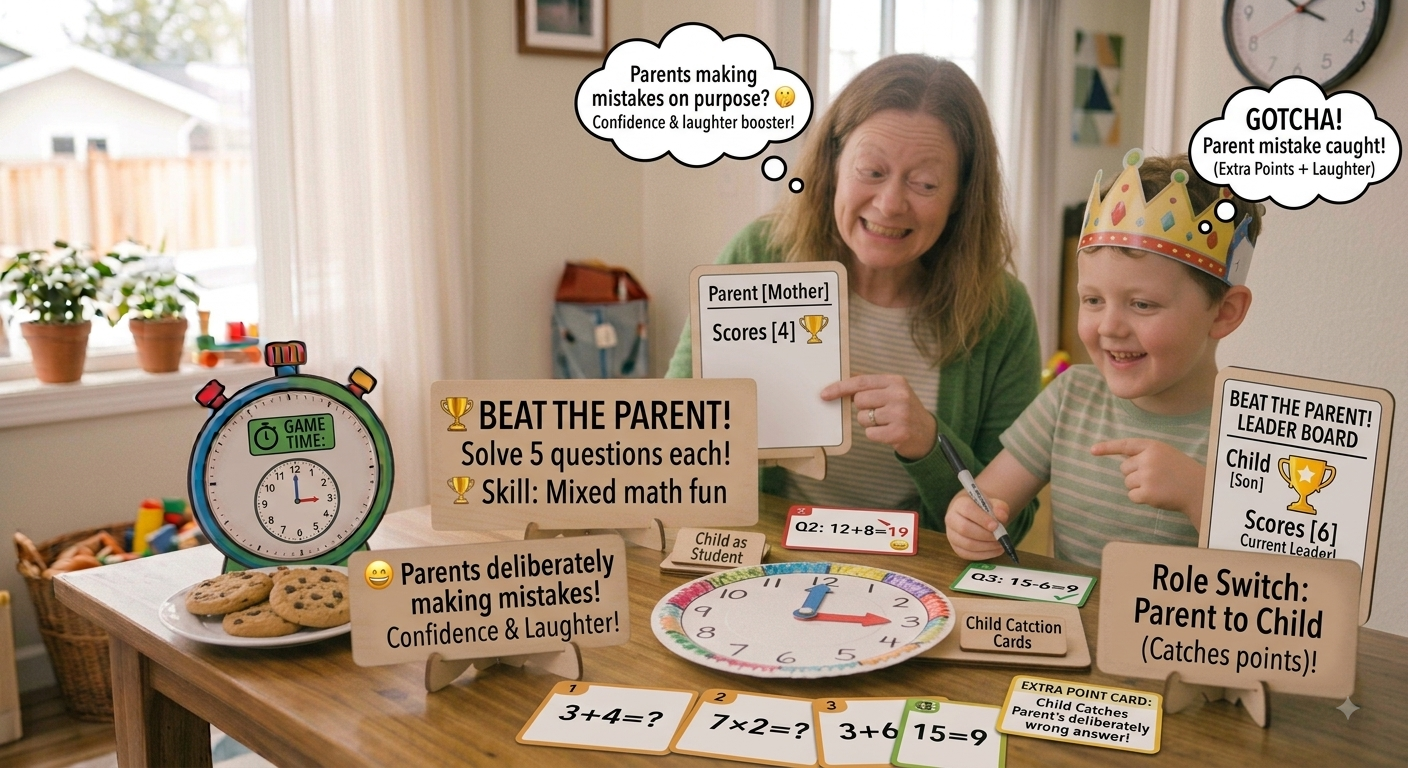
Skill: Mixed math fun
You vs your child—friendly competition time!
Solve 5 questions each.
BUT here’s the twist:
Parents can make mistakes on purpose
If your child catches it—they score extra points!
This builds confidence, laughter, and serious math thinking.
- Easier: Ask questions from a game your child already likes.
- Harder: Use two-step word problems.
What Should a 2nd Grader Know by the End of the Year?
These are the main 2nd grade math goals from the Common Core State Standards, which most US states use or base their own standards on. Each one lists the activities above that practice it.
- ✓Add and subtract within 20 in their head, and know all sums of two one-digit numbers from memory (2.OA.2)
Practice it: Roll, Add, and Race 🏁 · Math Bingo 🎉 - ✓Add and subtract within 100, and within 1,000 using models or drawings (2.NBT.5, 2.NBT.7)
Practice it: Make 100 🎯 - ✓Understand place value up to 1,000 (hundreds, tens and ones) and compare numbers with >, = and < (2.NBT.1, 2.NBT.4)
Practice it: Build My Number 🧱 · Dice Number Builder 🎲 - ✓Solve one- and two-step word problems within 100 (2.OA.1)
Practice it: Math Treasure Hunt 🗺️ · Missing Number Detective 🧩 - ✓Solve money problems with dollar bills, quarters, dimes, nickels and pennies (2.MD.8)
Practice it: Grocery Store Math 🛒 - ✓Tell time to the nearest five minutes, using a.m. and p.m. (2.MD.7)
Practice it: Paper Plate Clock ⏰ - ✓Measure and estimate length with a ruler (2.MD.1, 2.MD.3)
Practice it: Measure Your World 📏 - ✓Name triangles, quadrilaterals, pentagons, hexagons and cubes, and split shapes into halves, thirds and fourths (2.G.1, 2.G.3)
Practice it: Shape Detective 🔺 · Snack-Time Fractions 🍕 - ✓Read and make picture graphs and bar graphs (2.MD.10)
Practice it: Family Graph 📊
For written practice on these skills, see these 30+ solved 2nd grade math problems with free worksheets.
One App, Every Angle Your Child Needs for 2nd Grade Math
Liked these games? The Cuemath app has a new math workout every day, plus puzzles and 1v1 math battles your 2nd grader can play between activities. Free to try, no card needed.
100% Free • No Card Needed • A Few Minutes a Day
How to Make Math Activities More Fun?
You don't need to turn every activity into a competition. In fact, some children enjoy solving puzzles more when there is no pressure to "win."
Try These Simple Ideas to Make Math More Fun
- Let your child choose: Write three activities on slips of paper and let your child pick their favorite. Giving them a choice makes them feel more involved.
- Keep it short and sweet: You don’t need a long math session. Even 10–20 minutes of focused play can be enough. And when your child is still having fun, that’s a great time to stop and save some excitement for next time!
- Ask, “How did you figure that out?”: Don’t focus only on getting the right answer. Encourage your child to explain their thinking. You might be surprised by the creative ways they solve a problem.
- Turn everyday moments into math moments: Cooking, grocery shopping, cleaning up toys, traveling, or even setting the table can become an opportunity to count, compare, measure, add, or subtract.
- Celebrate the thinking, not just the answer: Instead of simply saying, “You’re right!” try, “I love how you figured that out!” It helps your child feel confident about tackling new problems—even when they don't get the answer right the first time.
A Simple 5-Day Math Activity Plan
Not sure where to begin? Try these math activities for 2nd grade students:
Monday: Roll, Add, and Race
Tuesday: Shape Detective
Wednesday: Grocery Store Math
Thursday: Snack-Time Fractions
Friday: Family Graph
That's just 10–20 minutes a day, but it gives your child repeated opportunities to use math in different ways.
If your child wants more, these free 2nd grade math games practice the same skills.
Turn "I Don't Like Math" Into "Can We Play Again?"
The goal of math activities for 2nd grade isn't to squeeze more worksheets into your child's day. It's to help children discover that math is already part of the world around them.
- A pile of coins can turn into a fun money-counting game.
- A pizza can become a delicious way to explore fractions.
- A walk around the house or neighborhood can turn into a measurement challenge.
- A deck of cards can spark a quick addition or subtraction competition.
- Your living room can become a geometry scavenger hunt as your child searches for shapes hiding in plain sight.
When math feels like something children do rather than something they simply complete, curiosity has room to grow.
So pick one activity tonight, grab whatever you already have at home, and let the math adventure begin!
Want a Tutor Who Teaches Math This Way Every Week?
A free 1:1 evaluation shows which 2nd grade skills your child has down and which need work, with games and visuals instead of worksheets.
Book a Free Evaluation100% free • No credit card needed • Grades K–12
Frequently Asked Questions
What are the best math activities for 2nd grade at home?
Some of the best options are dice games, number-building challenges, grocery-store math, shape hunts, measurement activities, math bingo, and missing-number puzzles. Choose activities that match your child's current skills and keep them short and playful.
How can I make 2nd grade math more fun?
Connect math to things your child already enjoys. Use snacks for fractions, toys for counting, shopping for money practice, and household objects for geometry. Games and challenges can make practice feel much less like traditional homework.
How long should a 2nd grader practice math at home?
There is no need for every activity to become a long study session. A focused 10–20 minute game can provide meaningful practice. The key is consistency and choosing activities that encourage your child to think and explain.
What skills should a 2nd grader practice in math?
Children can practice addition and subtraction, place value, comparing numbers, measurement, money, time, basic fractions, geometry, data, and problem-solving. Everyday activities can reinforce these skills naturally.
Are these 2nd grade math activities suitable for different learning levels?
Yes. Most activities can be adjusted. Use smaller numbers or fewer steps when your child needs support, and introduce larger numbers, extra rules, or multi-step challenges when they are ready for more.
Do these activities match what 2nd graders learn in school?
Yes. Each activity lines up with a 2nd grade Common Core standard, listed in the table above: adding and subtracting within 20 and 100, place value to 1,000, money, time to the nearest five minutes, measuring length, shapes, and simple picture and bar graphs.
What should I do if my child gets frustrated during a math game?
Make the numbers smaller and slow down. Switch to an easier version of the same game, such as one die instead of two, and stop while your child is still enjoying it so the next session starts on a good note.
Sources
- Common Core State Standards, Grade 2 Operations & Algebraic Thinking: adding and subtracting within 20 and 100, word problems
- Common Core State Standards, Grade 2 Number & Operations in Base Ten: place value to 1,000, comparing numbers
- Common Core State Standards, Grade 2 Measurement & Data: length, time, money and graphs
- Common Core State Standards, Grade 2 Geometry: shapes and halves, thirds and fourths

I was never the kid who loved math. I was much more interested in books, stories, and writing—and, somewhere along the way, I became even more curious about people. Why do we learn differently? Why does something make sense to one child but not another? And what makes a student feel confident enough to keep trying?
That curiosity led me to study Applied Psychology, where I learned more about how children think, learn, and make sense of the world around them.
My love for writing did the rest. What started as something I simply enjoyed became a career. Over the past five years, I've worked as a freelance writer across edtech, SaaS, B2B, travel, lifestyle, and healthcare, learning how to write for very different audiences without losing the human side of the story.
Today, I'm an SEO Content Writer & Editor at Cuemath, where I get to bring many of these interests together. Working in education—and especially around math—has made me even more curious about what happens behind the screen or textbook: what parents worry about, what students struggle with, and what actually helps them learn.
That's also how I like to research. I don't just look at search results and call it a day. I go where parents and students actually talk—forums, reviews, communities, and conversations with real families. Because sometimes the most useful insight isn't hiding in a keyword; it's in a parent's question, a student's frustration, or a small detail someone shares about their learning experience.
I write because I'm curious. I research because I want to understand. And I love turning what I learn into content that feels genuinely useful to the people reading it.