Online Maths Tutor vs AI Tutor or Maths App: What’s Better for Your Child?
Online maths tutor vs AI: which one will actually help your child understand maths? AI tutors and maths apps can mark answers and explain steps on demand, but they only see what your child types. Here’s how the three compare for Australian families.

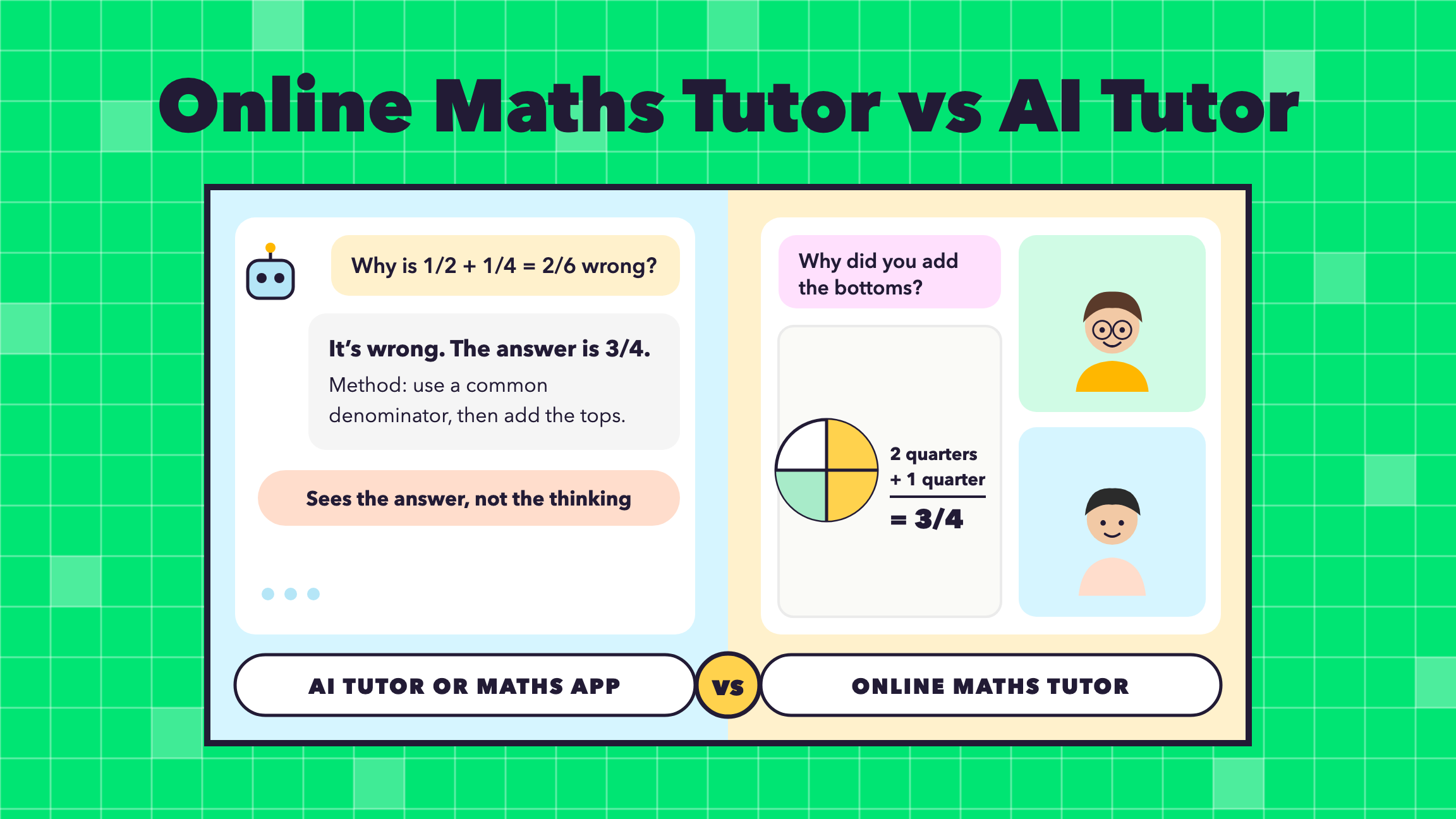
AI has changed what maths help looks like at home. A few years ago, most families chose between a tutor and a workbook. Now there are maths apps that set and mark practice, AI chatbots that explain a step the moment your child asks, and online maths tutors who teach live on a shared screen.
All three promise personal help, so the online maths tutor vs AI question is a fair one. What actually separates them?
- What Are Online Maths Tutoring, AI Tutors and Maths Apps?
- Online Maths Tutoring: A real person, live, on a shared screen
- AI Tutors: A chatbot that explains on request
- Maths Apps: Practice that adjusts as your child goes
- Online Maths Tutor vs AI Tutor vs Maths App: The Quick Answer
- How Do an Online Maths Tutor, an AI Tutor and a Maths App Compare?
- What Does a Live Tutor Notice That an App Can’t?
- Frequently Asked Questions
- Can AI replace a maths tutor?
- Is ChatGPT good for maths homework?
- Are maths apps enough for NAPLAN?
- Is online tutoring worth it?
- Is a live tutor better for struggling students?
- Does Cuemath use AI?
- Who are Cuemath’s coaches?
- Sources
What Are Online Maths Tutoring, AI Tutors and Maths Apps?
They all live on a screen, and that’s roughly where the similarity ends. Each one does a different job, and knowing which job you need done is most of the decision.
Online Maths Tutoring: A real person, live, on a shared screen
Maths teaching delivered live over the internet, usually one-on-one, where a tutor and child work through problems together on a shared screen in real time. The tutor sees the working as it happens, not only the final answer, and adjusts the lesson around it.
At Cuemath, every class runs on one principle: cue, don’t tell. Instead of handing over answers, a coach asks the right question at the right moment, so your child works the step out independently.
Five parts of the Cuemath platform make that kind of teaching possible:
For your child, that adds up to a class where they do most of the thinking and talking. For you, it means seeing what was covered and what is still shaky the same evening, instead of asking “How was maths?” and hearing “Fine.”

AI Tutors: A chatbot that explains on request
An AI tutor is a chatbot, such as ChatGPT, that explains maths in conversation. Your child types a question and gets a worked explanation in seconds, at any hour.
Newer tools try to hold back the answer: OpenAI’s study mode, launched in July 2025, guides students step by step instead of giving quick answers. But an AI tutor only knows what your child types, and it can be confidently wrong. OpenAI’s terms also require users to be at least 13, with a parent’s or guardian’s permission under 18.
Maths Apps: Practice that adjusts as your child goes
A maths app, such as Mathspace or IXL, sets practice questions, marks them instantly and changes the difficulty as your child works. Mathspace, for example, describes adaptive tasks that adjust question difficulty to each student in real time.
Math apps are good at building speed and accuracy. What they see is whether an answer is right, not how your child got there.
Online Maths Tutor vs AI Tutor vs Maths App: The Quick Answer
Put simply, an app can tell your child an answer is wrong. A tutor can tell them why, and make sure it doesn’t keep happening.
Want to See What a Cuemath Coach Would Spot?
In a free one-on-one evaluation, a Cuemath coach works through problems with your child and shows you where their thinking is strong and where it slips. You only choose a plan afterwards if you want to.
Book a Free EvaluationFree and online, for Kindergarten to Year 10.
How Do an Online Maths Tutor, an AI Tutor and a Maths App Compare?
The real test is what happens when your child is stuck. Here’s how each option handles the moments parents care about most.
Source: Cuemath Australia pricing page and platform article; Mathspace About Premium and Help Centre; IXL Australia family membership page; Cluey Learning Service Schedule and Fees; OpenAI Terms of Use and study mode announcement. All checked 30 October 2026.
In a real week, the gap looks more like this:
Source: Illustrative example. Mia and Leo are invented to show a common pattern; they are not real students.
Both children practised. Only one had someone watching how they thought, and that is what an online maths tutor adds that the other two can’t.
What Does a Live Tutor Notice That an App Can’t?
A good tutor watches the working, not just the answer. Cuemath describes its coaches this way: the coach watches how your child works, spots the habit behind a wrong answer, and cues the child forward rather than handing over the fix.
In an ordinary class, these are the signals a coach picks up that a screen can’t:
NAPLAN 2027 runs from 10 to 22 March for Years 3, 5, 7 and 9. If you’re reading this in Term 4, you still have the summer break and the first weeks of Term 1 before the test: enough time for a coach to find and work on a specific gap without cramming. Our NAPLAN 2027 dates guide has the full calendar. NAP key dates
Is Your Child Practising, or Actually Understanding?
A free evaluation with a Cuemath coach shows the difference in one session: where your child’s reasoning is solid and where a habit is getting in the way. If an app turns out to be enough, you’ll know that too.
Book a Free 1-on-1 EvaluationIf you enrol later, unused classes are refundable, no questions asked.
Frequently Asked Questions
Can AI replace a maths tutor?
No, AI cannot replace a math tutor. AI tutors can explain steps and set practice, but they only respond to what a child types, can give wrong answers confidently and can’t see frustration. A 2025 study of nearly 1,000 high school maths students found that unrestricted chatbot help lifted practice scores, but once it was taken away those students scored 17% lower than students who never had it.
Is ChatGPT good for maths homework?
It can help older students check their thinking, but it shouldn’t do the thinking for them. OpenAI’s study mode guides students step by step instead of giving the answer straight away. OpenAI’s terms require users to be at least 13, with a parent’s or guardian’s permission under 18. Ask your child to attempt each question on paper first, and read the chat now and then.
Are maths apps enough for NAPLAN?
For a child already working at year level, an app helps with speed, but it rarely fixes word problems. NAPLAN numeracy asks children to work through worded, real-world problems, and a child who struggles with those usually needs someone to look at how they are reasoning. NAPLAN 2027 runs from 10 to 22 March for Years 3, 5, 7 and 9.
Is online tutoring worth it?
For a child who is stuck, behind or losing confidence, usually yes. A live tutor watches how your child works, finds the reason behind each mistake and fixes it on the spot, which practice alone doesn’t do. At Cuemath, the same coach teaches your child one-on-one every session and follows the Australian Curriculum and your state’s syllabus, so the help lines up with what your child is doing at school.
Is a live tutor better for struggling students?
Usually, yes. When a child is struggling, the cause is often a misunderstanding that a practice app marks as wrong but can’t explain. A live tutor can watch the working, find the reason and change the explanation on the spot. Evidence for Learning notes that low-achieving students are particularly likely to benefit from one-to-one tuition.
Does Cuemath use AI?
Yes, but not as the teacher. Every Cuemath class is taught live by a human coach. Cuemath says it uses AI tools behind the scenes to analyse worksheets, app activity and coach and parent feedback to help shape each child’s learning plan. Its Smart Practice tool also adapts as a child progresses.
Who are Cuemath’s coaches?
Selected and trained maths coaches who stay with your child. Cuemath says only the top 1% of applicants become coaches. They hold degrees in maths, engineering or education, and are trained in the Australian Curriculum. Your child has the same coach in every session, so the coach gets to know how your child thinks.
Sources
- Mathspace: About Premium
- Mathspace Help Centre
- IXL Australia: Family membership
- OpenAI: Terms of Use
- OpenAI: Introducing study mode
- National Assessment Program: NAPLAN key dates
- Australian Curriculum (ACARA): Mathematics proficiencies

I write because I like understanding things properly, and I've never been able to do that quietly.
Six years in, what still interests me most isn't the writing itself. It's the person on the other side. Who are they, what were they actually worried about when they opened this page, and did they leave with what they came for? Most content fails that last test. It answers the easy question instead of the one that was asked.
At Cuemath, I write for parents and students in India and around the world. That range is the part I enjoy. A parent in Bangalore and a parent in Canada are asking about the same child, but not always in the same words, and that difference matters.
So I research before I write. Not just search results. Forums, reviews, the long comment threads where somebody finally admits what they're really confused about. That's usually where the useful thing is hiding.
I also spend time on how people find this writing at all, since a growing number of them now ask an AI instead of typing into Google. But that only works if the writing is clear to begin with. There's no shortcut around that part.