When Do Kids Learn the Standard Algorithm? Multiplication, Long Division and More by Grade
Schools still teach the “old way” to add, multiply and divide. They just wait until Grades 4, 5 and 6. Here's what your child learns first in each grade, why, and how to practice each step at home with free worksheets.

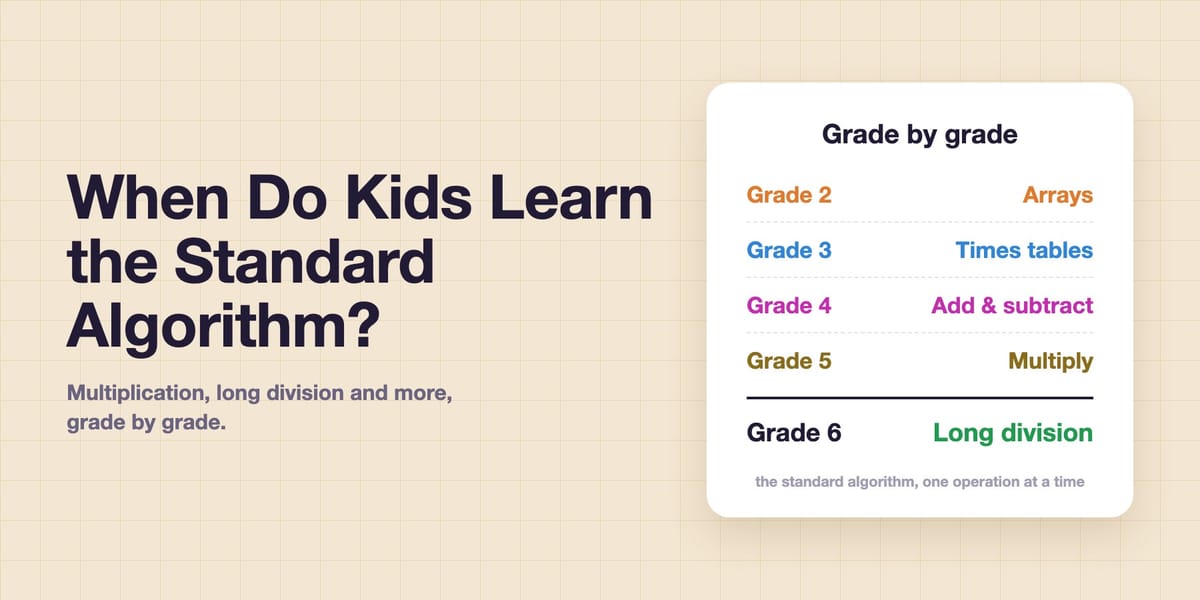
If your fourth grader is drawing boxes to multiply 46 × 27, you might wonder whether school will ever teach the way you learned. It will. The way you learned is called the standard algorithm, and Common Core brings it in one operation at a time: adding and subtracting in Grade 4, multiplying in Grade 5, and long division in Grade 6.
The years before each algorithm aren't wasted. Number bonds, the area model and partial products are the same math as the standard algorithm, just written out in full. When the algorithm arrives, your child learns a shorter way to write steps they already understand. One thing to know if you live in Texas: Texas starts the multiplication algorithm in Grade 3 and long division in Grade 4.
In this guide, we'll go through the grade-by-grade timeline, the strategy your child learns before each algorithm (with a link to our guide on each one), worked examples, the mistakes to look for, and free worksheets for every grade.
Try It Yourself: Same Problem, Two Ways. Work out 46 × 27 with the standard algorithm, then check it with partial products. The two rows of the algorithm (322 and 920) are the partial products added up. This guide shows why.
- What Is the Standard Algorithm?
- When Do Kids Learn the Standard Algorithm? Grade-by-Grade Timeline
- When Do Kids Learn Multiplication?
- Grade 4: The Standard Algorithm for Addition and Subtraction
- Grade 5: The Standard Algorithm for Multiplication
- Grade 6: Long Division and Decimals
- Why Schools Teach Strategies Before the Standard Algorithm
- 4 Standard Algorithm Mistakes to Watch For
- Standard Algorithm Worksheets by Grade
- How Cuemath Tutors Help With the Standard Algorithm
- FAQs
What Is the Standard Algorithm?
The standard algorithm is the written, step-by-step method for adding, subtracting, multiplying or dividing big numbers. It's the method most parents learned in school: stack the numbers, work one place value at a time, and carry or borrow when a column runs over.
“Algorithm” just means a fixed set of steps that works every time. “Standard” means it's the one most people use. There are four of them in elementary school:
| Operation | What your child does | Example | Grade |
|---|---|---|---|
| Addition | Adds each column from right to left and carries when a column makes 10 or more | 457 + 286 = 743 | Grade 4 |
| Subtraction | Subtracts each column from right to left and borrows when the top digit is smaller | 503 − 268 = 235 | Grade 4 |
| Multiplication | Multiplies by one digit at a time, writes one row per digit, then adds the rows | 46 × 27 = 1,242 | Grade 5 |
| Long division | Divides, multiplies, subtracts and brings down, then repeats | 952 ÷ 7 = 136 | Grade 6 |
The standard algorithm is fast because it hides the place values. When your child writes the 4 in the tens column of 46 × 27, that 4 means 40, but nothing on the page says so. That's why schools teach the long versions first. Each grade section below shows which strategy comes first and how it turns into the algorithm.
When Do Kids Learn the Standard Algorithm? Grade-by-Grade Timeline
Kids learn the standard algorithm one operation at a time: Grade 4 for adding and subtracting, Grade 5 for multiplying and Grade 6 for dividing. In the grades before each one, they solve the same kinds of problems with strategies that show every place value. Here's the Common Core timeline:
| Grade | What your child learns | Learned before this |
|---|---|---|
| Grade 1 | Adds within 100 with blocks, drawings and place value | Number bonds, ten frames |
| Grade 2 | Adds and subtracts within 1,000; adds the rows of an array | Number line, expanded form |
| Grade 3 | Knows times tables from memory; adds and subtracts with “strategies and algorithms” | Commutative and associative properties |
| Grade 4 | Standard algorithm: add and subtract. Multiplies and divides with models | Area model, box method, distributive property |
| Grade 5 | Standard algorithm: multiply. Divides with models | Partial products, lattice method |
| Grade 6 | Standard algorithm: long division and decimals | Partial quotients, area model for division |
Grade 3 is the first year Common Core uses the word “algorithm.” Standard 3.NBT.A.2 says kids add and subtract within 1,000 “using strategies and algorithms,” so some third graders already carry and borrow. The word “standard” first appears in Grade 4.
These are also the skills on state math tests. Grade 4 to 6 tests like Smarter Balanced and NJSLA check both the algorithm and the models that come before it.
When Do Kids Learn Multiplication?
Kids start multiplication in Grade 2 by adding the rows of an array, and they learn it as multiplication in Grade 3. By the end of Grade 3, Common Core expects them to know every fact up to 10 × 10 from memory. Most third graders are 8 or 9 years old.
Same array. In Grade 3, it gets a multiplication sign.
Here's how multiplication grows from grade to grade:
- Grade 1: No multiplication. Kids add and subtract within 20 and count to 120.
- Grade 2: Kids skip-count by 5s, 10s and 100s (2.NBT.A.2) and add the rows of arrays up to 5 by 5, like 3 + 3 + 3 + 3 = 12 (2.OA.C.4). This is multiplication without the × sign.
- Grade 3: Kids learn that 5 × 7 means 5 groups of 7 (3.OA.A.1), use the commutative, associative and distributive properties to find facts (3.OA.B.5), and know all products of two one-digit numbers from memory by the end of the year (3.OA.C.7).
- Grade 4: Kids multiply up to a 4-digit number by a 1-digit number, and 2-digit by 2-digit, with area models and partial products (4.NBT.B.5).
- Grade 5: Kids multiply whole numbers of any size with the standard algorithm (5.NBT.B.5).
Should a 6-year-old know multiplication? No. Common Core has no multiplication in kindergarten or Grade 1. If your 6-year-old likes counting by 2s, 5s and 10s, that's the right warm-up. Skip-counting turns into multiplication facts later.
How fast should a third grader know the facts? Common Core doesn't set a time limit. It asks kids to “know from memory” all products of two one-digit numbers by the end of Grade 3. A child who still counts on fingers for 7 × 8 in Grade 4 will find the multiplication algorithm slow, because every row uses several facts. Our guide to math facts practice has five-minute ways to build them, and the commutative property cuts the facts to learn from 100 to 55.
Between lessons, your child can practice times-table facts for a few minutes a day in the free Cuemath App.
Try It Yourself: Facts First. Your child needs these facts for the problems in this guide. Press Check My Answer on each card.
Grade 4: The Standard Algorithm for Addition and Subtraction
Common Core expects kids to add and subtract multi-digit whole numbers with the standard algorithm in Grade 4 (4.NBT.B.4). Grade 4 numbers go up to 1,000,000.
Learned before this: number bonds and ten frames in Grade 1, then the number line and expanded form in Grade 2.
How to add with the standard algorithm: 457 + 286
The carried 1 is 1 ten, then 1 hundred. It's a place value, not a stray digit.
How to subtract with the standard algorithm: 503 − 268
Zeros make subtraction hard. In 503 − 268, your child can't take 8 from 3, and there are no tens to borrow from.
503 is still 503. It's just written as 400 + 90 + 13.
You can check any subtraction by adding: 235 + 268 = 503. Cuemath's pages on addition with regrouping and subtraction with regrouping have more worked examples, and the free Grade 4 math curriculum has practice by topic.
Try It Yourself: Grade 4 Algorithm. Solve each one with the standard algorithm, then check by doing the opposite operation. Press Check My Answer on each card.
Grade 5: The Standard Algorithm for Multiplication
Common Core expects kids to “fluently multiply multi-digit whole numbers using the standard algorithm” in Grade 5 (5.NBT.B.5). This is the answer to “what is the standard algorithm in 5th grade”: multiplying numbers like 46 × 27 or 304 × 15 one digit at a time.
Learned before this: the distributive property in Grade 3, then the area model, the box method and partial products in Grade 4.
How to multiply with the standard algorithm: 46 × 27
The highlighted 0 is there because the 2 in 27 means 20.
Partial products and the standard algorithm give the same rows. Here's 46 × 27 both ways. The four partial products add up to the two rows of the standard algorithm:
That's why a child who understands partial products picks up the algorithm faster. The algorithm is partial products with the adding done in your head. Our partial products guide shows this step by step, and Cuemath's page on long multiplication has more examples. For mixed practice, try our 5th grade math problems or the free Grade 5 math curriculum.
Try It Yourself: Two Rows, Then Add. Fill in each row of the standard algorithm, then add the rows. Press Check My Answer on each card.
Is Your Child Ready for the Next Algorithm?
In a free 1:1 evaluation, a Cuemath tutor watches how your child multiplies, finds the exact step where the place values slip, and shows you what to practice next.
Book a Free Evaluation100% free · No credit card · About 30 minutes
Grade 6: Long Division and Decimals
Common Core expects kids to divide multi-digit numbers with the standard algorithm, also called long division, in Grade 6 (6.NS.B.2). In the same year, they add, subtract, multiply and divide decimals with the standard algorithm (6.NS.B.3).
Learned before this: dividing with area models and partial quotients, up to a 4-digit number divided by a 1-digit number in Grade 4 (4.NBT.B.6), and by a 2-digit number in Grade 5 (5.NBT.B.6).
How to do long division: 952 ÷ 7
Long division repeats four steps: divide, multiply, subtract, bring down.
Check by multiplying: 136 × 7 = 952.
Partial quotients and long division find the same answer. In Grades 4 and 5, your child solves 952 ÷ 7 by taking away easy groups of 7:
Decimals with the standard algorithm. The steps don't change. Only the decimal point needs care:
- Add and subtract: line up the decimal points. 12.5 + 3.75 = 16.25.
- Multiply: multiply as if there were no decimal points, then count the decimal places in both numbers. For 4.6 × 3.2, 46 × 32 = 1,472, and there are 2 decimal places, so the answer is 14.72.
- Divide by a decimal: move both decimal points the same number of places until you're dividing by a whole number. 7.5 ÷ 0.3 becomes 75 ÷ 3 = 25.
Cuemath's page on long division has more worked examples, and our guide to what kids learn in 6th grade math covers the rest of the year. The free Grade 6 math curriculum has practice by topic.
Try It Yourself: Long Division and Decimals. Use long division for the first two. For the decimal, multiply the whole numbers first, then place the point. Press Check My Answer on each card.
Why Schools Teach Strategies Before the Standard Algorithm
Schools teach strategies first because the Grade 4 and Grade 5 standards ask kids to show why the math works, not just get the answer. Common Core 4.NBT.B.5 and 5.NBT.B.6 ask kids to “illustrate and explain the calculation by using equations, rectangular arrays, and/or area models.” The standard algorithm doesn't show that, because it hides the place values.
Here's what goes wrong when a child learns the algorithm without the strategy first:
- They lose track of place value. A child who doesn't know the second row of 46 × 27 means 46 × 20 often forgets the 0 and gets 414 instead of 1,242.
- They can't tell if an answer makes sense. A child who knows 46 × 27 is close to 50 × 30 = 1,500 will catch 414 right away.
- They can't fix their own mistakes. If a step goes wrong, they have only the steps to go back to, not the meaning.
Can your child use the standard algorithm at home before school teaches it? Yes, as a way to check answers. On homework, though, use the method the teacher asked for. In Grade 4, the question is often graded on the model or explanation, not just the answer. If you're not sure, a short note to the teacher settles it.
Also Read
4 Standard Algorithm Mistakes to Watch For
Most standard algorithm mistakes come from losing track of place value. These four show up on homework all the time.
Mistake 1: Taking the smaller digit from the bigger one. In 503 − 268, your child does 8 − 3 = 5, 6 − 0 = 6 and 5 − 2 = 3, and writes 365. Each column has to take the bottom digit from the top digit, borrowing when the top is smaller.
Mistake 2: Forgetting the 0 in the second row. In 46 × 27, your child writes 46 × 2 = 92 under 322 without shifting it, and adds 322 + 92 = 414. The second row is 46 × 20 = 920.
Mistake 3: Skipping a 0 in the answer. In 824 ÷ 4, your child divides 8 ÷ 4 = 2, sees that 4 doesn't go into 2, skips it, and then does 24 ÷ 4 = 6. They write 26. The answer is 206: 4 goes into 2 zero times, and that 0 holds the tens place.
Mistake 4: Lining up the last digits instead of the decimal points. In 12.5 + 3.75, your child lines up the 5s on the right, so the tenths sit under the hundredths. Line up the decimal points first: 12.50 + 3.75 = 16.25.
Between lessons, your child can practice times-table facts for a few minutes a day in the free Cuemath App.
Standard Algorithm Worksheets by Grade
Each worksheet follows one topic from this guide. The first questions walk through the steps of one problem, like where to carry or what to bring down next, and the rest are full problems. Pick your child's grade, answer all 10, then press Check My Answers. Every question then shows how to solve it, step by step.
Each tab walks through the steps for one topic, then gives full problems. Answer all 10 and press Check My Answers to see how to solve each one.
How Cuemath Tutors Help With the Standard Algorithm
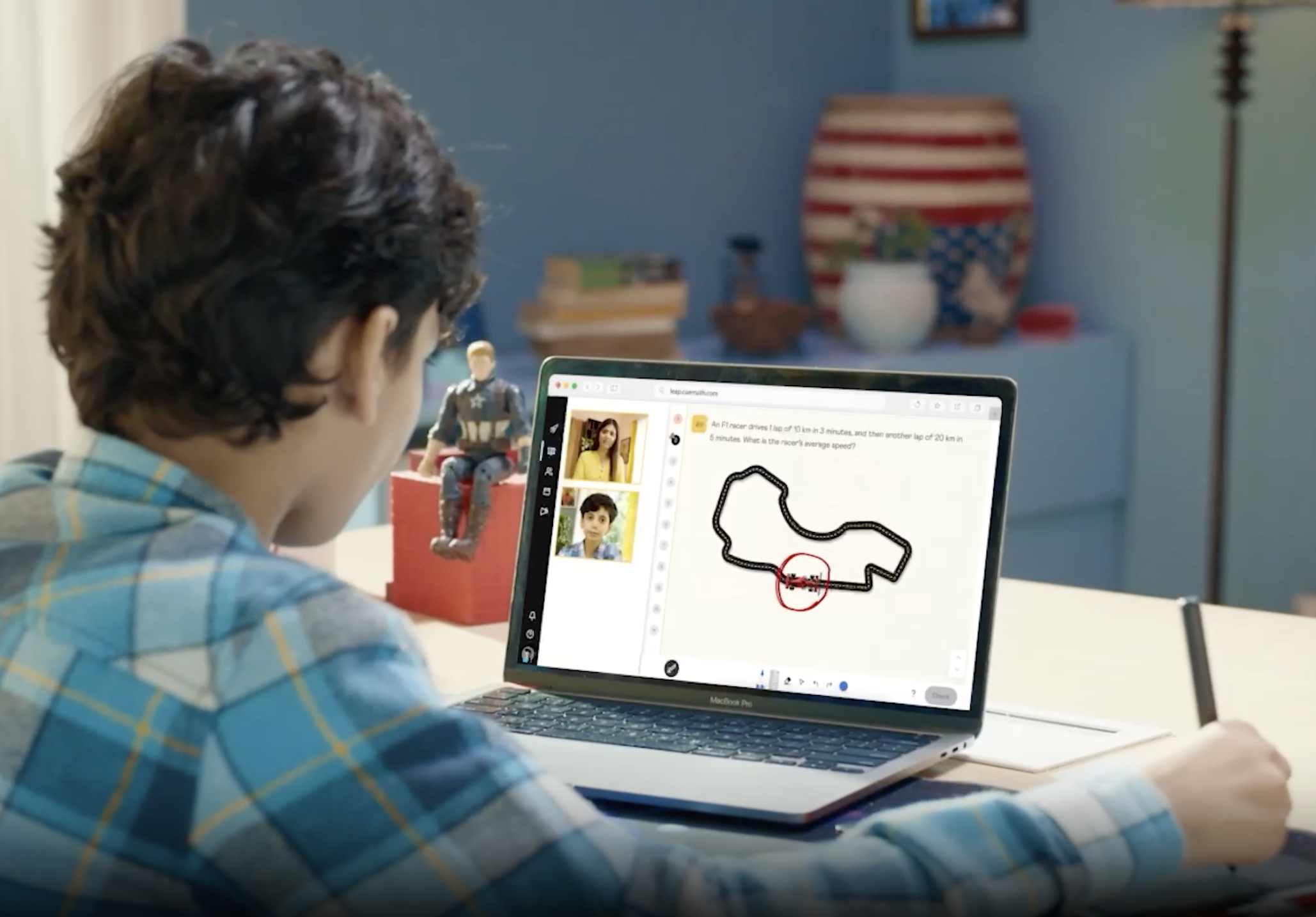
Cuemath tutors teach the standard algorithm by linking each step to the strategy your child already knows, so your child can say what every digit means. A worksheet only shows whether the answer is right. A tutor sees the exact step where your child loses a place value, like the missing 0 in the second row.
| How Cuemath helps | What it means for your child |
|---|---|
| How it works | In a 1:1 live class, the tutor writes a problem like 46 × 27 on the Cueboard (Cuemath's shared digital whiteboard). Your child solves it with partial products, then with the standard algorithm, and explains which partial products make each row. Cuemath calls this “cue, don't tell.” The tutor asks questions instead of giving the answer. |
| Who it helps | Grade 4–6 kids who get the steps right on Monday and wrong on Friday, kids who learned the algorithm at home and now struggle with the school's models, and Grade 3 kids who still count on fingers for multiplication facts. |
| What it won't fix by itself | If your child only needs more practice with steps they already understand, the worksheets above and a few minutes of daily fact practice are faster than a class. |
| Verdict | For a child who keeps losing place values in the algorithm, one-on-one practice that links each row to its partial products fixes the cause, not just the answer. Cuemath classes start at $15/class for K–2 and $20/class for Grades 3–7 on the 12-month plan. Meet Cuemath's Grade 4, Grade 5 and Grade 6 math tutors, or see how Grade 5 online math classes work. |
Cuemath has a 4.9 out of 5 rating on Trustpilot from 12,000+ reviews. Here's what US parents say:
Find the Exact Step Where Your Child Gets Stuck
In a free 1:1 evaluation, a Cuemath tutor checks your child's facts, place value and the algorithm for their grade, then shows you what to practice next.
Book a Free Evaluation100% free · No credit card · About 30 minutes
Between lessons, your child can practice times-table facts for a few minutes a day in the free Cuemath App.
Keep Exploring: The New Math Series
- What Is Subitizing? (Kindergarten)
- What Are Number Bonds? (Grade 1)
- Ten Frame Addition (Grade 1)
- Subtraction on a Number Line (Grade 2)
- What Is Expanded Form? (Grades 2 to 4)
- The Commutative Property (Grades 1 to 3)
- The Associative Property (Grades 1 to 3)
- The Distributive Property (Grade 3)
- Area Model Multiplication (Grade 4)
- The Box Method (Grade 4)
- Partial Products (Grade 4)
- The Lattice Method (Grades 4 to 5)
- New Math vs Old Math
FAQs
What is the standard algorithm?
The standard algorithm is the written, step-by-step method for adding, subtracting, multiplying or dividing multi-digit numbers: line up the numbers, work one place value at a time, and carry or borrow when needed. It's the method most parents learned in school. For example, the standard algorithm for 46 × 27 gives two rows, 322 and 920, which add to 1,242.
When do kids learn the standard algorithm?
Kids learn the standard algorithm in Grade 4 for addition and subtraction, Grade 5 for multiplication and Grade 6 for long division, under Common Core standards 4.NBT.B.4, 5.NBT.B.5 and 6.NS.B.2. Texas starts sooner: multiplication in Grade 3 and long division in Grade 4.
What is the standard algorithm in 5th grade?
In 5th grade, the standard algorithm means multiplying multi-digit whole numbers one digit at a time, like 46 × 27 = 1,242. Common Core standard 5.NBT.B.5 expects fifth graders to do this fluently. Fifth graders still divide with strategies like partial quotients; long division with the standard algorithm comes in Grade 6.
When do kids learn multiplication?
Kids start multiplication in Grade 2 by adding the rows of arrays (3 + 3 + 3 + 3 = 12) and learn it as multiplication in Grade 3, at about age 8. By the end of Grade 3, Common Core expects them to know all facts up to 10 × 10 from memory (3.OA.C.7).
What grade do kids learn multiplication?
Kids learn multiplication in Grade 3 under Common Core: what 5 × 7 means (3.OA.A.1), the properties that help find facts (3.OA.B.5), and all facts up to 10 × 10 from memory (3.OA.C.7). Multi-digit multiplication follows in Grade 4 with area models and partial products, and the standard algorithm in Grade 5.
Do 1st graders learn multiplication?
No, 1st graders don't learn multiplication under Common Core. Grade 1 covers adding and subtracting within 20 and adding within 100 with models. Counting by 2s, 5s and 10s at home is a good warm-up for multiplication later.
Is there multiplication in 2nd grade?
Yes, 2nd graders start the idea of multiplication without the × sign. Common Core 2.OA.C.4 asks them to find the total in an array of up to 5 rows and 5 columns by adding equal groups, like 4 + 4 + 4 = 12.
What grade do kids learn long division?
Kids learn long division with the standard algorithm in Grade 6 under Common Core (6.NS.B.2). They divide with strategies like partial quotients in Grade 4 (by 1-digit numbers) and Grade 5 (by 2-digit numbers) first. In Texas, long division by a 1-digit number starts in Grade 4.
Why don't schools teach the standard algorithm first anymore?
Schools teach strategies first because Common Core asks Grade 4 and 5 students to “illustrate and explain” multiplication and division with arrays, area models or equations. The standard algorithm hides the place values, so a child who learns it first may get 414 for 46 × 27 and not see that the answer is far too small.
Can my child use the standard algorithm if the teacher taught a different method?
Your child can use the standard algorithm at home to check answers, but on homework they should use the method the teacher asked for. In Grades 4 and 5, many questions grade the model or explanation, not just the answer. If you're not sure, ask the teacher.
Is the standard algorithm the “old way” of doing math?
Yes, the standard algorithm is the “old way” most parents learned, and schools still teach it. Common Core moved it later (Grades 4 to 6) and added strategies like the area model and partial products before it. Our guide to new math vs. old math compares the two side by side.
How can I help my child learn the standard algorithm at home?
Help your child learn the standard algorithm by checking that they know the strategy for their grade first, then practicing a few problems a day and asking them to estimate before they solve. If they can say what each row or carried digit means, they understand it. The worksheets in this guide check answers instantly, and Cuemath's free evaluation shows the exact step where your child gets stuck.
Sources
- Common Core Grade 1 NBT: 1.NBT.C.4, adding within 100 with models
- Common Core Grade 2 OA: 2.OA.C.4, adding the rows of arrays
- Common Core Grade 2 NBT: 2.NBT.A.2 and 2.NBT.B.7, skip-counting and adding within 1,000
- Common Core Grade 3 OA: 3.OA.A.1, 3.OA.B.5 and 3.OA.C.7, multiplication and facts from memory
- Common Core Grade 3 NBT: 3.NBT.A.2, “strategies and algorithms” within 1,000
- Common Core Grade 4 NBT: 4.NBT.B.4 to B.6, the addition and subtraction algorithm, multiplying and dividing with models
- Common Core Grade 5 NBT: 5.NBT.B.5 to B.7, the multiplication algorithm, dividing by 2-digit numbers, decimals
- Common Core Grade 6 NS: 6.NS.B.2 and 6.NS.B.3, long division and decimals
- Texas TEKS Grade 3 (19 TAC §111.5): TEKS 3.4F and 3.4G, Texas Grade 3 facts and multiplication algorithm
- Texas TEKS Grade 4 (§111.6): TEKS 4.4A, 4.4D and 4.4F, Texas Grade 4 algorithms
- Texas TEKS Grade 5 (§111.7): TEKS 5.3B and 5.3C, Texas Grade 5 algorithms
- TEA: Mathematics TEKS: Texas K–8 math TEKS in use since the 2014–15 school year
- Cuemath on Trustpilot: 4.9/5 from 12,000+ reviews

I was never the kid who loved math. I was much more interested in books, stories, and writing, and, somewhere along the way, I became even more curious about people. Why do we learn differently? Why does something make sense to one child but not another? And what makes a student feel confident enough to keep trying?
That curiosity led me to study Applied Psychology, where I learned more about how children think, learn, and make sense of the world around them.
My love for writing did the rest. What started as something I simply enjoyed became a career. Over the past five years, I've worked as a freelance writer across edtech, SaaS, B2B, travel, lifestyle, and healthcare, learning how to write for very different audiences without losing the human side of the story.
Today, I'm an SEO Content Writer & Editor at Cuemath, where I get to bring many of these interests together. Working in education, and especially around math, has made me even more curious about what happens behind the screen or textbook: what parents worry about, what students struggle with, and what actually helps them learn.
That's also how I like to research. I don't just look at search results and call it a day. I go where parents and students actually talk: forums, reviews, communities, and conversations with real families. Because sometimes the most useful insight isn't hiding in a keyword; it's in a parent's question, a student's frustration, or a small detail someone shares about their learning experience.
I write because I'm curious. I research because I want to understand. And I love turning what I learn into content that feels genuinely useful to the people reading it.