The SAT Is Adding a Science Score in 2027: What Parents Need to Know
The SAT still has no science section, but College Board will report a new Science Practices and Foundations score starting in spring 2027. Here's what it measures, who receives it, and why it doesn't change the score colleges see.

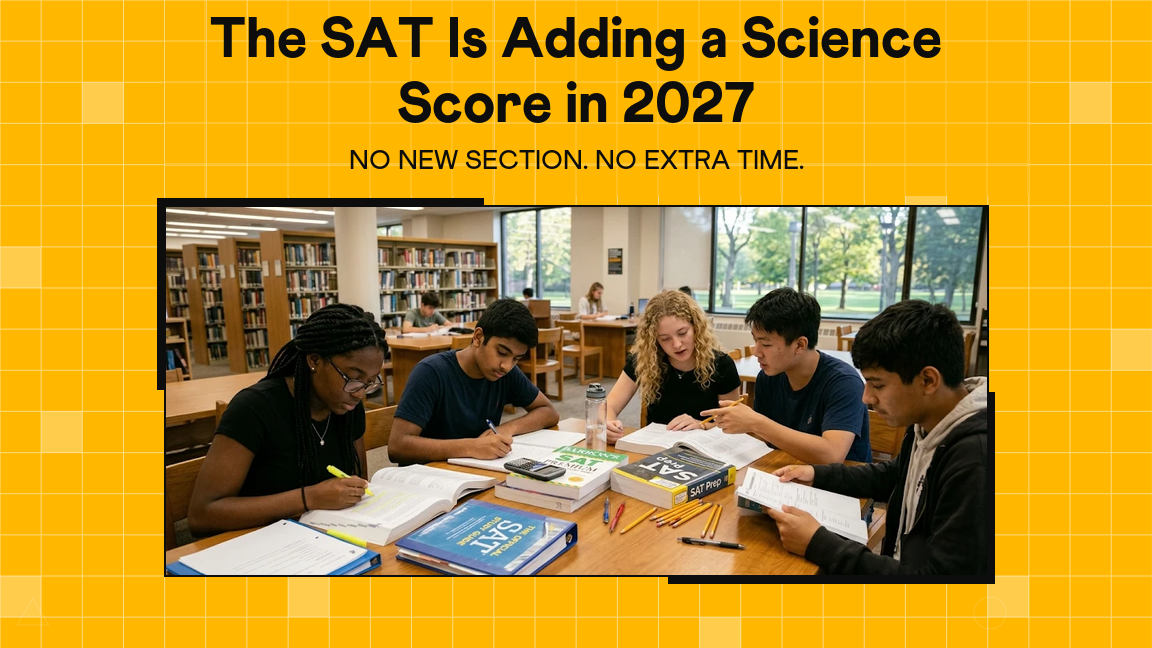
The SAT is preparing for another significant change in 2027, and this time, science is in the spotlight. With a new science score expected to become part of the testing landscape, students and parents may be wondering what this means for college admissions, test preparation, and academic planning. Will students need to prepare for an entirely new section? How will science performance be evaluated? And could this change influence college application decisions? As the SAT continues to evolve, understanding these updates early can help families make informed decisions. Here’s what you need to know about the upcoming science score, how it could affect students, and how to prepare for the changes ahead.
Key Takeaways
- There's still no science section on the SAT. The test keeps its two sections, Reading and Writing and Math.
- From spring 2027, score reports can include a Science Practices and Foundations score, on a scale of 65 to 95.
- College Board calculates this score from questions already on the test, so it adds no testing time.
- The score goes to your child's school, district and sometimes the state. It is not sent to colleges.
- The 400–1600 total and the two 200–800 section scores don't change.
- Does the SAT Have Science?
- What Is the New SAT Science Score?
- What Changes on the SAT in 2027, and What Doesn't
- Will Colleges See the SAT Science Score?
- When Does the SAT Science Score Start?
- Is It the Same as the Old Analysis in Science Score?
- How Should Students Prepare for the SAT Science Score?
- Frequently Asked Questions
- Sources
Does the SAT Have Science?
No, the SAT does not have a separate science section. It has two sections, Reading and Writing and Math, and science shows up inside both:
The SAT's Two Sections and Where Science Shows Up
| Section | Time | Questions | Where science appears |
|---|---|---|---|
| Reading and Writing | 64 minutes | 54 | Passages come from literature, history/social studies, the humanities and science |
| Math | 70 minutes | 44 | About 30% of questions are word problems set in a science, social studies or real-world scenario |
| Total | 2 hours 14 minutes | 98 | No separate science section |
The new score in 2027 counts those existing questions a second time. It doesn't add new ones. If your teen is choosing between tests, the ACT is the one with a science section; our SAT vs. ACT Math guide compares the math on both.
What Is the New SAT Science Score?
The new SAT science score is called Science Practices and Foundations, and College Board will report it on a scale of 65 to 95. College Board says it measures two things:
- how well a student applies common science practices
- how well a student uses the math skills that science depends on
College Board calculates the score from existing reading and writing and math questions. The SAT testing rules put it plainly: the score is "not from a new test section, so it adds no testing time."
The testing rules also say a score report "may include" this score. College Board hasn't said whether every student's report will show it, so check your child's report after a spring 2027 test.
What Changes on the SAT in 2027, and What Doesn't?
Only the score report changes. The test your child sits for in spring 2027 has the same sections, timing, and scoring as the test in fall 2026.
The SAT Before and After Spring 2027
| Fall 2026 tests | Spring 2027 tests onward | |
|---|---|---|
| Sections | Reading and Writing, Math | Same. No science section |
| Testing time | 2 hours 14 minutes | Same |
| Total score | 400–1600 | Same |
| Section scores | 200–800 each | Same |
| Science score | None | Science Practices and Foundations, 65–95 |
| Who gets the science score | — | School, district, sometimes the state. Not colleges |
Will Colleges See the SAT Science Score?
No. College Board's SAT testing rules say the science score "will not be sent to colleges and universities." It goes to your child's school and district, and in some cases to the state.
When your child sends SAT scores to colleges, the colleges get the same scores they get today: the 400–1600 total and the two section scores. To see where a score stands, read our guide to what a good SAT score is in 2026.
So who is the score for? College Board announced it on its page for schools and districts. That page describes it as a signal of students' readiness for further learning and work in science. Schools and states that give the SAT during the school day (SAT School Day) are the main users.
When Does the SAT Science Score Start?
The SAT science score starts with the spring 2027 tests. College Board's 2026–27 score report layout says it will be reported "starting with spring 2027 administrations." The Fall 2026 tests (October 3, November 7, and December 5) come before that.
First SAT Tests That Can Report the Science Score
| Spring 2027 SAT | Register by | Late registration and changes by |
|---|---|---|
| March 6, 2027 | February 19, 2027 | February 23, 2027 |
| May 1, 2027 | April 16, 2027 | April 20, 2027 |
| June 5, 2027 | May 21, 2027 | May 25, 2027 |
| SAT School Day | Testing window March 1 – April 30, 2027 | The school or district registers students |
Most students who take the SAT as juniors in spring 2027 are in the Class of 2028, so they'll be the first big group to see the score. For score release dates and retake timing, see SAT Scores 2026.
Testing in Spring 2027? Start With a Free SAT Math Check
A Cuemath math expert finds the exact math concepts your teen needs to work on, months before the March 6 SAT.
Book a Free Evaluation100% free · No credit card · About 30 minutes
Is It the Same as the Old Analysis in Science Score?
No. The old Analysis in Science score was a cross-test score on the paper SAT, reported on a 10–40 scale. The digital SAT doesn't report it.
The new Science Practices and Foundations score is different in two ways:
Old vs New SAT Science Score
| Analysis in Science (old) | Science Practices and Foundations (new) | |
|---|---|---|
| Which SAT | Paper SAT | Digital SAT, from spring 2027 |
| Score type | Cross-test score | Cross-section score, from the digital SAT's Reading and Writing and Math questions |
| Scale | 10–40 | 65–95 |
| Reported now? | No. The digital SAT doesn't report it | Yes, from spring 2027 tests |
So a 30 on the old scale and a 90 on the new one can't be compared.
How Should Students Prepare for the SAT Science Score?
Students don't need to study anything extra for the SAT science score. It comes from the same questions that produce the reading and writing and math scores, so regular SAT prep covers it. There's no biology, chemistry, or physics to memorize.
College Board hasn't published which questions count toward the science score. Its description (science practices plus the math science depends on) points to skills that already matter on the test:
SAT Skills Behind the Science Score
| Skill | Where it shows up on the SAT |
|---|---|
| Reading charts, tables and graphs | Problem-Solving and Data Analysis is one of the four SAT Math areas, with 5–7 questions |
| Word problems in a science setting | About 30% of SAT Math questions are set in a science, social studies or real-world scenario |
| Ratios, rates, percentages and units | Science word problems on the test use these |
| Short science passages | The Reading and Writing section includes science passages that ask what the evidence supports |
A student who is shaky on these loses points on the 400–1600 score now, whatever happens with the science score. Cuemath's SAT Math prep works on these skills one-on-one, and the free SAT Math practice curriculum has practice for each of the four Math areas.
Cuemath students have done this before: read how Vanya scored 1530 with a 790 in math and how another student scored 790 in math on his first attempt.
Find the SAT Math Gaps That Cost Points
A Cuemath math expert runs a free 1:1 evaluation that shows exactly which concepts your teen is missing, from data and graphs to algebra, before the spring 2027 SAT.
Book a Free Evaluation100% free · No credit card · About 30 minutes
More on the SAT:
- What Is a Good SAT Score in 2026?
- SAT Scores 2026: Results, Release Dates & What Students Need to Know
- SAT Prep Tips 2026: 10 Expert Strategies
Frequently Asked Questions
Does the SAT have science?
No, the SAT has no science section. Science appears inside the Reading and Writing and Math sections, and from spring 2027, College Board will report a separate science score built from those questions.
Does the SAT have a science section in 2027?
No, the SAT does not have a science section in 2027. The test keeps its two sections and its 2 hours 14 minutes of testing time; only the score report adds a science score.
What is the SAT science score?
The SAT science score is the Science Practices and Foundations score, reported on a 65–95 scale from spring 2027. It measures how well a student applies common science practices and the math skills science relies on.
Do colleges see the SAT science score?
No, colleges don't see the SAT science score. College Board's testing rules say it "will not be sent to colleges and universities"; it goes to the student's school, district, and sometimes the state.
Does the science score change the 1600 SAT score?
No, the science score doesn't change the 400–1600 total. The total and the two 200–800 section scores stay the same, and the science score is reported separately.
When will students first get an SAT science score?
Students can first get an SAT science score from the spring 2027 tests: March 6, May 1, and June 5, 2027, plus SAT School Day from March 1 to April 30, 2027. Fall 2026 tests come before the change.
Is the SAT science score the same as the old Analysis in Science score?
No, the new score isn't the old Analysis in Science score. The old one was a 10–40 cross-test score on the paper SAT; the new one uses a 65–95 scale on the digital SAT.
Does my child need to study science for the SAT?
No, your child doesn't need to study science content for the SAT. The science score comes from existing questions, so practicing data, graphs, and science word problems in regular SAT prep covers it. Cuemath's SAT Math tutors work on these skills as part of SAT Math prep.
Sources
- College Board: SAT Testing Rules (Science Practices and Foundations score; not sent to colleges)
- College Board: Electronic Score Report Data Layout 2026–27, PDF (spring 2027 start; 65–95 scale; old Analysis in Science 10–40)
- College Board: Why Offer the SAT? For Schools & Districts (Coming in 2027: Science Score)
- College Board: SAT Test Dates and Deadlines (spring 2027 dates; SAT School Day window)
- College Board: How the SAT Is Structured (sections, timing, question counts)
- College Board: The Reading and Writing Section (science passages)
- College Board: The Math Section Overview (questions in context; Problem-Solving and Data Analysis)

I was never the kid who loved math. I was much more interested in books, stories, and writing, and, somewhere along the way, I became even more curious about people. Why do we learn differently? Why does something make sense to one child but not another? And what makes a student feel confident enough to keep trying?
That curiosity led me to study Applied Psychology, where I learned more about how children think, learn, and make sense of the world around them.
My love for writing did the rest. What started as something I simply enjoyed became a career. Over the past five years, I've worked as a freelance writer across edtech, SaaS, B2B, travel, lifestyle, and healthcare, learning how to write for very different audiences without losing the human side of the story.
Today, I'm an SEO Content Writer & Editor at Cuemath, where I get to bring many of these interests together. Working in education, and especially around math, has made me even more curious about what happens behind the screen or textbook: what parents worry about, what students struggle with, and what actually helps them learn.
That's also how I like to research. I don't just look at search results and call it a day. I go where parents and students actually talk: forums, reviews, communities, and conversations with real families. Because sometimes the most useful insight isn't hiding in a keyword; it's in a parent's question, a student's frustration, or a small detail someone shares about their learning experience.
I write because I'm curious. I research because I want to understand. And I love turning what I learn into content that feels genuinely useful to the people reading it.