What Is the PSAT Test? Format, Scores, and What Your Child's Score Means
The PSAT test is a practice SAT, and for juniors it is also the entry test for National Merit. This blog covers the three versions of the PSAT, how to register, what's on the test, what to bring on test day, how PSAT scores work, and how to prepare, with three practice questions to try at home.

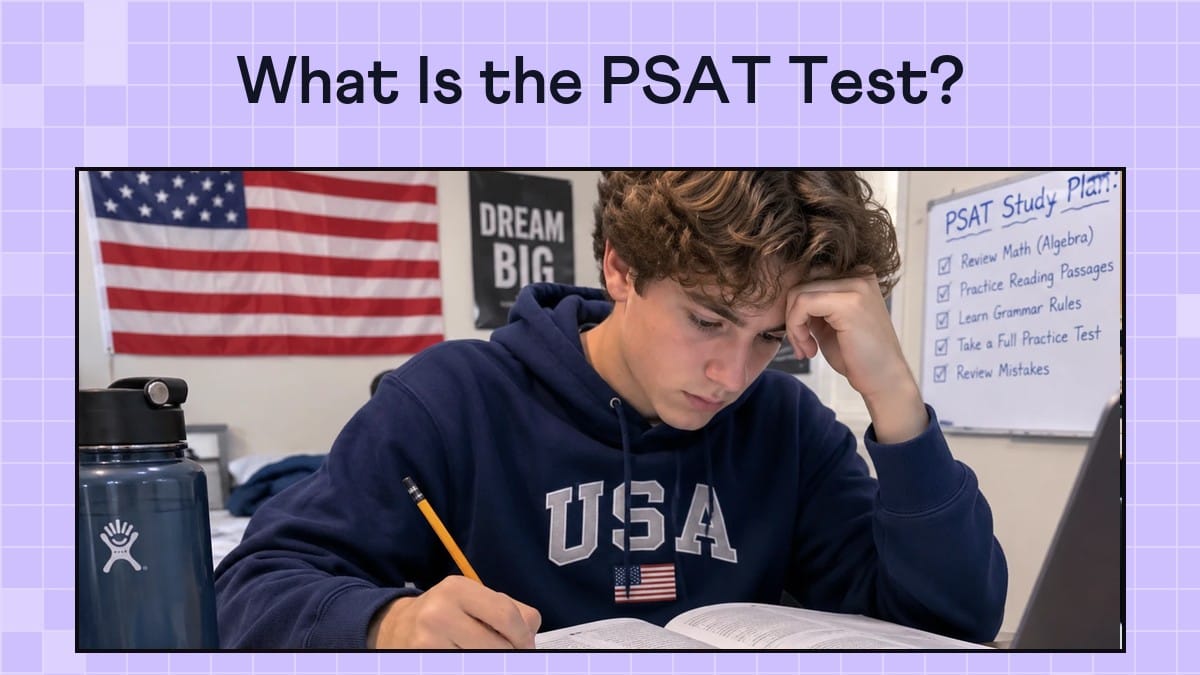
The PSAT is an important milestone in your child’s academic journey, offering an opportunity to experience the SAT format, assess college readiness, and identify areas for improvement before taking the actual exam.
But what exactly is the PSAT, who should take it, and what do the scores tell you about your child’s academic progress?
The College Board offers three versions of the PSAT for students in grades 8 through 11, each designed to match different stages of learning. This blog covers everything parents need to know, from the digital test format, subjects, and registration process to test-day requirements and score interpretation. Whether your child is taking the PSAT for the first time or preparing for the PSAT/NMSQT and potential National Merit recognition, understanding the test can help you support their preparation and plan their next steps with confidence.
Key Takeaways
- The PSAT is College Board's practice SAT. It comes in three versions: PSAT 8/9, PSAT 10, and PSAT/NMSQT.
- All three last 2 hours 14 minutes, have 98 questions, run on the Bluebook app, and include a built-in Desmos calculator for all of Math.
- The PSAT/NMSQT and PSAT 10 are scored from 320 to 1520. The PSAT 8/9 is scored from 240 to 1440.
- In the 2024–25 school year, the average PSAT score was 998 for 11th graders and 911 for 10th graders.
- Only the PSAT/NMSQT taken in 11th grade counts for National Merit. Juniors needed a Selection Index of 208 to be named Commended Students in the class of 2027.
- Colleges never see PSAT scores. The PSAT is practice, a benchmark, and a scholarship screen.
- What Is the PSAT Test?
- Which PSAT Should Your Child Take in Each Grade?
- How to Register for the PSAT
- What's on the PSAT? Format and Timing
- What Math Is on the PSAT?
- PSAT Test Day: What to Bring
- Try 3 PSAT-Style Math Questions
- How PSAT Scores Work
- What Is a Good PSAT Score?
- What Does Your Junior's PSAT Score Mean?
- PSAT Scores and National Merit: How the Selection Index Works
- When Do PSAT Scores Come Out?
- PSAT vs SAT: What's Different?
- Does a PSAT Score Predict Your SAT Score?
- PSAT Myths vs Facts
- How to Prepare for the PSAT
- Frequently Asked Questions
- Sources
What Is the PSAT Test?
The PSAT (Preliminary SAT) is a College Board test that measures the same reading, writing, and math skills as the SAT for students in 8th through 11th grade. Schools give it during the school day, and there are three versions. Each one is built for a different grade.
The Three PSATs at a Glance
| PSAT 8/9 | PSAT 10 | PSAT/NMSQT | |
|---|---|---|---|
| Who takes it | 8th and 9th graders | 10th graders | 10th and 11th graders (mostly juniors) |
| When | Fall or spring (the school picks) | Spring: March 1–April 30, 2027 | Fall: October 1–30, 2026 |
| Score range | 240–1440 | 320–1520 | 320–1520 |
| Counts for National Merit? | No | No | Yes, in 11th grade only |
The PSAT isn't required, and colleges never see the scores. Families use it for three things: a practice run for the SAT, a check on whether a student is on track for their grade, and, in 11th grade, a shot at National Merit.
Which PSAT Should Your Child Take in Each Grade?
A student can take a PSAT in every grade from 8th to 11th, and each year's test does a different job. Only the PSAT/NMSQT in 11th grade counts for National Merit.
PSAT Roadmap: 8th to 11th Grade
| Grade | Test | When | What it's for |
|---|---|---|---|
| 8th | PSAT 8/9 | Fall or spring (the school picks) | A first look at the format. The 8th-grade benchmarks are 390 Reading and Writing and 430 Math. |
| 9th | PSAT 8/9 | Fall or spring (the school picks) | A check on a year of growth against the 9th-grade benchmarks (410 and 450). |
| 10th | PSAT 10 or PSAT/NMSQT | Spring (PSAT 10) or October (PSAT/NMSQT) | A practice run for National Merit. The score doesn't count, but it shows what to fix before 11th grade. |
| 11th | PSAT/NMSQT | October | The National Merit entry test, and the last PSAT before the SAT. |
How to Register for the PSAT
Students register for the PSAT through their school, not through College Board. Ask the school counselor which version the school offers, on which day, and whether your child needs to sign up.
PSAT Registration at a Glance
| What to know | Details |
|---|---|
| Cost | The 2026 PSAT/NMSQT costs $18. Many districts and schools cover part or all of it, and some schools add their own fee for running the test. |
| Homeschooled students | Use College Board's in-school assessment search to find a nearby school that gives the PSAT, then contact that school at least 4 weeks before the testing window opens to be added to its registration list. The same steps apply to students testing at a different school. |
| Accommodations | Students approved by College Board's Services for Students with Disabilities (SSD) share their SSD number when they register. |
| Testing windows | The fall 2026 PSAT/NMSQT window ran October 1–30, 2026. The spring PSAT 10 and PSAT 8/9 window is March 1–April 30, 2027. |
What's on the PSAT? Format and Timing
Every PSAT, including the PSAT 8/9, lasts 2 hours 14 minutes and has 98 questions in two sections: reading and writing first, then math. Your child takes it on a laptop or tablet in College Board's Bluebook app.
PSAT Format and Timing
| Section | Modules | Time | Questions |
|---|---|---|---|
| Reading and Writing | 2 modules of 27 questions | 64 minutes (32 + 32) | 54 |
| Break | — | 10 minutes | — |
| Math | 2 modules of 22 questions | 70 minutes (35 + 35) | 44 |
| Total | 2 hours 14 minutes | 98 |
Three things about the digital PSAT surprise parents who took the paper version:
- The second module adapts. Every student gets a mixed first module in each section. How your child does on it decides whether the second module is easier or harder, and the harder second module opens up the higher scores.
- A calculator is built in for all of math. Bluebook includes the Desmos graphing calculator. Your child can also bring an approved calculator.
- Some questions don't count. Each module includes 2 unscored test questions that College Board is trying out. Your child can't tell which ones they are, so every question deserves full effort.
What Math Is on the PSAT?
PSAT Math covers four areas. Algebra and advanced math together make up about two-thirds of the section, so those topics move the score the most.
| Math area | Share of PSAT/NMSQT and PSAT 10 Math | What it looks like |
|---|---|---|
| Algebra | About 35% | Linear equations, inequalities, and systems; word problems that turn into one equation |
| Advanced Math | About 32.5% | Quadratics, exponents, functions, and nonlinear equations |
| Problem-Solving and Data Analysis | About 20% | Percents, ratios, rates, units, and reading tables and graphs |
| Geometry and Trigonometry | About 12.5% | Area, volume, angles, triangles, circles, and right-triangle trig |
- About 1 in 4 math questions has no answer choices. Your child types in the answer, so guessing doesn't help on those.
- The PSAT 8/9 has the same four areas but more algebra and no trigonometry.
- The Reading and Writing section uses short passages, each with one question, and covers four areas: Craft and Structure, Information and Ideas, Standard English Conventions (grammar), and Expression of Ideas.
PSAT Test Day: What to Bring
On PSAT test day, your child needs a fully charged device with the Bluebook app already installed and set up, plus a pen or pencil. Students testing at a school other than their own also need a valid photo ID.
- A charged laptop or tablet with Bluebook installed and exam setup done (required). The battery should last about 3 hours. Some schools lend devices, so ask first.
- A pen or pencil for scratch work (required).
- A valid photo ID, required only for students testing at a school that isn't their own.
- An approved calculator (optional). Bluebook has Desmos built in, but your child can bring a handheld calculator they know well, plus spare batteries.
- Snacks and a drink (optional). They stay under the desk during testing; the 10-minute break is the time to use them.
Inside Bluebook, your child can mark questions to come back to within a module, and a countdown timer gives an alert when 5 minutes are left. Trying Bluebook's practice test at home first means none of this is new on the day.
Try 3 PSAT-Style Math Questions.
Here are three questions in the style of the PSAT Math section, one from each of the three biggest areas. These questions are for practice, as they aren't official College Board questions, but each one hides the kind of trap that costs students points on test day. Give your child about 95 seconds per question, the PSAT pace (35 minutes for 22 questions), and let them answer before tapping Reveal the answer.
A bowling alley charges $6 for shoe rental plus $4.50 for each game. Ava spent $28.50 in total. How many games did she bowl?
A) 4 B) 5 C) 6 D) 7
Reveal the answer
Answer: B) 5
How to solve it: Write one equation: 6 + 4.50g = 28.50. Subtract the $6 first: 4.50g = 22.50, so g = 5.
The trap: Dividing $28.50 by $4.50 gives about 6.3, which pulls students toward C. The $6 shoe rental has to come out before you divide.
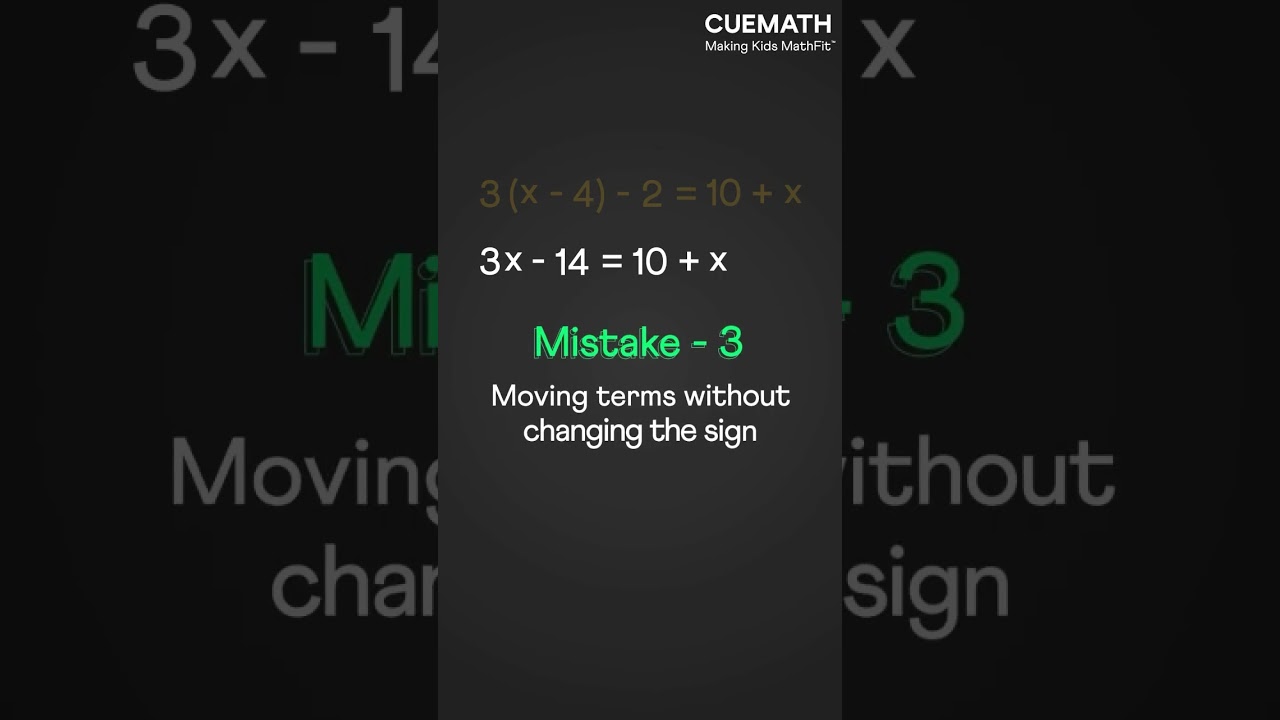
▶ Watch on YouTube: linear equations, step by step (about 1 minute)
A hoodie costs $60. The store takes 20% off, and then takes another 10% off the sale price at checkout. What is the final price?
A) $42.00 B) $43.20 C) $45.00 D) $48.00
Reveal the answer
Answer: B) $43.20
How to solve it: 20% off $60 leaves $48 (60 × 0.80). Then 10% off $48 leaves $43.20 (48 × 0.90).
The trap: Adding the discounts to get 30% off gives $42, choice A. The second discount comes off the sale price, not the original price.
x² − 7x + 10 = 0. What is the sum of the solutions?
Type your answer: ______
Reveal the answer
Answer: 7
How to solve it: Factor: (x − 2)(x − 5) = 0, so x = 2 or x = 5, and 2 + 5 = 7. On the PSAT, your child can also graph y = x² − 7x + 10 in Desmos and read the two x-intercepts.
The trap: Stopping at one solution (2 or 5), or typing −7. The question asks for the sum of both.
How did your child do? Three right at the PSAT pace means the core skills are in place, and timed practice tests are the next step. One or two right points usually point to a specific gap, such as setting up equations or working with percents, and finding that gap is faster than redoing every topic.
Want free practice first? Try our free SAT Math practice curriculum. It covers the same math as the PSAT.
How PSAT Scores Work
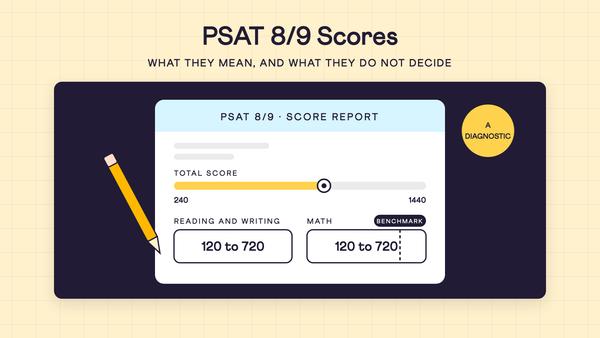
The PSAT/NMSQT and PSAT 10 give your child two section scores from 160 to 760, one for reading and writing and one for math, and a total from 320 to 1520. The PSAT 8/9 uses a lower scale: 120 to 720 per section and 240 to 1440 in total.
PSAT Score Ranges
| Test | Each section | Total score |
|---|---|---|
| PSAT 8/9 | 120–720 | 240–1440 |
| PSAT 10 | 160–760 | 320–1520 |
| PSAT/NMSQT | 160–760 | 320–1520 |
| SAT (for comparison) | 200–800 | 400–1600 |
College Board puts the SAT, PSAT/NMSQT, PSAT 10, and PSAT 8/9 on one connected score scale, so your child can track growth from one test to the next. A 1150 on the PSAT and a 1150 on the SAT a year later mean your child held steady, not that they stalled.
Your child's score report shows:
- Total score and the two section scores, with percentiles that compare your child with other students in the same grade.
- Benchmark indicators that show whether each section score meets the College Board's benchmark for your child's grade.
- The NMSC Selection Index (PSAT/NMSQT only), the number National Merit uses. We explain it below.
What Is a Good PSAT Score?
A good PSAT score meets College Board's benchmark for your child's grade in both sections or beats the national average: 998 for 11th graders and 911 for 10th graders in the 2024–25 school year. College Board sets a benchmark for each grade that shows whether a student is on track for college-level work.
PSAT Benchmarks and Average Scores by Grade
| Grade | Test | Reading and Writing benchmark | Math benchmark | Average total (2024–25) |
|---|---|---|---|---|
| 8th | PSAT 8/9 | 390 | 430 | See our PSAT 8/9 blog |
| 9th | PSAT 8/9 | 410 | 450 | See our PSAT 8/9 blog |
| 10th | PSAT 10 or PSAT/NMSQT | 430 | 480 | 911 |
| 11th | PSAT/NMSQT | 460 | 510 | 998 |
Meeting both benchmarks is harder than it sounds. In 2024–25, 40% of 11th graders and 34% of 10th graders met the benchmark in both sections. Math was the harder one: 67% of juniors met the reading and writing benchmark, but only 42% met the math benchmark.
What Does Your Junior's PSAT Score Mean?
| Total score (11th grade) | What it means | A good next step |
|---|---|---|
| Below 970 | At least one section is under the 11th-grade benchmark (460 Reading and Writing, 510 Math). | Look at the two section scores and start with the one under its benchmark. |
| 970–1099 | Around the national junior average of 998. If both sections clear their benchmarks, your child is on track. | Take a full-length practice test to find the weakest math area. |
| 1100–1299 | Well above the junior average. | Target the harder second modules: Advanced Math and multi-step word problems. |
| 1300–1379 | Strong. Close to National Merit range in many states. | Check the Selection Index, not just the total (see below). |
| 1380 and up | Near or above the 2027 Commended cutoff (Selection Index 208), depending on the section split. | Compare the Selection Index with your state's Semifinalist cutoff. |
PSAT Scores and National Merit: How the Selection Index Works
National Merit doesn't use your child's total PSAT score. It uses the Selection Index, which counts reading and writing twice: (2 × Reading and Writing + Math) ÷ 10. The Selection Index runs from 48 to 228, and only scores from the PSAT/NMSQT taken in 11th grade count.
A worked example
A junior scores 700 in Reading and Writing and 680 in Math, for a total of 1380.
Selection Index = (2 × 700 + 680) ÷ 10 = (1,400 + 680) ÷ 10 = 208, exactly the national Commended cutoff for the class of 2027.
Flip the scores (680 Reading and Writing, 700 Math) and the total stays 1380, but the Selection Index drops to 206. Because Reading and Writing counts twice, the split matters as much as the total.
Here is how the class of 2027 played out (juniors who took the PSAT/NMSQT in October 2025):
- About 1.25 million students entered the program (1,254,659 from 18,403 schools).
- About 50,000 high scorers were recognized.
- About 34,000 of them became Commended Students. The national cutoff was a selection index of 208.
- 16,230 became semifinalists. Each state has its own cutoff, from 208 in Alaska, Montana, North Dakota, West Virginia, and Wyoming to 223 in New Jersey and Washington, D.C.
National Merit Semifinalist Cutoffs, Class of 2027 (Selected States)
| State | Semifinalist cutoff |
|---|---|
| New Jersey | 223 |
| Massachusetts | 221 |
| Washington | 221 |
| California | 220 |
| New York | 220 |
| Texas | 219 |
| Illinois | 218 |
| Georgia | 217 |
| Florida | 216 |
| Ohio | 216 |
- Cutoffs change every year.
- Juniors who took the PSAT/NMSQT in October 2026 are competing in the 2028 program.
- NMSC notifies semifinalists through their schools in September 2027, and commended students hear in late September 2027.
- A sophomore who takes the PSAT/NMSQT gets practice and a score report but must take it again as a junior to enter National Merit.
- The PSAT can also open a second door. College Board's National Recognition Program gives awards (for first-generation students, students from rural areas and small towns, and others) to 10th and 11th graders who take the PSAT/NMSQT, PSAT 10, or AP Exams and meet the program's requirements. If your child takes AP classes, our blog on the AP Exam schedule for 2027 has the May dates.
When Do PSAT Scores Come Out?
PSAT/NMSQT Fall 2026 scores are already out. They came out between October 22 and November 12, 2026, depending on the day your child's school gave the test. Your child can see them by signing in at College Board's student score site or in the BigFuture School app.
Fall 2026 PSAT/NMSQT Score Release Dates
| School tested by | Students saw scores on |
|---|---|
| October 9, 2026 | October 22, 2026 |
| October 23, 2026 | November 5, 2026 |
| October 30, 2026 | November 12, 2026 |
PSAT 10 and spring PSAT 8/9 tests run from March 1 to April 30, 2027, and College Board posts those score dates for each school's testing day. State testing programs can follow different dates, so check with your school if your child's scores aren't showing up.
PSAT vs SAT: What's Different?
The PSAT and SAT test the same skills in the same Bluebook app with the same structure. The difference is what the score does: the SAT goes to colleges, and the PSAT doesn't.
PSAT vs SAT
| PSAT/NMSQT | SAT | |
|---|---|---|
| Who takes it | 10th and 11th graders | Mostly 11th and 12th graders |
| Length | 2 hours 14 minutes, 98 questions | 2 hours 14 minutes, 98 questions |
| Score range | 320–1520 | 400–1600 |
| College-ready benchmark | 460 Reading and Writing, 510 Math (11th grade) | 480 Reading and Writing, 530 Math |
| Sent to colleges? | No, never | Yes, to the colleges your child picks |
| National Merit? | Yes, for juniors | No |
For most families, the PSAT works best as a free dress rehearsal for the SAT. A junior who sees a weak math score in November has months to fix it before a spring SAT. Our SAT Math prep page shows how Cuemath tutors use full-length digital SAT mock tests and Desmos strategies with high schoolers.
If your child is already looking ahead, our blog on SAT scores in 2026 covers score release dates and retakes, and the SAT adds a science score in 2027.
Does a PSAT Score Predict Your SAT Score?
- A PSAT score shows where your child stands on the SAT scale today, but it isn't an official SAT prediction.
- College Board puts the PSAT and SAT on one score scale, so there's no PSAT-to-SAT conversion chart to look up: a 1150 on the PSAT and a 1150 on the SAT mean the same level of skill.
- What changes is time. A junior who takes the PSAT/NMSQT in October often takes the SAT months later, and College Board's benchmarks expect growth in between: the 11th-grade PSAT benchmark is 460 reading and writing and 510 math, while the SAT benchmark is 480 and 530.
- The PSAT/NMSQT also tops out at 1520 (the PSAT 8/9 at 1440), so a student near the top needs the SAT to show a higher score.
PSAT Myths vs Facts
Parents hear a lot about the PSAT from other parents. Here are six common myths, checked against College Board's own rules.
How to Prepare for the PSAT
The fastest PSAT prep starts with one full-length practice test, then fixes the weakest topics one at a time. Here is the order that works:
- Take a free full-length practice test in Bluebook. College Board's practice tests adapt like the real PSAT and give your child a score. Take it timed, in one sitting.
- Find the weaker section. Compare each section score with the benchmark for your child's grade in the table above.
- Sort math mistakes by area. Algebra and advanced math make up about two-thirds of PSAT Math, so gaps there cost the most points. If algebra is the weak spot, our blog on the best algebra tutors compares online options.
- Practice with Desmos. Graphing an equation to find its x-intercepts (as in Question 3) takes seconds and catches algebra slips.
- Practice at test pace. That is about 71 seconds per reading and writing question and 95 seconds per math question.
- Juniors aiming for National Merit: start the summer before 11th grade. The 10th-grade PSAT is the best practice run, since only the junior-year score counts.
Where Cuemath fits: Cuemath is a math-only program, so it helps with the PSAT Math section, not Reading and Writing. A Cuemath tutor works one-on-one with your child twice a week, starting with the topics your child gets wrong (linear equations, percents, quadratics) and building up to full-length digital SAT mock tests. If math feels hard beyond the PSAT, our blog on online math tutoring for high school students who are struggling compares the options.
Real SAT results from Cuemath students
790/800 SAT Math on his first try
Scored 1520/1600 in Grade 10, with 730 in Reading and Writing, after learning with Cuemath since 2020.
Read the story →1530/1600 SAT, with 790/800 in Math
Joined Cuemath in 2020 and went on to AP Calculus BC and the AMC with her tutor, Iniyan MDR.
Read the story →Results as published in Cuemath's student stories. They are not typical of every child.
Free, with no pressure to join. Your child gets a 1:1 session with a math specialist, and you keep the evaluation report and a personalized learning plan, whether or not you sign up.
Frequently Asked Questions
What is the PSAT test?
The PSAT test is College Board's practice SAT for 8th to 11th graders, given in three versions: PSAT 8/9, PSAT 10, and PSAT/NMSQT. It lasts 2 hours 14 minutes, tests reading, writing, and math, and the junior-year PSAT/NMSQT is the entry test for National Merit.
Does my child have to take the PSAT?
No, the PSAT isn't required, and colleges never see the scores. Most schools offer it during the school day, and juniors who want a shot at National Merit must take the PSAT/NMSQT in 11th grade.
Can homeschooled students take the PSAT?
Yes, homeschooled students can take the PSAT at a nearby school that gives it. Find one with College Board's in-school assessment search and contact the school at least 4 weeks before the testing window opens.
Is a 700 a bad PSAT score?
A 700 on the PSAT/NMSQT or PSAT 10 is below average: the 2024–25 average was 911 for 10th graders and 998 for 11th graders. It means at least one section is under the grade benchmark, so the score report shows which skills to work on first.
Is a 1200 a good PSAT score?
Yes, a 1200 is a good PSAT score for both 10th and 11th graders. It is about 200 points above the 2024–25 junior average of 998 and almost 300 above the sophomore average of 911.
Is the PSAT out of 1520 or 1600?
The PSAT/NMSQT and PSAT 10 are out of 1520, with 760 per section. The PSAT 8/9 is out of 1440, and only the SAT goes up to 1600.
Do colleges see PSAT scores?
No, colleges never see PSAT scores. College Board doesn't send PSAT/NMSQT, PSAT 10, or PSAT 8/9 scores to colleges. Colleges see SAT scores only when your child chooses to send them.
How long is the PSAT, and how many questions are on it?
The PSAT is 2 hours 14 minutes long and has 98 questions: 54 in Reading and Writing and 44 in Math. A 10-minute break comes between the two sections, and the PSAT 8/9 has the same length and question count.
What PSAT score do you need for National Merit?
For the class of 2027, juniors needed a Selection Index of at least 208 to be named Commended Students, and 208 to 223 to be Semifinalists, depending on their state. The Selection Index is (2 × Reading and Writing + Math) ÷ 10, so a 1380 total can land right at 208.
Can a 10th grader qualify for National Merit with the PSAT?
No, only the PSAT/NMSQT taken in 11th grade counts for National Merit. A sophomore who takes it gets practice and a score report, then must take it again as a junior.
When do PSAT scores come out in 2026?
Fall 2026 PSAT/NMSQT scores came out on October 22, November 5, or November 12, 2026, depending on when the school tested. Students see them by signing in at College Board's score site or in the BigFuture School app.
How much does the PSAT cost?
The 2026 PSAT/NMSQT costs $18, and many schools and districts pay part or all of it. Some schools add a small fee for running the test, so ask the school counselor.
Does Cuemath help with PSAT prep?
Cuemath helps with the PSAT Math section through one-on-one math tutoring for high schoolers, including full-length digital SAT mock tests and Desmos strategies. Cuemath teaches math only, so it doesn't cover the Reading and Writing section.
Sources
- College Board: Fall 2026 PSAT/NMSQT Student Guide: test window, fee, registration and homeschool steps, test-day items, Selection Index formula, score report, and the National Recognition Program
- College Board: 2026–27 Assessments Calendar: PSAT testing windows and fall 2026 score release dates
- College Board: SAT Suite test specifications overview: structure, timing, score scales, grade-level benchmarks, and content areas
- College Board: PSAT/NMSQT test structure: PSAT/NMSQT sections, modules, and timing
- College Board: PSAT 8/9 overview: PSAT 8/9 grades and testing seasons
- College Board: 2025 SAT Suite Annual Report: average scores and benchmark rates by grade, 2024–25
- College Board Help Center: Will colleges get my child's PSAT/NMSQT scores?: PSAT scores are not sent to colleges
- NMSC: Guide to the National Merit Scholarship Program (September 2026): entrants, the Commended cutoff, and state Semifinalist cutoffs for the class of 2027

I was never the kid who loved math. I was much more interested in books, stories, and writing, and, somewhere along the way, I became even more curious about people. Why do we learn differently? Why does something make sense to one child but not another? And what makes a student feel confident enough to keep trying?
That curiosity led me to study Applied Psychology, where I learned more about how children think, learn, and make sense of the world around them.
My love for writing did the rest. What started as something I simply enjoyed became a career. Over the past five years, I've worked as a freelance writer across edtech, SaaS, B2B, travel, lifestyle, and healthcare, learning how to write for very different audiences without losing the human side of the story.
Today, I'm an SEO Content Writer & Editor at Cuemath, where I get to bring many of these interests together. Working in education, and especially around math, has made me even more curious about what happens behind the screen or textbook: what parents worry about, what students struggle with, and what actually helps them learn.
That's also how I like to research. I don't just look at search results and call it a day. I go where parents and students actually talk: forums, reviews, communities, and conversations with real families. Because sometimes the most useful insight isn't hiding in a keyword; it's in a parent's question, a student's frustration, or a small detail someone shares about their learning experience.
I write because I'm curious. I research because I want to understand. And I love turning what I learn into content that feels genuinely useful to the people reading it.