


GPS
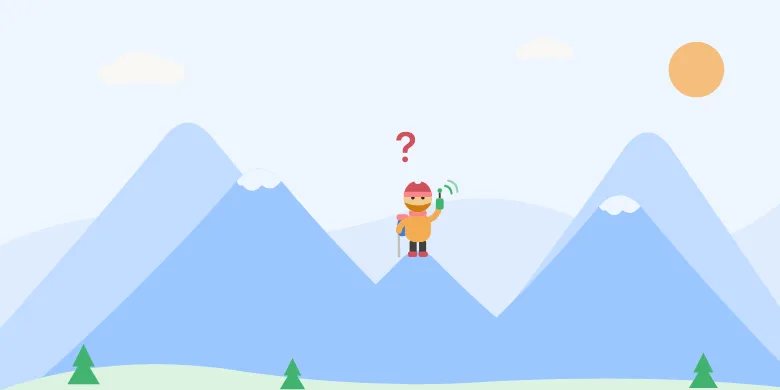
A hiker is lost. All we have are a few distances. Find him and discover how GPS works.
Concept
Your phone knows exactly where you are. But how? No cameras, no wires — just math. Kid discovers that GPS works by drawing circles from satellites, and the spot where three circles overlap is your location.
The Experience
Kid starts with a mystery: "You're somewhere on this map. A satellite says you're 5km from Tower A." That's a circle — you could be anywhere on it. Not helpful yet.
Second satellite: "You're 3km from Tower B." Now two circles. They intersect at exactly two points. Close, but which one?
Third satellite: "You're 4km from Tower C." Three circles. One point where all three overlap. That's you.
Kid does this hands-on: draws circles on a map using compass/radius tools, finds the intersection, and locates the target. Multiple rounds with different tower positions and distances. Then the twist — what happens when the distances have small errors? The three circles don't meet at a point anymore — they form a small triangle of uncertainty. That's why GPS says "accurate to 3 metres," not "exact."
What Math Does The Kid Do?
- Draws circles with given centre points and radii.
- Finds intersection points of two circles, then three.
- Understands that each constraint (distance from a point) eliminates possibilities.
- Explores how measurement error creates uncertainty zones.
- Works with scale, distance, and coordinate positioning.
Why This Matters
You'll understand how GPS actually works — not as magic, but as circles and intersections, the same geometry running inside the phone in your pocket.
Frequently asked questions
GPS is tagged for Grades 7-12.
No — GPS plays directly in the browser, right on this page. No login, no download.
Discover the hidden math behind something a kid already sees every day.
No — GPS is free to play, no sign-up needed.