


The Wobble Test
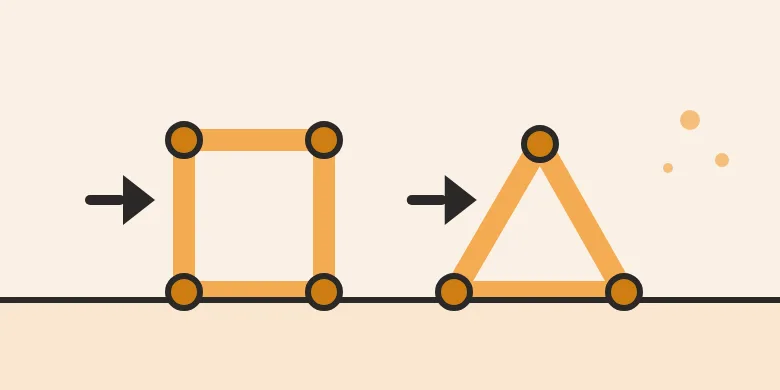
Two shapes made of sticks. What happens when you push them?
Concept
A 4-stick square and a 3-stick triangle look equally sturdy sitting still. Kid discovers by pushing both that the triangle holds its shape while the square collapses — because three fixed side lengths lock a triangle's shape completely, while a four-sided loop can flex into many different shapes without changing a single stick length.
The Experience
Kid is asked how many sticks make a square (4), then predicts which shape — square, triangle, or both — will keep its shape when pushed.
Pushing the square: on each push it visibly skews into a parallelogram, and after two pushes the game confirms "The square FOLDED."
Pushing the triangle the same way: nothing moves — "The triangle HELD," the direct payoff of the hook.
The twist: "The same 4 sticks. Make another shape." Each tap reshapes the same 4-stick loop into a different slanted quadrilateral — a whole gallery of distinct shapes built from identical sticks — while the same button on a 3-stick loop can't produce anything new: every triangle it makes is the same.
To show why, the kid joins two opposite corners of the square, splitting it into two triangles, and sees that neither of those triangles can change shape — so a square built from two rigid triangles can't be rigid as a whole unless it stays split.
A "line them up" step rotates a row of triangles the kid has made — some pointing different ways — back to the same orientation, animating them into a single stack that coincides exactly, proving they're all really the same triangle just turned around.
The exploration closes by sending the kid hunting for hidden triangles in a bridge, a roof, and a crane — real structures built to stay rigid — with a bookshelf included as a deliberate non-triangle foil to sharpen the contrast.
What Math Does The Kid Do?
- Counts sides/sticks needed to build a given polygon.
- Predicts and then empirically tests a geometric claim through direct manipulation.
- Observes that a quadrilateral's shape isn't fixed by its side lengths alone (angles can vary).
- Recognizes triangle rigidity as a structural property, in contrast to a "floppy" 4-bar shape.
- Splits a shape into triangles to reason about why it is or isn't rigid.
- Identifies real-world structures that use triangles for rigidity, versus ones that don't.
Why This Matters
You understand why triangles hold up bridges and cranes — not because someone told you, but because you pushed a stick square until it collapsed, watched an identical stick triangle stay rigid, then spotted the same triangles hiding in real structures.
Frequently asked questions
The Wobble Test is tagged for Grades K-3.
No — The Wobble Test plays directly in the browser, right on this page. No login, no download.
Discover the hidden math behind something a kid already sees every day.
No — The Wobble Test is free to play, no sign-up needed.