


The First Ruler
What did people use before rulers? Hands, arms… and feet! Now try on your room!
Concept
Rulers didn't always exist — people used their own bodies to measure. Kid discovers that a "footspan" (one foot, heel to toe) can measure a room, but different people's feet give different answers — which is why the world eventually agreed on one standard foot.
The Experience
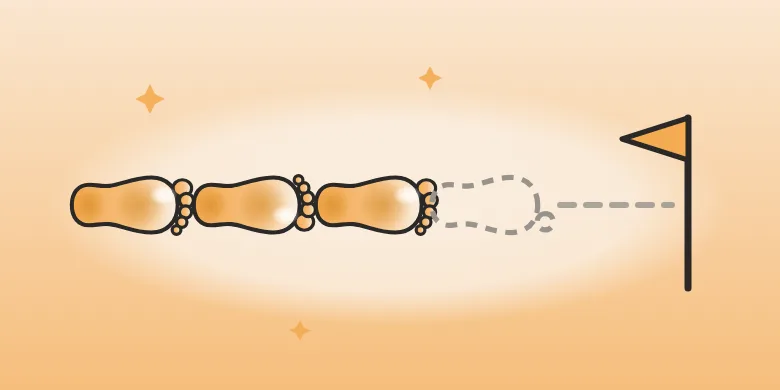
Kid sees a bedroom and is shown "This is a footspan — one foot, heel to toe," illustrated on a cartoon foot with a dashed measuring line.
Kid is asked to guess how many footspans it takes to cross the room to a flag, picking from 5 / 10 / 15 / 20.
Kid taps "Stamp a footspan" repeatedly, watching a counter climb as footprints lay down in a row across the room toward the flag, stopping partway with the message "Look how far we've come!" before being asked to guess again and finishing the stamping to the far wall.
Kid finishes stamping to exactly 10 footspans, and the game confirms "The room is 10 footspans — spot on!"
Twist: a character with visibly bigger feet measures the same room. Kid predicts "More, or fewer?" footspans for her, then watches her side-by-side stamping animation land on just 6 — fewer, because bigger feet cover more ground per step. A third character, a baby, is shown getting 14 footspans for the same room — "Same room, 3 different answers!"
Final concept check: "How should everyone get the same answer?" — options "Use the same foot" vs "Use their own foot." Picking "Use the same foot" is confirmed correct, followed by "Feet come in all sizes — so people invented one standard foot for everyone!" and the historical note that the foot as a unit came from a king's foot.
Closing screen shows foot, hand-span, and arm-span as historical measuring units before the final line: "You measured just like the very first measurers! Try your real room tonight."
What Math Does The Kid Do?
- Estimates a length before measuring (guesses footspan count, twice).
- Performs iterative unit measurement (repeatedly lays a single unit end-to-end to measure a distance).
- Compares the same distance measured in different-sized non-standard units (own foot vs. a bigger foot vs. a baby's foot).
- Reasons about the inverse relationship between unit size and count (bigger unit = fewer units needed).
- Selects the correct explanation for why a common measurement needs a standardized unit.
Why This Matters
You've measured the same room with your own foot, a bigger foot, and a baby's foot — and gotten three different answers, 10, 6, and 14 "footspans." Now you know exactly why the world needed one standard unit.
Frequently asked questions
The First Ruler is tagged for Grades K-2.
No — The First Ruler plays directly in the browser, right on this page. No login, no download.
Discover the hidden math behind something a kid already sees every day.
No — The First Ruler is free to play, no sign-up needed.