How to Do 5th Grade Math the New Way and Check the Answer
5th grade math the new way: area models, partial quotients, fraction bars and decimal grids. How to read each one and check the answer your own way.

Check the number your way. The drawing is your child's to explain. That is the whole routine for a 5th grade math page you cannot read: estimate the size of the answer, work the problem the way you learned (a calculator is fine for your check), and compare. If your number matches your child's, the answer is right, whatever the drawing looks like. If it does not, circle the problem for the teacher and leave the drawing alone.
The drawings are not a new kind of math. The 5th grade standard for division lets the class show its work with a picture: "Illustrate and explain the calculation by using equations, rectangular arrays, and/or area models." The first practice standard tells students to "check their answers to problems using a different method," and the way you learned is a different method. So you check the number. Your child explains the picture.
Homework looks strange mainly in four places this year: multiplying and dividing big numbers, decimals, fractions with different denominators (the bottom numbers), and volume. For multiplication, your column method is the grade's own target; the standard says "Fluently multiply multi-digit whole numbers using the standard algorithm." For division, the column method arrives in 6th grade in Common Core states ("Fluently divide multi-digit numbers using the standard algorithm"), so 5th grade uses the drawings below. Texas, which has its own standards, names the standard algorithm for division in 5th grade. When each column method arrives, grade by grade, is on the standard algorithm page.
How to read the drawing on the page
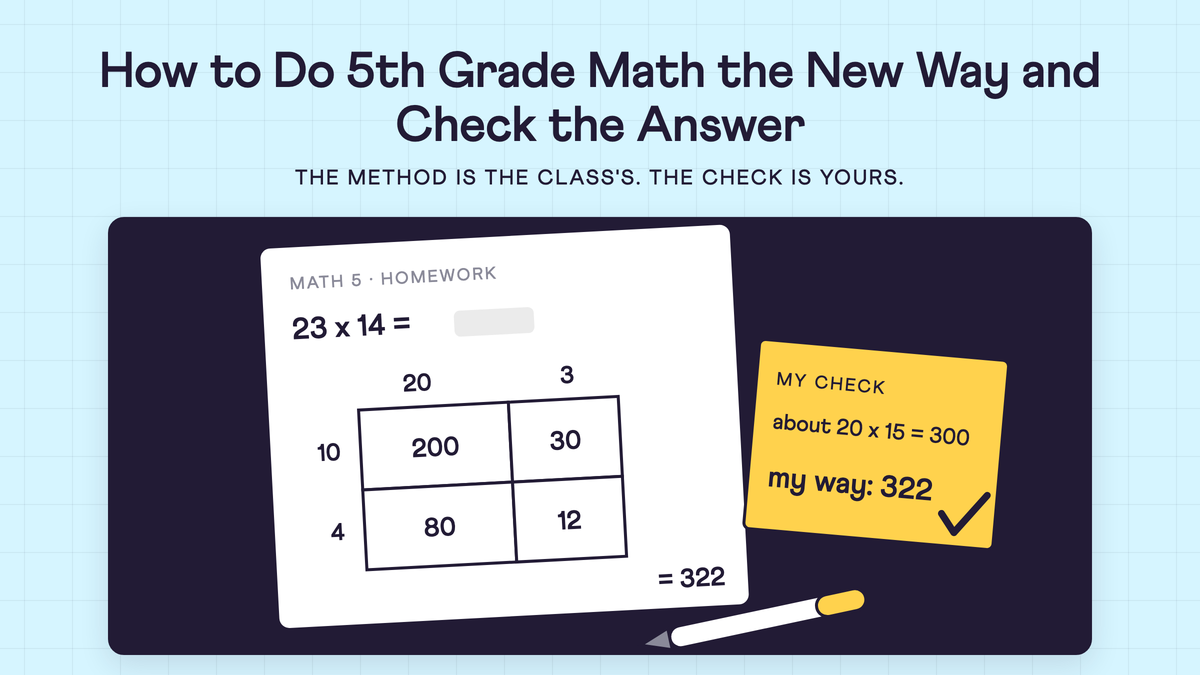
Boxes: an area model, for multiplication. A rectangle cut into boxes, one box per place value. For 23 times 14, your child splits 23 into 20 and 3, and 14 into 10 and 4, then fills four boxes: 200, 30, 80 and 12. The sum is 322. Your check: 23 times 14 in columns is 322. The area model multiplication page draws it box by box.
A stack of subtractions: partial quotients, for division. Long division written as easy multiples. For 756 divided by 21, your child might take 30 twenty-ones (630), subtract, and have 126 left; then 6 more (126), and nothing left. The answer is 30 + 6 = 36. Your check: 21 times 36 = 756.
Bars cut into pieces: fraction bars, for fractions. A bar cut into equal parts. For 2/3 + 1/4, the bars are re-cut into twelfths: 8/12 + 3/12 = 11/12. Your check is the common denominator you learned. Estimate first: 2/3 plus 1/4 is a little less than 1, and 11/12 is a little less than 1. It fits.
A shaded square: a decimal grid, for decimals. A square cut into 100 small squares, so each small square is one hundredth. For 0.4 times 0.3, your child shades 4 columns and 3 rows; the overlap is 12 small squares, so 0.12. Your check: 4 times 3 is 12, and 0.1 times 0.1 is 0.01, so the answer has two decimal places: 0.12.
Layers of cubes: volume. Count the cubes in one layer, then multiply by the number of layers. A box 5 cubes long, 4 wide and 3 high has 20 cubes in a layer and 3 layers: 60 cubes. Your check: 5 times 4 times 3 = 60.
Two of the big publishers print parent pages that explain these drawings unit by unit: Illustrative Mathematics (free family pages for its 5th grade units) and Great Minds (Parent Tip Sheets for Eureka Math, behind a short sign-up form). Look for the program's name at the top of the worksheet, or ask the teacher which one the class uses.
How to check the answer, in five steps
- Estimate the size. Round the numbers and do it in your head: 23 times 14 is about 20 times 15, so about 300. For fractions, a half plus something cannot be less than a half. The fractions standard asks the child to do this too: "estimate mentally and assess the reasonableness of answers."
- Work it your way, on scrap paper or a calculator.
- For division, multiply back: 21 times 36 should give 756.
- Numbers match: the answer is right. Now ask your child to say how the drawing got there (Show me how your boxes make 322). The standard's words are "explain the reasoning used", and the explaining is your child's job, not yours.
- Numbers do not match: circle it and leave the drawing alone. If it is due tomorrow, check one box or one step at a time (tens times tens, then tens times ones) until you find the one that differs. The teacher reads the drawing to see where the method broke.
The check is quick. If your child cannot say that 400 is ten 40s, or stalls on 7 times 8, tonight's method may not be the problem; an earlier skill may be. Our page on a child behind in math is for finding which one.
When to write to the teacher
Write when the same drawing stumps your child three nights in a row, when answers that check out your way come back marked wrong, or when your child cannot say what the drawing means. Three questions, by email so the answers are in writing:
- Which math program does the class use for this unit, and is there a family page for it?
- Is this homework graded on the answer, on the drawing, or on the explanation?
- When my child gets the right answer my way, what do you want at home: the class's method, or just the check?
Where Cuemath fits
Cuemath is live, one-on-one online math tutoring for grades K through 12. If the homework method is the only problem, the routine above is enough and no tutor is needed. If the trouble is older than tonight's homework, a free evaluation shows which earlier piece is missing.
When the homework is not the whole story
A free Cuemath MathFit Evaluation, a skills-and-gaps check in a live one-on-one session, shows where your child is solid and where a gap sits, in your child's own work. No credit card, and the report is yours either way.
Book a Free EvaluationFor students in Grades K to 12 worldwide.
FAQs
Can I use a calculator to check my child's homework?
Yes, for your check. The standard asks the child to check "using a different method," and your calculator is one. Keep it off your child's worksheet: Texas's 5th grade standards say students "perform their work without the use of calculators", and in Common Core states the drawing is the work the class wants to see.
Why does 5th grade homework use an area model and not the way I learned?
Because the standard lists a picture as one way to show the work, and not only in 5th grade: the 4th grade multiplication line ends with the same sentence, "Illustrate and explain the calculation by using equations, rectangular arrays, and/or area models." Illustrative Mathematics' 5th grade page says the class then compares those steps with the column method to learn why it works. The boxes are the step before the column method, not a replacement for it.
How do I check a fraction multiplication answer?
Compare the answer to the whole number. Multiplying by a fraction less than 1 makes a number smaller, and by a fraction more than 1 makes it bigger; Illustrative Mathematics' unit page states that rule. So 3/4 times 8 must come out under 8 (it is 6), and 5/4 times 8 must come out over 8 (it is 10). An answer on the wrong side is wrong before you check the arithmetic.
What does 'explain your reasoning' mean on a 5th grade worksheet?
Say, in words, why the steps work, not only what the answer is. The decimals standard puts it as "relate the strategy to a written method and explain the reasoning used." Spoken counts: Texas's standards accept it "in written or oral communication". Let your child say it out loud first, then write the sentence down.
Is 5th grade math the same in Texas?
Mostly. Texas's 5th grade standards, the TEKS, cover the same four places: multiplication "using the standard algorithm", division "using strategies and the standard algorithm", decimal multiplication with area models, fractions with unequal denominators, and volume by layers. One difference that matters for the drawings: Texas names the standard algorithm for division in 5th grade, and Common Core puts it in 6th. Texas also adds topics Common Core does not list in 5th grade, such as personal financial literacy.
Where can I find a parent guide for my child's math program?
Ask the teacher which program the class uses, then search its name with the word family or parent. Illustrative Mathematics prints family pages for its 5th grade units, with the drawings explained and questions to ask at home. Great Minds prints Parent Tip Sheets for Eureka Math, "arranged in the same sequence as the student homework", behind a short sign-up form. If the class uses another program, ask the teacher for its parent page by name.
My child's answer is right but the teacher marked the drawing wrong. What now?
Ask what is graded: the answer, the drawing, or the explanation (the second teacher question above). If the drawing is graded, the standard's line is the reason: the class is asked to "Illustrate and explain the calculation", so a right answer with a broken drawing can lose points. The fix is your child's: redo the drawing and say each step out loud.