Best Back-to-School Math Activities for Kindergarten (2026)
9 playful, hands-on math activities to start the kindergarten year strong: counting, shapes, patterns, sorting, guessing, and graphing. Each uses everyday materials, includes three levels, and takes just 10 to 15 minutes. Recommended by Cuemath tutors.

Summer break is ending, and a new school year is about to begin. Some kids are going back to kindergarten. Others are starting it for the very first time. After weeks away from numbers, math can feel far off, and even a little scary.
These back-to-school math activities ease kids in gently. They don't look like math at all. They look like play. Kids count caterpillar spots, hunt for hidden shapes, and hop across numbers drawn on the floor. Little by little, math feels normal and fun again, so no child feels lost or confused on the first day.
Play is how young kids learn math. When children touch, move, and talk about numbers, math starts to make sense. The counting and sorting they do now is the base for the adding and subtracting they will do later. So play is not a warm-up. It is the real work.
This guide has 9 hands-on activities for the first weeks of school. They work in a classroom or at home. Each one uses things you already have, like blocks, beads, stickers, and chalk. And each one builds a core kindergarten skill: counting, shapes, patterns, sorting, guessing amounts, and simple graphs.
These 9 activities are recommended by Cuemath tutors who teach kindergarten and early math every day. Our tutors use activities like these in class to teach math through play, and they share them with parents to use at home.
Every activity gives you one clear goal, a short list of what you need, easy steps, and three levels so you can match it to your child. You also get a quick way to check if it clicked, and how long it takes. A comparison table is at the end. Last reviewed: July 2026.
- How Do These Kindergarten Math Activities Help Kids Learn?
- 9 Back-to-School Math Activities for Kindergarten Kids
- 1. Counting Caterpillars
- 2. Shape Scavenger Hunt
- 3. Pattern Parade
- 4. Number Jump
- 5. Estimation Jar
- 6. All About Me Graph
- 7. Dot-to-Dot Drawings
- 8. Sorting Station
- 9. Counting Collections
- All 9 Kindergarten Math Activities at a Glance
- Kindergarten Math Activities for Home
- Kindergarten Math Activities for Summer
- Math Games and Tutoring Cuemath Tutors Recommend
- Frequently Asked Questions
School math + test prep + skills AI can't match, at $0 cost.
Everything your child needs from Grade K to 12, curriculum mastery, test prep, and enrichment math, is now in one free app.
Simple log in with email, nothing else
How Do These Kindergarten Math Activities Help Kids Learn?
These kindergarten math activities help kids because they turn numbers into something a child can see, hold, and move. At this age, kids learn by doing first and by symbols later. A number on paper is just a shape to them. Five blocks they can hold is real.
Three things happen when a five-year-old learns math through play:
- Real things first. Moving real objects teaches number sense in a way a worksheet cannot.
- Patterns build thinking. Spotting what comes next is how math thinking begins.
- Short bursts keep it fun. Learning sticks best when you stop before your child gets tired.
This is how Cuemath tutors teach kindergarten math in their 1:1 classes. They start with something a child can see and touch, then link it to the number it stands for. The activities below work the same way. All you need are everyday objects.
9 Back-to-School Math Activities for Kindergarten Kids
Each activity takes 10 to 15 minutes. That is long enough to learn and short enough to hold a five-year-old's focus. Add movement breaks and songs to keep energy up. Do them in any order.
1. Counting Caterpillars: Counting 1 to 10
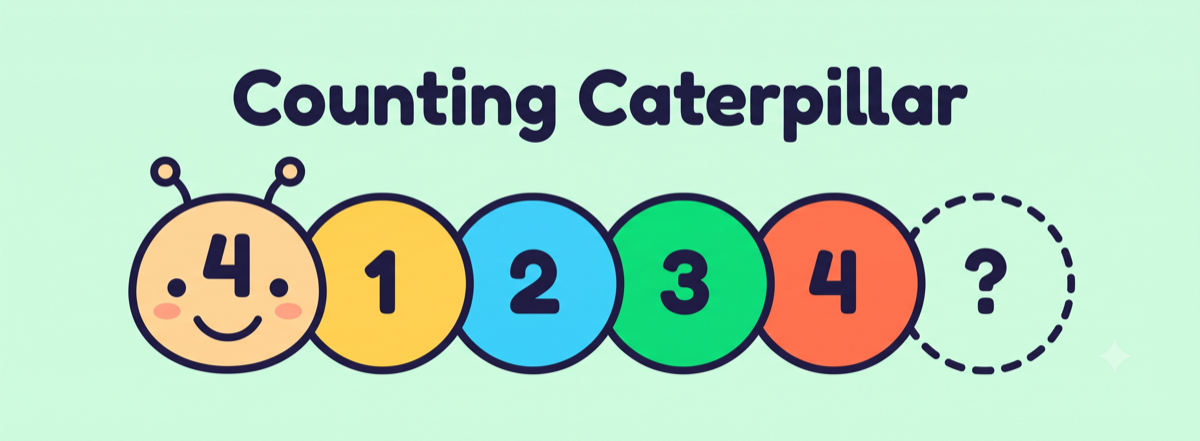
Skill: Number recognition and one-to-one counting (numbers 1 to 10).
You'll need: A paper caterpillar head with a numeral on it, plain paper circle "segments," glue sticks or Velcro dots, and large number cards.
How to play: Give each child a caterpillar head labeled with a numeral, say "4." The child counts out that many body segments and attaches them in order, saying each number aloud: "one, two, three, four." Repeat with a new head showing a different number.
Three levels:
- Just starting (1 to 3): Use only numbers 1 to 3, and pre-count the segment sets so the child practices matching, not counting from scratch.
- On level (1 to 5): Give a mixed pile of segments. The child counts from 1 for each new caterpillar.
- Ready for more (1 to 10): Use numerals up to 10, or add number words on the head. Extension: the child writes their own number and adds the matching segments.
Quick check: Ask "How many segments does your caterpillar have?" Watch for skipping a number or counting one twice. Those are the two most common slip-ups at this age.
Time: 10 to 15 minutes.
2. Shape Scavenger Hunt: Naming Shapes
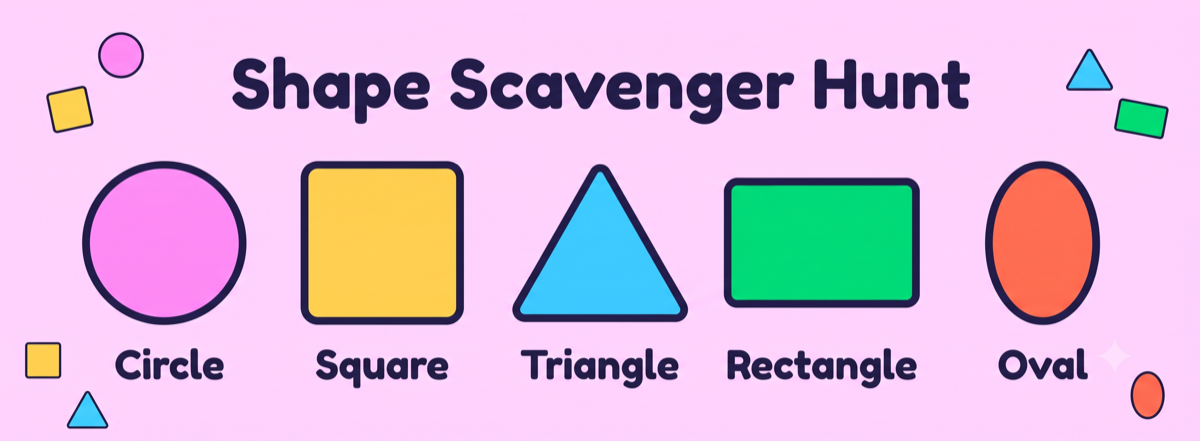
Skill: Recognizing and naming basic 2D shapes: circle, square, triangle, rectangle, and oval.
You'll need: Colored shape cut-outs, labeled baskets or sorting mats (one per shape), and optional sticker rewards.
How to play: Hide shape cut-outs around the room before children arrive. Give each child or pair a basket or mat labeled with a target shape. Call out a shape ("Find a triangle!") and children race to find matching shapes and place them on the correct mat. Rotate through several shapes.
Three levels:
- Just starting: Limit it to two shapes (circle and square) and use color cues, for example only red pieces are circles.
- On level: Use three or four shapes with no color hints. Children identify shapes by sight.
- Ready for more: Include five or more shapes plus a few decoys. Children sort and explain what makes each shape different, like "A triangle has three corners."
Quick check: After the hunt, ask each child to name one shape they found and point to what defines it: straight sides, corners, or curved edges.
Time: 15 minutes.
3. Pattern Parade: Making Patterns
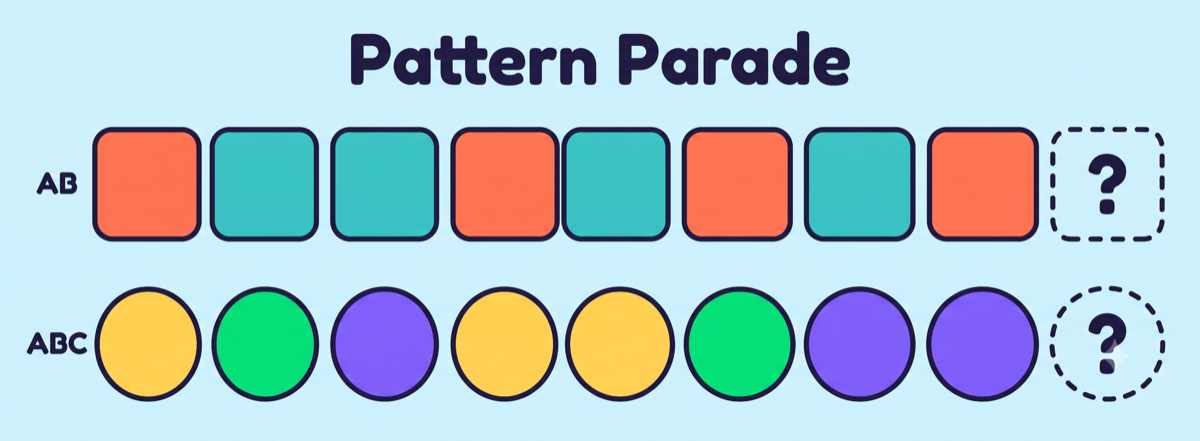
Skill: Recognizing, extending, and creating repeating patterns (AB, AAB, ABC).
You'll need: Colored snap cubes or counting blocks, and pattern strip cards showing example sequences.
How to play: Build a simple repeating pattern with cubes, for example red, blue, red, blue. Children continue it with their own blocks, saying the rule aloud as they work ("red, blue, red, blue..."). Once confident, each child creates their own pattern and challenges a partner to continue it.
Three levels:
- Just starting: AB patterns using two colors. The child copies and extends your pattern.
- On level: ABC patterns using three colors. The child creates an original pattern and reads it aloud.
- Ready for more: Shape or size patterns (square, circle, triangle). The child describes the rule in words: "First the square, then the circle, then the triangle."
Quick check: Listen for whether your child can say the rule ("next comes..."), not just build it. Saying the rule out loud is the real skill.
Time: 10 minutes.
4. Number Jump: Putting Numbers in Order
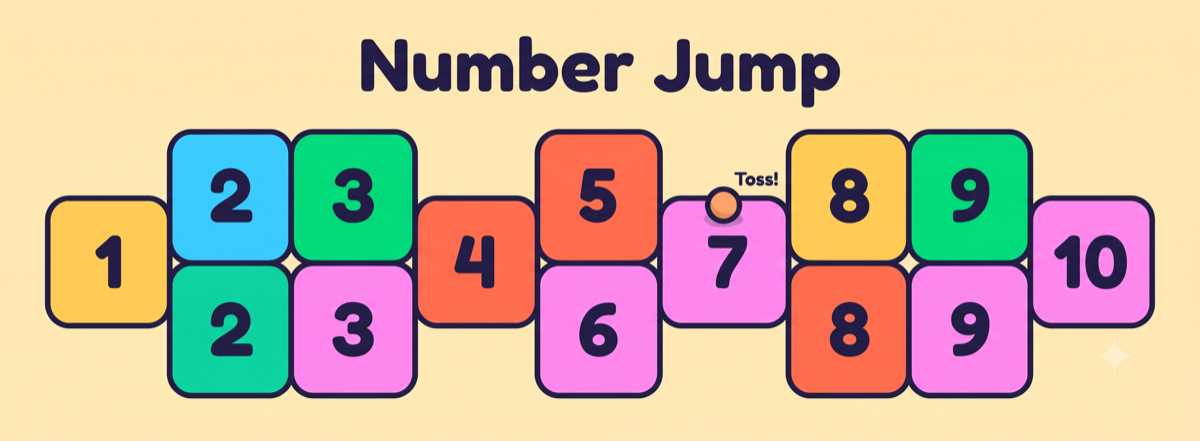
Skill: Putting numbers in order (1 to 10). This one adds movement, which helps on wiggly mornings.
You'll need: Tape or chalk to mark numbered squares (1 to 10) on the floor, and small beanbags.
How to play: Lay out ten numbered squares in hopscotch formation. A child tosses a beanbag onto any square, then hops from 1 upward, saying each number aloud until reaching the beanbag. They pick it up and hop back, then pass to the next child.
Three levels:
- Just starting: Use squares 1 to 5. Children can step instead of hop.
- On level: Full 1 to 10 grid. Challenge children to count without pausing.
- Ready for more: Reverse count from 10 to 1, or skip count by landing only on odd numbers.
Quick check: Watch whether your child says the numbers in the right order without looking down. Getting the numbers wrong out loud, not just missing a jump, is what to notice.
Time: 10 to 15 minutes.
5. Estimation Jar: Guessing Amounts
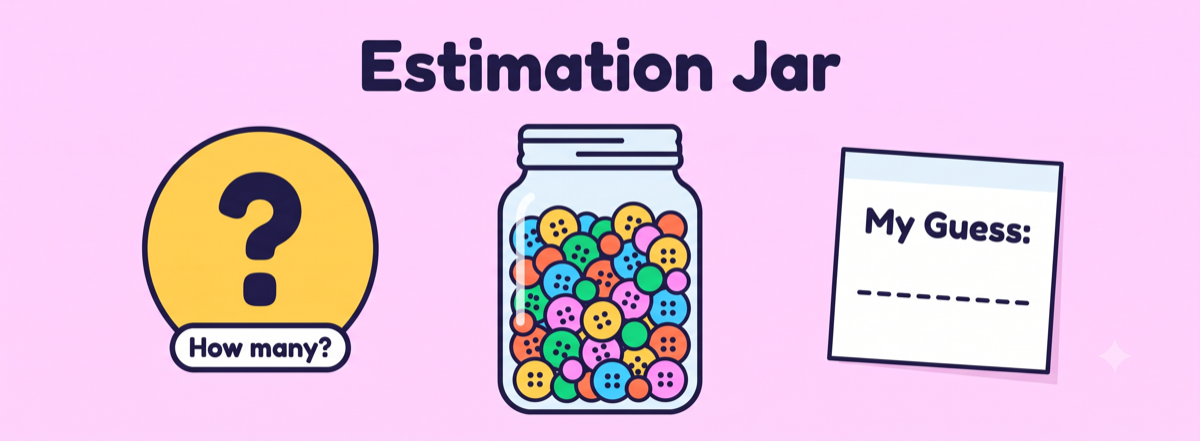
Skill: A first taste of estimating (making a smart guess), and of learning that the last number you count tells you how many there are.
You'll need: A clear jar or container, 20 to 50 small objects (buttons, beads, or counters), and paper and crayons.
How to play: Show the filled jar. Each child quietly guesses how many items are inside and records it with a number, tally, or drawing. Then count together, moving each item as you go. Compare the real number to the guesses: whose was closest?
Three levels:
- Just starting: Use a smaller jar with up to 10 items. Children say their guess aloud instead of writing it.
- On level: 20 to 30 items. Children write or mark a guess, then count by ones.
- Ready for more: 40 to 50 items. Children group objects into tens before counting, then work out the difference between their guess and the answer.
Quick check: Ask "Why do you think there are about that many?" Their answer tells you if they are really thinking about the amount or just saying a random number.
Time: 10 minutes.
6. All About Me Graph: Reading a Simple Graph
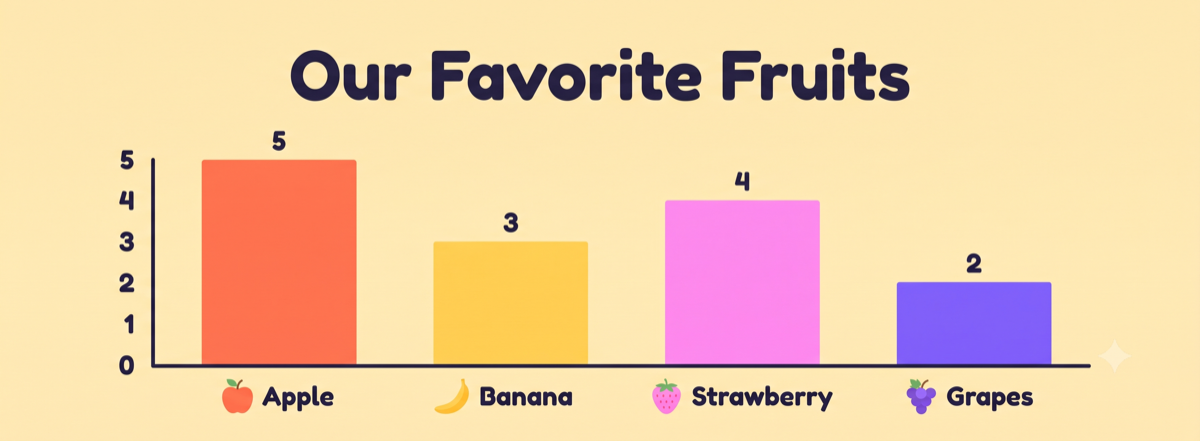
Skill: Collecting data, sorting it into categories, and reading a simple bar graph.
You'll need: A large paper chart with picture-labeled columns (favorite fruit or color), dot stickers, and markers.
How to play: Pick a fun class topic: favorite fruit, pet, or color. Draw a blank bar graph on poster paper with a picture and label for each choice. One by one, children add a dot sticker to their column. Once everyone has gone, discuss: "Which column is tallest? How many chose apples? Are there more banana lovers or grape lovers?"
Three levels:
- Just starting: Two choices only (apple or banana). Count the stickers aloud together after each child adds one.
- On level: Three or four choices. Children place stickers on their own and read their column's total.
- Ready for more: Five or more categories. Children answer comparison questions and help tally the results.
Quick check: Ask "How do you know which fruit won?" Look for children who point to the graph rather than counting from memory.
Time: 15 minutes, including discussion.
7. Dot-to-Dot Drawings: Counting in Order

Skill: Counting sequence and fine motor skills (numbers 1 to 20).
You'll need: Printable dot-to-dot worksheets (1 to 10 or 1 to 20) that form simple shapes or animals, and crayons.
How to play: Give each child a dot-to-dot worksheet. Starting at 1, they draw a line to 2, then 3, and so on until the picture appears. Encourage them to say each number aloud as they connect the dots: "one to two, two to three..." Once the outline is revealed, they color it in.
Three levels:
- Just starting: 1 to 10 dot-to-dots with large, clearly numbered dots. Work through it together.
- On level: 1 to 20 worksheets completed independently.
- Ready for more: Add skip-count patterns (connect every 2nd number) or leave blank dots where children fill in the missing number before connecting.
Quick check: The finished picture tells you instantly whether the connections were drawn in order. Check that lines always run from a lower number to a higher one.
Time: 10 minutes.
8. Sorting Station: Sorting by Color, Size, and Shape
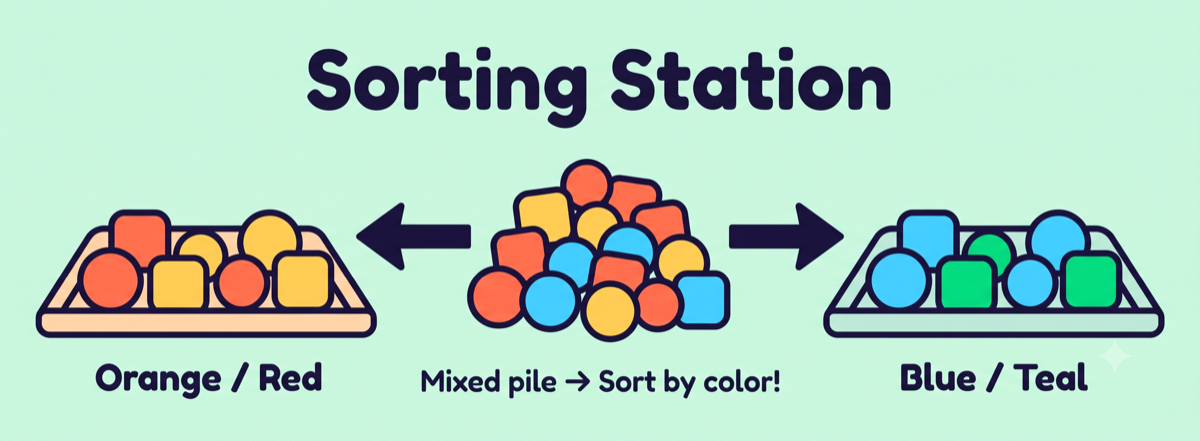
Skill: Sorting objects by one thing at a time: color, size, or shape.
You'll need: A mixed collection of everyday objects (buttons, shells, blocks) that vary in color, shape, and size, plus sorting trays or labeled mats.
How to play: Give each child a tray and a mixed pile. Call out a sorting rule ("Sort by color: red versus blue"). Children place each object in the correct section. Then call a new rule ("Now sort by size: big versus small") and have them re-sort the same pile. Ask them to explain their choices.
Three levels:
- Just starting: One clear rule (color), two groups only.
- On level: Sort by shape or size with three groups (big, medium, small).
- Ready for more: Sort by two things at once, or explain why a tricky item belongs in one group.
Quick check: After sorting, ask "Why is this one in the big group?" Consistent reasoning, not guessing, shows real understanding.
Time: 10 minutes per sorting rule.
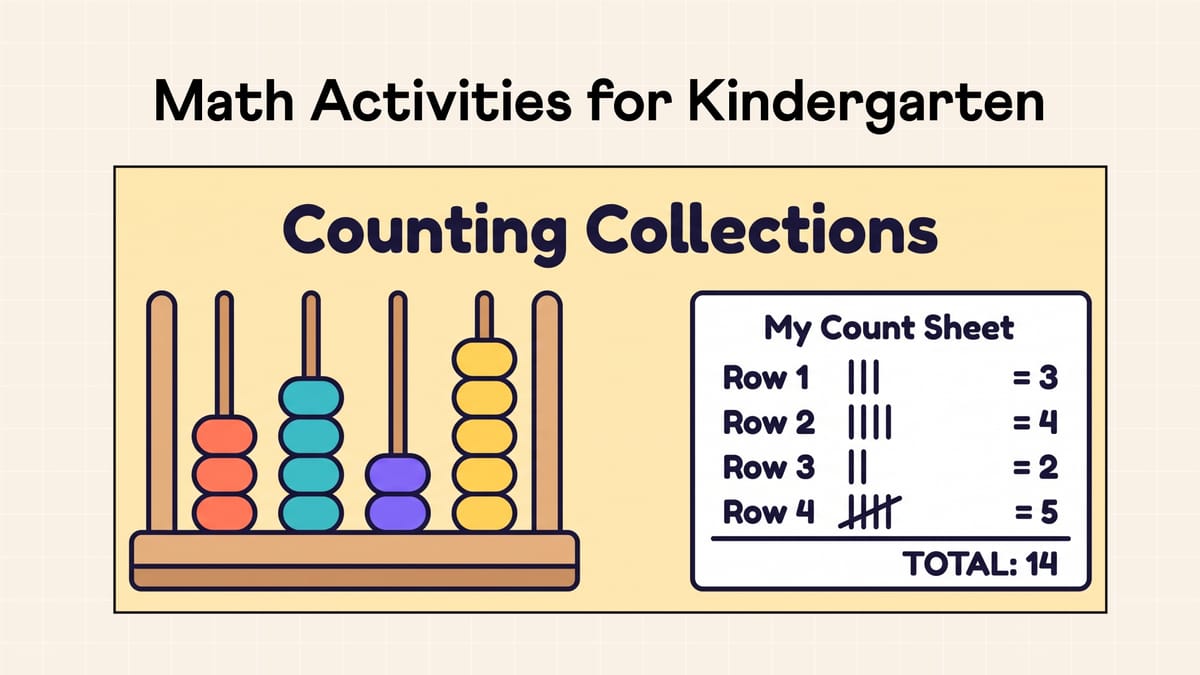
9. Counting Collections: Counting and Writing Numbers
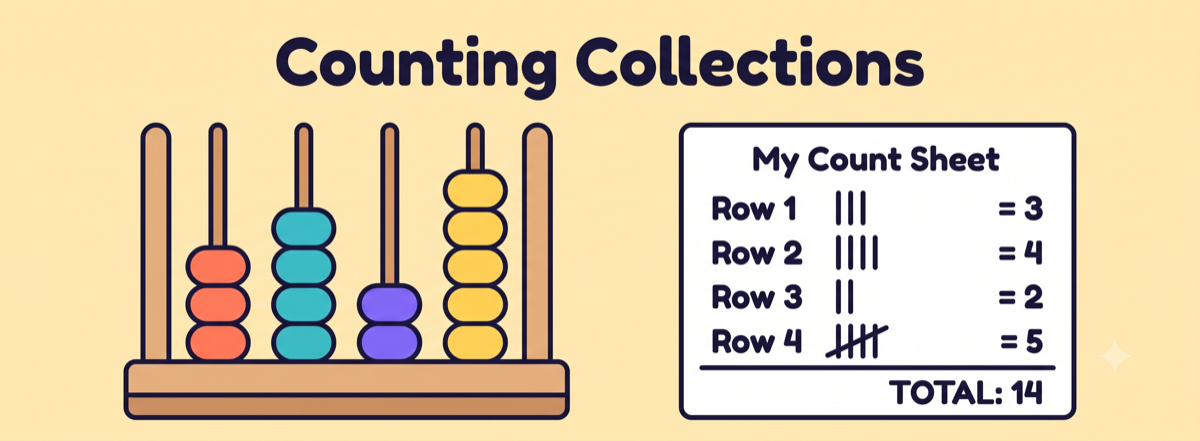
Skill: One-to-one counting, tracking totals, and recording quantities.
You'll need: Small baskets of identical items (beads, blocks, or buttons) for each child, and counting mats or plain paper.
How to play: Each child scoops a small handful, about 10 to 20 pieces, onto their mat. They count one by one, moving each object aside as it is counted, and record the total with a number card, tally marks, or by writing the numeral. Then they double-check by counting again.
Three levels:
- Just starting: Limit to 5 to 10 items. Use touch-counting alongside an adult.
- On level: Up to 20 items. The child counts independently and uses tally marks to keep track.
- Ready for more: 20+ items. Children group into tens and ones ("2 tens and 3 ones makes 23"), then compare two collections ("Which pile has more?").
Quick check: Recount each child's collection after they finish. Talk through any difference together; this is a powerful learning moment, not a correction.
Time: 10 minutes.
All 9 Kindergarten Math Activities at a Glance
Use this table to plan which activities to do and when. The "Easy" ones are great for the first days. The "Medium" ones fit once your child knows the routine. Difficulty is just a guide, so trust what you see. You can make any activity easier or harder in seconds by changing the numbers or objects.
| Activity | Skills Targeted | Materials | Time | Difficulty |
|---|---|---|---|---|
| Counting Caterpillars | Counting, number sense | Paper caterpillar pieces, number cards | 10 min | ★★☆☆☆ Easy |
| Shape Scavenger Hunt | Shape recognition | Shape cut-outs, baskets | 15 min | ★★☆☆☆ Easy |
| Pattern Parade | Pattern making, sequencing | Colored cubes or blocks | 10 min | ★★★☆☆ Medium |
| Number Jump | Number sequencing | Number mats or chalk, beanbag | 10 min | ★★☆☆☆ Easy |
| Estimation Jar | Estimation, counting | Clear jar with objects, paper | 10 min | ★★★☆☆ Medium |
| Graph: All About Me | Data sorting, graphing | Chart paper, stickers | 15 min | ★★★☆☆ Medium |
| Dot-to-Dot Drawings | Counting order, fine motor | Dot-to-dot worksheets, crayons | 10 min | ★★☆☆☆ Easy |
| Sorting Station | Classifying by attribute | Mixed objects, sorting mats | 10 min | ★★★☆☆ Medium |
| Counting Collections | One-to-one counting | Counters, bead frames, paper | 10 min | ★★★☆☆ Medium |
Kindergarten Math Activities for Home
The best kindergarten math activities for home use things you already have and take just a few minutes. Turn everyday moments into small games: count, sort, and spot shapes. Keep each one short and playful, and your child gets math practice without it feeling like a lesson.
This is exactly what Cuemath tutors tell parents to do at home. Here is a simple way to use these activities:
- Start with counting. Count stairs, spoons, or toy cars out loud, touching each one (like Counting Collections).
- Add shapes and patterns. Spot circles and squares around the house, or make a red, blue, red pattern with socks (Pattern Parade).
- Sort something real. Sort laundry or blocks by color, then sort the same pile again by size (Sorting Station).
- Guess, then check. Fill a jar with buttons and guess together before counting (Estimation Jar).
- Keep it to 10 minutes. Stop while it is still fun, so your child asks to play again tomorrow.
You don't need worksheets or special kits. The three levels in each activity let you make any game easier or harder right away. That is why these simple games work so well at home.
Kindergarten Math Activities for Summer
Kindergarten math activities for summer keep number skills sharp so kids don't slip before school starts. A few short, fun games each week are enough to beat the summer slide and make going back to school easier.
Over the summer, use these same activities in a light, no-pressure way:
- Take math outside. Chalk a hopscotch grid for Number Jump, or go on a shape hunt at the park.
- Count real things. Shells at the beach, berries in a bowl, or cars spotted on a drive all work.
- Play, don't drill. One 10-minute game most days beats a daily worksheet at this age.
- Add daily math games. Short, playful practice on an app keeps counting and patterns fresh between activities.
In the last week or two of summer, do one short activity a day as a gentle warm-up so the first day back feels familiar.
Math Games and Tutoring Cuemath Tutors Recommend
When these activities click and your child wants more, Cuemath tutors point parents to two next steps. Short daily math games, and 1:1 tutoring when your child is ready for a set routine. Both use the same hands-on, playful approach as the activities above.
Daily math games for 10 minutes of playful practice
Cuemath's math games are the app version of the counting and pattern games above. They are quick, they adjust to your child, and they grow number sense a little each day.
1:1 tutoring for kindergarten and first grade, whenever they're ready
A Cuemath tutor teaches kindergarten and first-grade math one-on-one, using these same hands-on games and adjusting each one to your child. It is a natural next step when your child is ready for a set routine.
Keep the momentum going as your child moves up. These guides pick up where kindergarten leaves off:
Suggested Reading
Frequently Asked Questions
What are the best back-to-school math activities for kindergarten?
The best back-to-school math activities for kindergarten are hands-on games that teach one skill at a time: counting, shapes, patterns, sorting, guessing amounts, and simple graphs. The nine in this guide each use everyday things, take 10 to 15 minutes, and come with three levels so every child fits in. Cuemath tutors who teach young kids every day recommend activities just like these.
What math activities for toddlers work before kindergarten?
Math activities for toddlers work best when they are simple, hands-on, and short. Just make the kindergarten games smaller: count to three instead of ten, sort by one color, or match two shapes instead of five. Counting steps out loud, stacking blocks, and naming shapes at home all build the number sense they carry into kindergarten.
What are simple toddler math activities I can do at home?
Simple toddler math activities you can do at home include counting stairs as you climb, sorting laundry by color, lining up toys from small to big, and pointing out circles and squares on a walk. Keep each one to a few minutes and let your toddler lead. As they grow, Cuemath's kindergarten tutors build on these same everyday habits.
How long should kindergarten math activities last?
Kindergarten math activities should last about 10 to 15 minutes each. That is long enough to learn and short enough to end before a five-year-old loses focus. If your child drifts sooner, take a quick movement break and come back later.
Do these back-to-school math activities work for homeschool or at home?
Yes, these back-to-school math activities work just as well at home as in a classroom. Every one uses common items like blocks, buttons, and chalk, and the three levels let a parent adjust on the spot. Parents who want a set routine can pair the activities with a Cuemath tutor who teaches kindergarten math one-on-one.
When should I consider a math tutor for my kindergartner?
Think about a math tutor for your kindergartner if they often avoid number games, get upset with counting, or still can't recognize the numbers 0 to 10 even with practice. A Cuemath tutor works 1:1 using the same playful games as this guide, so help feels like play, not pressure. The evaluation is free, and you don't need a credit card.
What are good back-to-school math activities for kids?
Good back-to-school math activities for kids are short, hands-on games that teach one skill at a time, such as counting, sorting, patterns, and shapes. The nine activities in this guide are made for kindergarten but scale up or down easily for slightly older or younger kids. Each takes 10 to 15 minutes and uses everyday things like blocks, buttons, and chalk.
What kindergarten math activities work for summer?
Kindergarten math activities for summer should be light and playful to stop the summer slide. Outdoor counting, shape hunts, hopscotch number games, and an estimation jar all keep skills sharp without feeling like schoolwork. Aim for one 10-minute game most days instead of daily worksheets.
How can I teach kindergarten math at home using simple activities?
You can teach kindergarten math at home using simple activities by turning everyday moments into games: count stairs, sort laundry by color, spot shapes on a walk, and guess then count buttons in a jar. Keep each one to about 10 minutes and let your child lead. Cuemath's kindergarten tutors use these same everyday habits in their 1:1 classes.
Sources
- Common Core State Standards, Kindergarten Mathematics — the counting, geometry, sorting, and pattern skills each activity targets.
- NRICH Early Years Mathematics, University of Cambridge — research-backed, play-based early math tasks.
- DREME, Stanford Graduate School of Education — research on early math learning and number sense development.
- NAEYC, "Play" — how play supports young children's learning and brain development.

I grew up a science kid. Math was not my best subject. Class moved fast, I was too shy to ask for help, and I somehow ended up more curious about how people learn than about the subjects themselves.
That's what pulled me into education, not to teach, but to understand how schools and tutoring programs actually work and what young learners genuinely need from them.
My love for writing did the rest. I had too many observations and nowhere to put them, so I started writing, and haven't stopped. Over the last five years I've written about edtech, student life, and how kids learn math. This guide is recommended by Cuemath's expert tutors.
I work at Cuemath now, so factor that in. I research by going where parents actually talk: forums, reviews, and direct conversations with families. I'm writing for the parent trying to make math feel less scary, one counting game at a time.