CogAT Test by Grade: Kindergarten, Grade 1, Grade 2, and Grade 3
Parents talk about the CogAT as if it were one test. It is closer to a set of tests that share a name. What a kindergartener, a first grader, and a third grader actually take, and what two districts verifiably do with it.

Parents talk about the CogAT as if it were one test. It is closer to a set of tests that share a name. Your child's grade decides three things: which level of the test they take, what the questions look like, and whether your district tests that grade at all this year. A kindergartener and a third grader can both "take the CogAT" and have very different mornings. This page walks through the test grade by grade, using what the publisher states about the test itself and what two districts we track verifiably do with it. What the scores open, and the fuller district calendars, live on our main CogAT page.
What the CogAT is
CogAT stands for Cognitive Abilities Test. Riverside Insights publishes it and describes it as a test that "measures verbal, quantitative, and nonverbal reasoning." Its administration guide says it covers students from kindergarten through grade 12. It is a reasoning test, not a curriculum test. Schools and districts buy it and give it. Parents cannot register a child directly, and there is no national test date. Each district picks its own windows and its own grades.
The test splits at grade 3
Riverside builds the test in levels: separate levels for grades K through 6 and banded levels for grades 7-12. The publisher's brochure sorts its subtest table into two blocks. Levels 5/6 through 8 cover grades K-2. Levels 9 through 17/18 cover grade 3 and up.
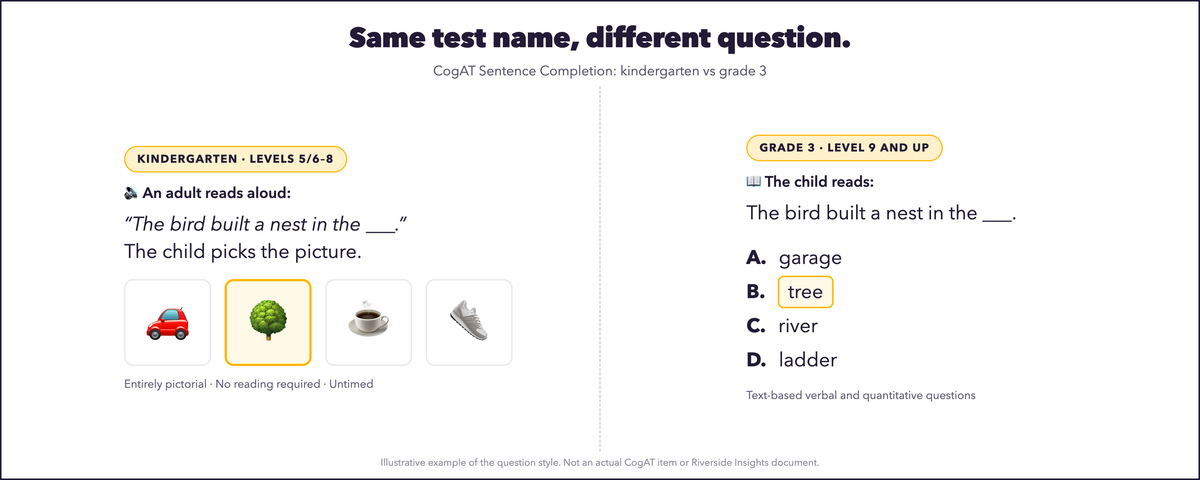
The line between those blocks is the change parents feel. Below it, the test is pictures. From Level 9, which the brochure labels grade 3, the verbal and quantitative questions are text-based. The clearest example is the Sentence Completion subtest, which exists on both sides of the line. At the K-2 levels, the child listens: a sentence is read aloud in English or Spanish, and the child picks the picture that completes it. At Level 9 and up, the child reads the sentence and picks the answer. Same subtest name, different skill on the way in.
Here is the shape of it in one view; the sections below fill in the detail.
| Grade | What the test looks like | Frisco ISD | Fairfax County |
|---|---|---|---|
| Kindergarten | All pictures, questions read aloud, untimed | Not a testing grade; parent referral window Jan 5-19, 2027 | Not the universal year (grade 2 is) |
| Grade 1 | Same picture format | District-wide window (Nov 5-20, 2026 on the 2026-27 calendar) | No universal grade 1 test on the current cycle's page |
| Grade 2 | Last picture-level year | Not one of the district-wide grades (1, 3, and 5) | The universal year: October 2026 window covers all grade 2 |
| Grade 3 and up | Text-based verbal and quantitative questions from Level 9 | Full testing years at grades 3 and 5 (grade 3: Oct 15-30, 2026 on the 2026-27 calendar) | Fills gaps: October group is students with no score on file, plus select retakes |
Frisco testing windows are from the district’s published 2026-27 testing calendar, which warns that dates are subject to change. All Fairfax dates are pending school board approval.
The CogAT test in kindergarten
There is a real version of this test for five-year-olds, built so a child who cannot read can take it. Riverside's directions for online testing at the K-2 levels are blunt: "Questions are in multiple-choice format and are entirely pictorial. No reading is required of students in any of the subtests." An adult carries the reading. In proctor-led online sessions the administrator reads the directions and every question aloud; in audio mode the child hears recorded directions and prompts, and online audio directions come in several languages, including Spanish, Mandarin, Cantonese, and Vietnamese. The sessions are not timed. The guide says testing times vary widely and tells administrators to fit the pace to the students, not the students to the pace. Riverside says the full test fits in less than two class periods.
So the format is friendly. The real kindergarten question is whether your district tests the grade at all. In the two districts detailed on this page, it does not. Frisco ISD's district-wide windows cover grades 1, 3, and 5; a kindergartener there enters gifted screening through a parent referral window instead, January 5-19, 2027, for placement in the 2026-27 program, the year they are already in, because a kindergartener cannot be screened before starting school. In Fairfax County, the universal test year is grade 2, and full-time referrals are accepted for grades 2-7. For a kindergarten parent the job is a date, not a test: find out whether a referral window exists for your child's grade, and when it closes.
The CogAT test in grade 1
A first grader sees the same picture format, with the same online administration: no reading, directions read aloud, no clock. What changes is the district's behavior. Frisco tests grade 1 district-wide; on the published 2026-27 testing calendar the grade 1 window is November 5-20, 2026, the last of the three grade windows that year. Fairfax's current page lists no universal grade 1 administration. In the 2024-25 cycle Fairfax gave all grade 1 students the NNAT, a different test, from November 12 to December 13, 2024; nothing like it appears on the current cycle's page. In a district shaped like Fairfax, first grade is a waiting year, and the tested year comes next.
The CogAT test in grade 2
Second grade is the last picture-level year, and in Fairfax it is the year that matters. The October 2026 window covers all students in grade 2, plus students in grades 3-7 with no score on file who are not already found eligible for full-time services, plus select students retaking a test once. One ability test score is required for screening into AAP, Fairfax's Advanced Academic Programs, so this window puts a score in every second grader's file with no parent action. The test happens on its own. The referral does not: full-time AAP referrals for grades 2-7 run August 24 to December 15, 2026, and Fairfax makes no exceptions to the deadline.
One caution before you write "CogAT" on the family calendar. The current Fairfax pages say only "nationally normed ability test." The last cycle that named the instruments was 2024-25: October was CogAT, November was NNAT, March was CogAT. Your second grader will very likely take an ability test in October; which one, the district has not said.
The CogAT test in grade 3
Third grade is where the test changes shape. From Level 9 the verbal and quantitative questions are text-based, and the child reads them. A third grader's session looks like a test in the ordinary school sense: read the question, pick the answer.
Third grade also splits the districts. In Frisco, grade 3 is a full testing year with its own district-wide window: October 15-30, 2026 on the published 2026-27 calendar. In Fairfax, the October group for grade 3 is students with no score on file who are not already found eligible for full-time services, plus select students retaking a test once. A March 2027 window exists for certain students in grades 2-7 who still have none. Same grade, opposite defaults: Frisco tests the whole grade again, Fairfax fills gaps.
Before you copy any date
The Frisco testing windows above are from the district's published 2026-27 testing calendar, and that calendar's own header warns that dates are subject to change. The Frisco referral windows are current, from the district's 2026-27 referral calendar, which carries the same warning. Every Fairfax date sits under a banner that all dates are pending school board approval. And your district may match neither pattern: the CogAT is district-determined, with no national test date. Your district's gifted or assessment page is the only source that can say what happens this year.
What a parent actually does, by grade
The work is the same at every age, and it is calendar work, not test work.
- Kindergarten: check whether your district tests or screens kindergarteners at all. In Frisco the kindergarten path is the January referral window, January 5-19, 2027. Where one window exists, the deadline is the whole game.
- Grades 1 and 2: if your child's grade is a testing year, the school runs the test and you do nothing to make it happen. Your job is any referral deadline that sits on top of it. In Fairfax that is December 15, 2026.
- Grade 3 and up: find out whether your child already has a score on file and whether your district tests the grade again. Frisco does, at grades 3 and 5. In Fairfax the October group above grade 2 is students without a score, plus select retakes.
- New to a district: ask about a separate window. Frisco ran one for grades 1-12 students new to the district from August 12 to 25, 2026; it closed on August 25, and Frisco's next referral windows open January 5, 2027.
- Every grade: our calendar records, as a pattern it cannot confirm centrally, that many districts require a parent referral form weeks before the testing window. Treat that as a prompt to check your district's page, not as a rule.
One last piece of comfort for parents of the youngest testers. In Frisco, when a grade 1, 3, or 5 student's scores meet the criteria, campus gifted teachers reach out automatically. In a testing year, the test comes to your child. The deadline is the only part that waits for you.
Where Cuemath fits
The CogAT measures reasoning rather than taught content, so nobody can prepare a child for it in the way parents usually mean, and no one can promise a result. Anyone selling you that is selling you something else.
The question worth asking is separate: is my child's math reasoning where I would want it, this year, regardless of any test. A free Cuemath evaluation is a read on exactly that.
Curious where your child's math reasoning actually sits?
A free Cuemath evaluation looks at reasoning, application, fluency, and understanding for your child's grade.
Book a Free EvaluationFor students in Grades K to 12 worldwide.
FAQs
What is the CogAT test?
The CogAT, or Cognitive Abilities Test, is a reasoning test published by Riverside Insights. It measures verbal, quantitative, and nonverbal reasoning, and it covers students from kindergarten through grade 12. It is not a curriculum test: it measures how a child reasons, not what they have been taught.
Who gives the CogAT, and can I register my child for it?
Schools and districts give the CogAT; parents cannot register a child directly, and there is no national test date. Each district picks its own testing windows and its own grades. What a parent controls is the referral: where a referral window exists for your child's grade, the deadline is the part that waits for you.
Does my child need to read to take the CogAT?
Not before grade 3. Riverside's directions for online testing at the kindergarten-through-grade-2 levels state that questions are entirely pictorial and no reading is required; an administrator or recorded audio reads everything aloud. From Level 9, which the publisher labels grade 3, the verbal and quantitative questions are text-based and the child reads them.
Is the CogAT timed?
At the kindergarten-through-grade-2 levels, no. Riverside's directions for those levels say the tests are not timed, that testing times vary widely, and tell administrators to fit the pace to the students rather than the students to the pace. Riverside also says the full test fits inside two class periods. For grade 3 and up we could not confirm the timing from Riverside's published materials, so ask your school what to expect on the day.
What changes on the CogAT in grade 3?
The questions change from pictures to text. Riverside builds the test in levels, and from Level 9, which its brochure labels grade 3, the verbal and quantitative questions are text-based. The clearest example is Sentence Completion: at the K-2 levels the child listens to a sentence read aloud and picks a picture; at Level 9 and up the child reads the sentence and picks the answer.
Do kindergarteners take the CogAT?
Only if their district tests kindergarten, and the two districts this page tracks do not. Riverside builds a fully pictorial version a five-year-old can take, but Frisco ISD's district-wide windows cover grades 1, 3, and 5, and Fairfax County's universal test year is grade 2. In Frisco, the kindergarten path is a parent referral window instead.
Is the CogAT offered in languages other than English?
Partly, at the picture levels. At the K-2 levels, a Sentence Completion sentence can be read aloud in English or Spanish, and online audio directions come in several languages, including Spanish, Mandarin, Cantonese, and Vietnamese.
Can you prepare a child for the CogAT?
Not in the way parents usually mean. The CogAT measures reasoning rather than taught content, so no one can promise a result, and anyone selling a guaranteed score is selling you something else. There is one real and narrow benefit: a short run-through of the question format, so a child who has never seen this style of question does not lose time to the format itself on the day. That is worth an hour. Beyond it, drilling chases the wrong thing. The question worth asking is separate: is your child's math reasoning where you would want it this year, regardless of any test.