ICAS Results 2026: Check Your Results and Login Details
ICAS 2026 results are rolling out to Australian schools and parents this month, starting with Mathematics. Here's how to log in and what each award level means.

ICAS runs six subject tests each year for students from Year 2 to Year 12 in Australia and New Zealand. Mathematics was the last subject this year, held between 24 and 28 August 2026.
Results have started going out to schools from mid-September 2026 onward, and most schools should have them by now. Once your school has them, you can log in online to see your child's award and full report.
ICAS 2026 Result Key Dates
Every date below is counted from the last day of a subject's test window, not the day your child gave the exam.
| Event | Date |
|---|---|
| Mathematics test window | 24–28 August 2026 |
| Results sent to schools | 8–10 business days after testing ends (Mid september) |
| Results open to parents online | About 5 business days after that |
| Certificates sent to schools | 10–13 weeks after release |
Source: ICAS Assessments — ICAS 2026 dates and results process
How to Check Your Child's ICAS Result?
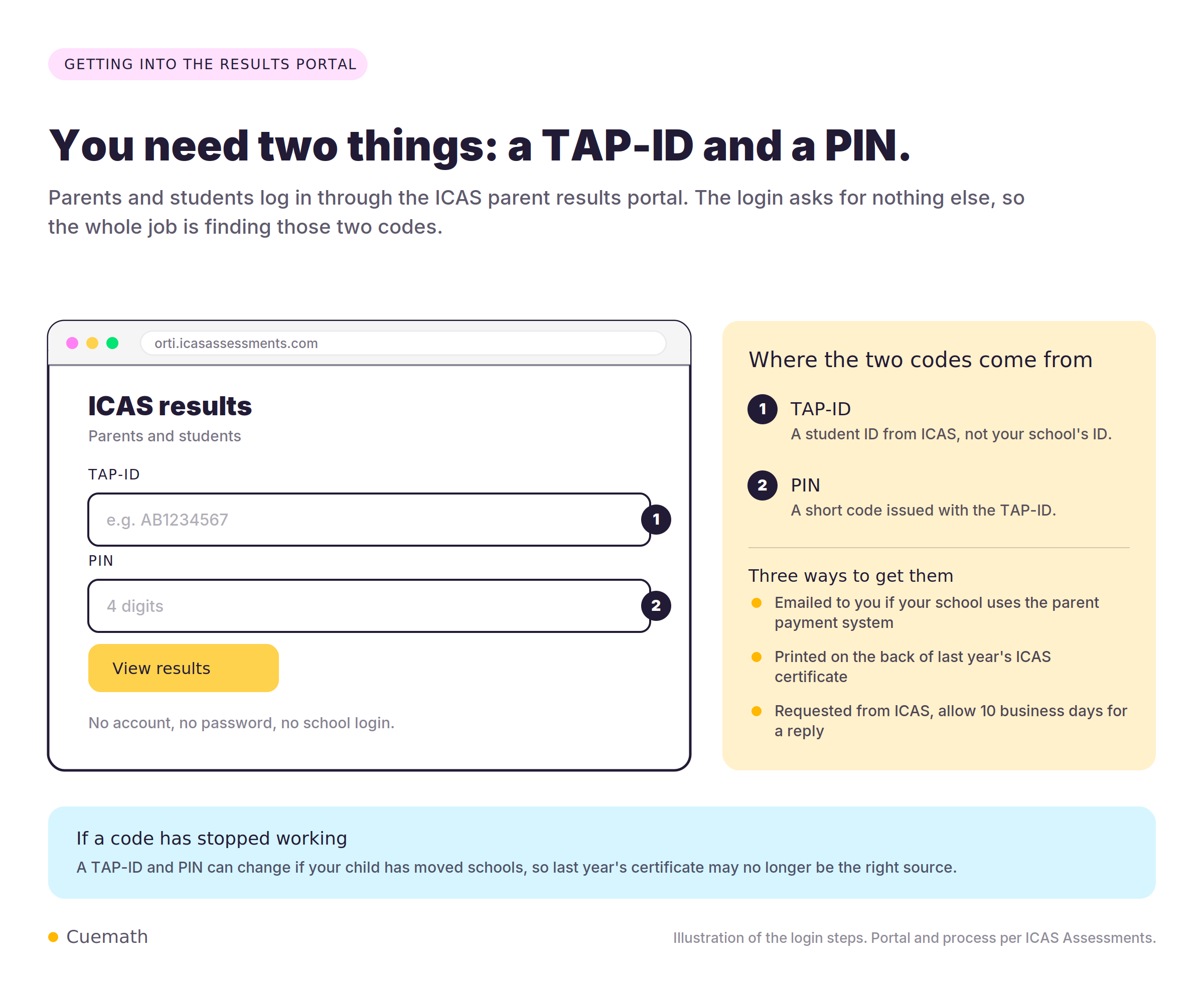
- Check your email for the ICAS results notification.
- Go to the ICAS results portal.
- Log in with your child's TAP-ID and PIN. Both are emailed to you or printed on the back of last year's certificate.
- Your child's report will show the award and a breakdown by skill area.
- No email and no old certificate? Use ICAS's TAP-ID request form, or ask your school's ICAS coordinator.
If You Can't Access Your Child's Results Yet
- Results not showing? Check that your child's specific subject has actually finished its release window — Mathematics, being one of the last subjects sat, is generally among the last to release results, even if an earlier subject like Digital Technologies or Writing has already come through.
- Can't find your TAP-ID and PIN? These are usually in your original ICAS confirmation email, or printed on the back of a previous year's certificate if your child has sat ICAS before. If neither is available, ICAS provides an official TAP-ID/PIN request form on its site.
- Registered through your school rather than paying directly? Your school's ICAS coordinator holds the login details in that case, not you — so the fastest path is asking your child's teacher directly rather than searching for a parent portal login that won't apply to you.
What Does Each ICAS Award Mean?
| Award | Who Gets It |
|---|---|
| ICAS Medal | Top student in the state, for that subject and year level |
| High Distinction | Top 1% of students |
| Distinction | Next 10% |
| Credit | Next 25% |
| Merit | Next 10% |
| Participation | Everyone else who sat the test |
Source: ICAS Assessments — ICAS achievement levels
There's no pass-or-fail mark. The test is written above normal school level, so a Credit or Merit is still a good result.
Why This Matters
ICAS ranks your child against students across the whole country, not just their class. That's why the result can look different from a school report — school marks are based on what was taught that term, while ICAS goes further.
ICAS results also aren't used for NSW Opportunity Class or Selective School entry. Those are decided by the placement test alone.
What Should You Do Next
- Log in and check the result and skill-area breakdown.
- Note which area was weakest.
- Mention it to your child's teacher if you want a second opinion.
- Watch for the printed certificate — it reaches schools 10-13 weeks later.
Keep an Eye On
Certificates and medals go out later this term. If your school hasn't said anything by mid-October, check with your child's teacher or the school's ICAS coordinator.
Want Help With the Result?
A free 1:1 session with a Cuemath tutor can go through the report with your child.
Book a Free SessionICAS 2026 FAQs
Is ICAS harder than NAPLAN?
They're not really comparable in difficulty, because they test different things. NAPLAN is a compulsory national literacy and numeracy check tied to the school curriculum, sat by every student in Years 3, 5, 7 and 9. ICAS is optional, covers six separate subjects, and is designed to stretch students beyond grade-level content — its harder questions specifically aim to challenge top performers, which is why ICAS can feel more difficult even to students who find NAPLAN easy. A student who's comfortable with NAPLAN can still find ICAS's top-tier questions genuinely tough, and that's by design, not a sign anything is wrong.
What is a good ICAS score?
There's no single pass mark — ICAS reports where your child sits nationally rather than against a fixed target. As a rough guide: Distinction and above (the top 11% of participants) is a strong result, Credit (the next 25%) is solidly above average, and Merit or Participation still means your child completed a nationally benchmarked assessment, which has value on its own regardless of the award tier.
What is the hardest ICAS subject?
Mathematics and Digital Technologies tend to prompt this question most often, since ICAS Maths in particular includes non-routine problem-solving questions that go beyond standard classroom material by design. Difficulty also depends heavily on the individual child, though — a student strong in reading and language will often find English or Spelling Bee more approachable than Maths, and vice versa.

I write because I like understanding things properly, and I've never been able to do that quietly.
Six years in, what still interests me most isn't the writing itself. It's the person on the other side. Who are they, what were they actually worried about when they opened this page, and did they leave with what they came for? Most content fails that last test. It answers the easy question instead of the one that was asked.
At Cuemath, I write for parents and students in India and around the world. That range is the part I enjoy. A parent in Australia and a parent in Canada are asking about the same child, but not always in the same words, and that difference matters.
So I research before I write. Not just search results. Forums, reviews, the long comment threads where somebody finally admits what they're really confused about. That's usually where the useful thing is hiding.
I also spend time on how people find this writing at all, since a growing number of them now ask an AI instead of typing into Google. But that only works if the writing is clear to begin with. There's no shortcut around that part.
Taking you to pick a time for the evaluation…
Sources
Assessment provider sources
- ICAS Assessments - ICAS 2026 dates — Mathematics sitting window of 24-28 August 2026 and the full subject calendar
- ICAS Assessments - ICAS results: our process and timeframes — release stages, business-day intervals and the 10-13 week certificate timeline
- ICAS Assessments - ICAS support for parents — the 15 business day parent access figure and TAP-ID and PIN guidance
- ICAS Assessments - ICAS achievement levels — the six achievement levels and the fixed percentage bands
- ICAS Assessments - Understanding ICAS results — percentile definition, skill-area and question-level reporting
- ICAS Assessments - ICAS Mathematics competition — the five maths learning areas assessed
- ICAS Assessments - About ICAS Assessments — Janison and University of Sydney involvement, 40-year history, 41 countries