California Will Test Every K-2 Student in Math
California's SB 1067 is now law. Every child in kindergarten, 1st and 2nd grade will take a math assessment each year, starting no later than 2028-29. Here is what it checks, when it starts, who can skip it, and what happens if a child needs help.

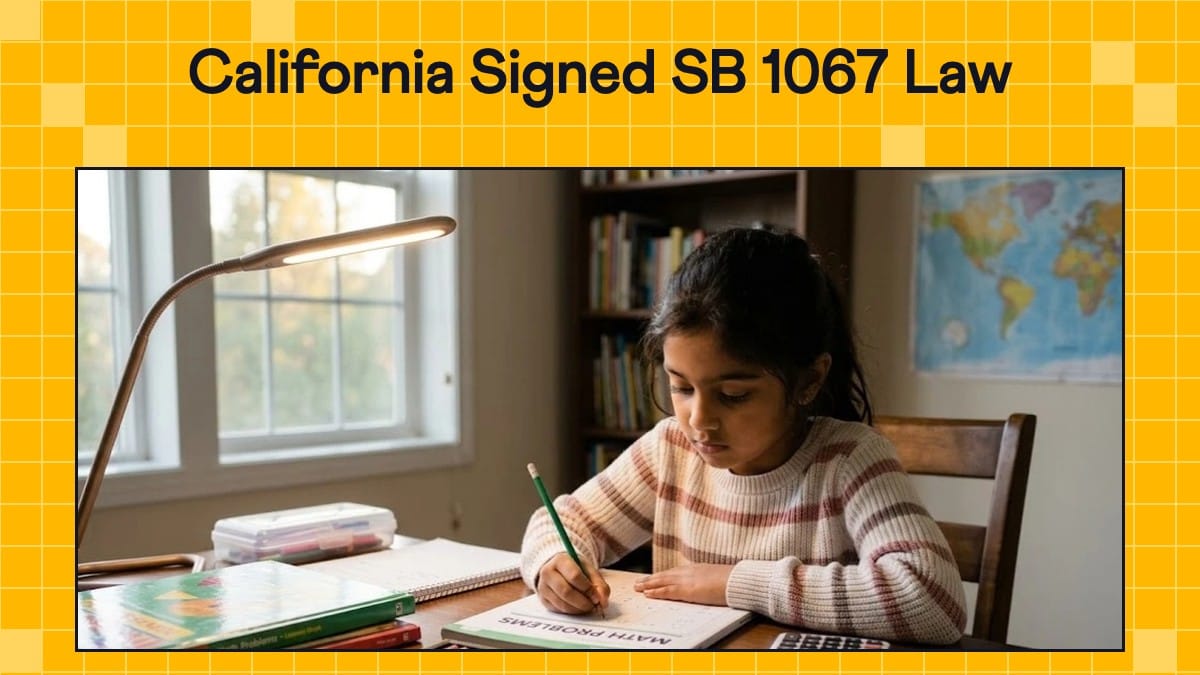
California has signed SB 1067 into law, a move that will significantly alter how early math is taught in the state. The new law will require schools to test students from kindergarten through second grade so that math learning needs can be identified at an early age. The goal is to identify problems early and make sure children get the right help so they can develop good foundational numeracy skills.
For parents and teachers, the switch could give a clearer window into how their children are doing in math during some of the most critical early years of learning. It also raises questions about how assessments will be used, how schools will support students in need of extra help, and how families can work with teachers to turn assessment results into meaningful support.
Will My Child Be Assessed Under SB 1067?
Yes, if your child will be in kindergarten, 1st grade, or 2nd grade in 2028-29 or later. Find your child's grade today:
| Grade in 2026‑27 | Grade in 2028‑29 | Assessed? |
|---|---|---|
| Preschool (age 3) | Kindergarten | Yes, in kindergarten, 1st and 2nd grade |
| TK | 1st grade | Yes, in 1st and 2nd grade |
| Kindergarten | 2nd grade | Yes, once, in 2nd grade |
| 1st grade | 3rd grade | No, unless the district starts early |
| 2nd grade | 4th grade | No, unless the district starts early |
What Does SB 1067 Do?
SB 1067 requires every California school district, county office of education, and charter school that serves K-2 students to assess each child's math knowledge once a year. Senator Akilah Weber Pierson (D-San Diego) wrote the bill. It passed the Assembly 71-0 and the Senate 40-0.
- Sets up a state list of approved tests: The State Board of Education sets the criteria, and the California Department of Education publishes the list.
- Makes every district pick one: Districts adopt a test at a public meeting. A district can use a test that isn't on the list only if its board certifies that the test meets all the state criteria.
- Assesses every K-2 child each year: This includes children who enroll after the test date. Children who don't yet speak enough English take it in their home language when the state list has one.
- Requires help for children who need it: If results show a child needs more support, the district must provide it.
Short answers to common questions
Does TK count?
No. The law defines kindergarten so that it excludes transitional kindergarten.
Is it a test for dyscalculia?
No. It measures math knowledge and flags children who need support. It can't diagnose a disability.
Can it hold my child back?
No. Results can't be used for promotion, retention or gifted placement.
California already does the same for reading: since 2025-26, schools have screened K-2 children for risk of reading difficulties, including dyslexia. For other changes affecting schools this year, see US K-12 education changes in 2026.
When Does the K-2 Math Assessment Start?
The K-2 math assessment starts no later than the 2028-29 school year. Districts may start earlier once they have adopted a test. Here are the key dates.
| Date | What happens | Status |
|---|---|---|
| September 27, 2026 | Governor signs SB 1067; it becomes Chapter 674 | Done |
| July 31, 2027 | State Board approves the criteria for choosing tests | Set by law |
| January 31, 2028 | Department of Education publishes the list of approved tests | Set by law |
| April 30, 2028 | Department posts math support and intervention resources | Set by law |
| June 30, 2028 | Every district adopts its test at a public meeting | Set by law |
| 2028-29 school year | Every K-2 child is assessed, then every year after | Latest start |
| July 31, 2028 | State Board decides what districts report to the state | Set by law |
What Will the Math Assessment Check?
The assessment will check foundational math skills for each grade, as set out in California's Mathematics Framework. The state hasn't picked the actual tests yet; the approved list comes on January 31, 2028. The law tells the State Board to look for tests that:
- measure grade-level foundational math skills
- have been checked on children who speak different home languages, not just English speakers
- Give teachers guidance on reading the results and explaining them to families, including in the family's home language
For kindergarten, a kindergarten readiness assessment can count if it meets the criteria. The tests will measure children against California's grade-level standards:
| Grade | By the end of the year, a child can |
|---|---|
| Kindergarten | Count to 100 by ones and tens; count out up to 20 objects; add and subtract within 5 quickly; find the number that makes 10 with any number from 1 to 9 |
| 1st grade | Count to 120 from any number; add and subtract within 10 quickly and within 20 with strategies; explain that 34 means 3 tens and 4 ones |
| 2nd grade | Know all sums of two one-digit numbers from memory; add and subtract within 100; explain that 706 means 7 hundreds, 0 tens and 6 ones; skip-count by 5s, 10s and 100s |
What Happens If the Assessment Shows My Child Needs Help?
If the assessment shows your child needs more help, the district must provide support that fits the specific gaps the assessment found. Here is what the law requires after the assessment.
| Area | What SB 1067 says |
|---|---|
| Support the district must offer | Math teaching focused on your child's needs Progress checks over time Early intervention, such as small-group lessons One-on-one or small-group tutoring Further evaluation, if needed |
| What the school must send you | Information about the assessment before it happens, ideally with back-to-school materials Your child's results "in a timely manner," with an explanation A notice if your child needs extra support, and the support planned |
| Not a disability diagnosis | Results can't decide special education or 504 eligibility. A school can use them to recommend a fuller evaluation, never to delay one. |
| Not high-stakes | Results can't be used to hold a child back, place a child in a gifted program, or evaluate teachers. |
| Translated notices | Notices to parents follow California's existing translation rules. |
Can Parents Opt Out of SB 1067 Testing?
No. SB 1067 does not give parents a general right to opt out. A district may skip a child only when the parent gives prior written consent and the child meets one of these four conditions:
- The child has a current diagnosis of dyscalculia or another disability.
- The child already has an IEP (special education) or a 504 plan.
- The child is being evaluated for special education or a 504 plan, and other tests already cover the same ground.
- The child doesn't know the test language well enough to be tested fairly.
If none of these apply, your child takes the assessment. Even when one applies, the district decides.
Parent tip: If your child already has an IEP or 504 plan, ask the school in writing whether it plans to give or skip the assessment, so the decision is on record.
What You Can Check at Home Now
You don't need to wait for 2028-29 to see where your child stands. These five-minute checks come straight from the grade-level standards above. Try them at the end of the school year, not the start.
| Grade | Ask your child | What to look for |
|---|---|---|
| Kindergarten | Count out loud to 100, then count by tens: 10, 20, 30… | Counts in order without skipping |
| Kindergarten | Put 15 coins on the table and ask, "How many?" | Touches each coin once |
| Kindergarten | "What goes with 7 to make 10?" | Says 3 (fingers are fine) |
| 1st grade | 5 + 3, 9 − 4 and 6 + 4 | Answers in about 3 seconds, without counting on fingers |
| 1st grade | Write 34: "How many tens? How many ones?" | Says 3 tens and 4 ones |
| 1st grade | Start at 87 and keep counting to 120 | Counts to 120 in order |
| 2nd grade | 8 + 7, 9 + 6 and 13 − 5, out loud | Knows them from memory |
| 2nd grade | 46 + 27, then "How did you get that?" | Explains it with tens and ones, not just the answer |
| 2nd grade | Write 706: "What does the 0 mean?" | Says there are no tens |
The kindergarten make-10 check is a number bond, and a ten frame makes it easy to see. For the full list of 1st grade topics, see what 1st graders learn in math. If any 2nd grade check was shaky, these free 2nd grade math games practice the same skills.
Keep Counting, Facts and Place Value Sharp
The Cuemath app gives your child short, personalized math workouts, a few minutes a day.
Try the Cuemath app100% free · No card needed
What Should I Do This Week?
If you're reading this in October 2026, start here. Tick each one off as you go.
- Write down any check your child got stuck on
- Ask the teacher what math assessment the school uses now
- Watch back-to-school materials for SB 1067 notices
- Note January 31, 2028, when the state's approved test list comes out
Skip for now: test-prep workbooks for an assessment the state hasn't chosen yet.
What Are the Common Myths About SB 1067?
These six come up in the news coverage. Here's what the signed law actually says.
| Myth | Reality |
|---|---|
| "Newsom signed it on September 28." | The official bill history says September 27, 2026. |
| "Testing starts in June 2028." | June 30, 2028 is the deadline for districts to pick a test. Testing starts by the 2028-29 school year. |
| "Parents can opt out in writing." | Written consent works only if the child also meets one of four conditions, and the district decides. |
| "It covers TK." | It covers kindergarten, 1st and 2nd grade. TK is excluded. |
| "It diagnoses dyscalculia." | It measures math knowledge. It can't diagnose a disability, but it can lead to a fuller evaluation. |
| "Results decide if my child moves up a grade." | The law bars using results for promotion, retention or gifted placement. |
Source: SB 1067 chaptered text and bill history, California Legislative Information.
Why Some Educators Opposed SB 1067
Opponents objected to the cost. Supporters pointed to California's low math scores.
| Topic | Details |
|---|---|
| Who opposed it | California Teachers Association Association of California School Administrators (ACSA) California County Superintendents California Mathematics Council |
| Why they opposed it | The law requires the assessment and the support, but it doesn't fund either. It only states that the Legislature "intends" to provide funding. ACSA ran a veto campaign arguing the bill mandates a K-2 math assessment "without additional funding or supports." |
| Why supporters backed it | On California's 2025 state tests, 37% of students were proficient in math. The bill's author, Senator Weber Pierson, told EdSource that students who miss foundational math skills in K-2 "rarely catch up." |
| What it means for parents | The law guarantees that your child gets assessed. How much support your school can afford afterward depends on its budget. |
For how this year's California score reports changed, see CAASPP 2026 results: new labels, same cut scores.
Can Tutoring Help Before the State Assessment?
Yes, when it builds the foundational skills the assessment checks. SB 1067 itself lists one-on-one or small-group tutoring as one of the supports a district can provide.
Not Sure Which K-2 Math Skills Your Child Should Work On First?
Get a free evaluation and see where your child is strong, and where they need more practice, before the state checks.
Book a free evaluation100% free · No credit card needed · Online, one-on-one
Frequently Asked Questions
Is California SB 1067 law now?
Yes, SB 1067 is law in California. Governor Newsom approved it on September 27, 2026, and the Secretary of State filed it the same day as Chapter 674, Statutes of 2026.
When did Newsom sign SB 1067?
Newsom signed SB 1067 on September 27, 2026. Some reports say September 28, but the official California bill history and the governor's September 27, 2026, legislative update both show September 27.
What grades does SB 1067 cover?
SB 1067 covers kindergarten, 1st grade, and 2nd grade. Transitional kindergarten (TK) is not included. The law defines kindergarten so that it excludes TK.
When does the SB 1067 math test start?
The SB 1067 math assessment starts no later than the 2028-29 school year and repeats every year after that. Districts must choose their test by June 30, 2028, and some may start earlier.
Is the SB 1067 math assessment a test for dyscalculia?
No, the SB 1067 assessment does not diagnose dyscalculia or any disability. It measures math knowledge and flags children who need more support. A school can use the results to recommend a full evaluation.
Can I opt my child out of the SB 1067 math assessment?
Not in most cases. A district may skip a child only with the parent's prior written consent and if the child has a disability diagnosis, an IEP or 504 plan, an ongoing special education evaluation, or not enough skill in the test language.
Can SB 1067 results be used to hold my child back?
No, SB 1067 bars using results for any high-stakes purpose, including promotion, retention, and gifted placement. The law also bars using them to evaluate teachers or hold schools accountable.
Will I see my child's SB 1067 results?
Yes, schools must share your child's SB 1067 results with you in a timely manner. They must explain the results, tell you if your child needs extra support, and describe the support they plan.
Does SB 1067 come with funding?
No, SB 1067 does not include new funding. The law states the Legislature's intent to fund it. If the Commission on State Mandates finds it creates state-mandated costs, districts can claim reimbursement through that process.
My child is in 1st grade now. Will they be assessed under SB 1067?
Probably not. A child in 1st grade in 2026-27 will be in 3rd grade by 2028-29, past the K-2 range, unless their district starts the assessment early.
Sources
- SB 1067 bill history, California Legislative Information (signed and chaptered September 27, 2026; Chapter 674; floor votes)
- SB 1067 chaptered bill text, California Legislative Information (grades, deadlines, opt-out conditions, required supports, limits on use, funding language)
- Governor Newsom's legislative update, September 27, 2026 (SB 1067 in the signed list)
- EdSource: California bill to catch math struggles in youngest students heads to governor's desk (opposition groups, 37% math proficiency in 2025, Senator Weber Pierson's quote)
- ACSA: Help us stop mandated math assessments (SB 1067) (administrators' funding objection; advocacy group)
- Senator Akilah Weber Pierson: SB 1067 (the author's case for the bill; advocacy)
- Common Core: Kindergarten Counting and Cardinality and Operations and Algebraic Thinking (count to 100, add and subtract within 5, make 10)
- Common Core: Grade 1 Operations and Base Ten (fluency within 10, count to 120, tens and ones)
- Common Core: Grade 2 Operations and Base Ten (sums from memory, within 100, place value to 1,000)

I was never the kid who loved math. I was much more interested in books, stories, and writing, and, somewhere along the way, I became even more curious about people. Why do we learn differently? Why does something make sense to one child but not another? And what makes a student feel confident enough to keep trying?
That curiosity led me to study Applied Psychology, where I learned more about how children think, learn, and make sense of the world around them.
My love for writing did the rest. What started as something I simply enjoyed became a career. Over the past five years, I've worked as a freelance writer across edtech, SaaS, B2B, travel, lifestyle, and healthcare, learning how to write for very different audiences without losing the human side of the story.
Today, I'm an SEO Content Writer & Editor at Cuemath, where I get to bring many of these interests together. Working in education, and especially around math, has made me even more curious about what happens behind the screen or textbook: what parents worry about, what students struggle with, and what actually helps them learn.
That's also how I like to research. I don't just look at search results and call it a day. I go where parents and students actually talk: forums, reviews, communities, and conversations with real families. Because sometimes the most useful insight isn't hiding in a keyword; it's in a parent's question, a student's frustration, or a small detail someone shares about their learning experience.
I write because I'm curious. I research because I want to understand. And I love turning what I learn into content that feels genuinely useful to the people reading it.