Do AP Classes Count as College Credit? How Much & Which Subjects (2026)
Do your AP scores actually help you get into college? The honest answer: yes, but mostly after you're admitted, as credit that saves time and tuition. Here's what your scores really do on an application, and why some colleges quietly still want to see them.


- ✓AP classes can count as college credit, but the AP exam score is what earns it, not the class grade.
- ✓Most colleges require a 4 or 5 for credit. Many state universities accept a 3. The most selective schools usually give course placement instead of credit.
- ✓One AP exam is usually worth 3 to 8 college credit hours. Calculus AB gives about 4 credits; Calculus BC can give 8.
- ✓Every college sets its own AP credit policy. College Board does not, so the same score can be worth different credit at different schools.
- ✓STEM exams with a clear course match (Calculus, Chemistry, Computer Science A) convert to credit most reliably. Physics 1, Psychology, and Human Geography usually count as electives only.
- ✓AP Precalculus credit is inconsistent because the exam is new. Ohio State gives credit; the University of California and University of Georgia do not. A strong score mainly earns placement into calculus.
- ✓You must actively send your AP scores to your college through College Board. Credit is not applied automatically.
- ✓Most medical schools do not accept AP credit for prerequisites like biology, chemistry, and physics.
- ✓AP credit does not affect your college GPA, and AP credit travels to selective or out-of-state schools better than dual enrollment credit does.
Yes, AP classes can count as college credit, but not always. Whether you get credit depends on three things: your AP exam score, the college you attend, and the subject.
Most colleges give credit for a 4 or 5. Many state universities accept a 3. The most selective colleges usually give course placement instead of credit.
Passing the AP class is not what earns the credit. Your score on the AP exam is. This guide shows how AP credit works, how many credits one exam is worth, what score you need, which AP subjects count, and what top colleges give in 2026.
Last reviewed: July 2026. Reviewed by Cuemath’s high school AP math curriculum experts.
- Do AP Classes Count as College Credit?
- How Does AP Credit Actually Work?
- How Many College Credits Is One AP Class Worth?
- What AP Score Do You Need for College Credit?
- Which AP Subjects Count for College Credit?
- AP Credit Policies at Top Colleges in 2026
- AP Credit vs Dual Enrollment Credit
- Do Med Schools Accept AP Credit?
- How Cuemath Students Score a 4 or 5 on AP Math: Tutor Tips
- Do AP Scores Also Matter for Admissions?
- The Bottom Line for 2026 and Beyond
- Frequently Asked Questions
- Sources
Do AP Classes Count as College Credit?
Yes, but the AP class itself never grants the credit. Your exam score does, and only if your college’s policy awards it. The class prepares you. The AP exam in May is what colleges actually read. If you score well enough and send that score to your college, its registrar decides how much credit or placement you get.
Three things decide whether it counts:
- Your score. Most colleges want a 4 or 5. Many state universities award credit for a 3. The most selective schools often give placement, not credit.
- Your college. Every college sets its own AP policy. College Board does not. A 4 in AP Chemistry can be 8 credits at one school and zero at another.
- The subject. STEM exams with a clear college-course match convert to real credit most reliably. Others, like Physics 1 and Psychology, often count as elective credit only.
So the answer is: it depends. The rest of this guide shows you how to find your number.
How Does AP Credit Actually Work?
AP credit works in four steps: you take the exam, your score is released, you send it to your college, and the college applies its own credit policy. Students often lose credit at the third step because they never send their scores. Here is the full sequence.
- Take the AP exam in May. Your class grade does not matter for credit. Only the 1 to 5 exam score does.
- Get your score in July. AP scores are released in early-to-mid July.
- Send your official score to your college through College Board’s score-reporting system. This is not automatic. You have to request it, and there is a deadline.
- The college registrar applies its policy and posts credit, course placement, or both to your record.
One thing to check: scores often arrive after summer orientation, so many universities run their own placement test as a backup. Look up your college’s AP credit deadline before you register for fall classes.
How Many College Credits Is One AP Class Worth?
One AP exam is usually worth 3 to 8 college credit hours, depending on the subject and school. A one-semester course equivalent like Calculus AB gives about 3 to 4 credits. A full-year equivalent like Calculus BC, which covers two courses, can give 6 to 8.
Here is what that looks like at real public universities:
| AP exam | Score | Credits | What it covers |
|---|---|---|---|
| Calculus AB | 4–5 | 4 | One Calculus I course |
| Calculus BC | 4–5 | 8 | Calculus I + II (two courses) |
| Most humanities / social science exams | 3–5 | 3 | One intro course or elective |
| Single exams at Ohio State | 3–5 | 5 (10 for Calc BC) | Varies by each school’s credit-hour system |
The rule you see everywhere, that a 3 is 3 credits and a 4 or 5 is 6, is only a rough guide. Each school sets the number per exam, and credit-hour systems differ. Two colleges can award very different amounts for the same score.
What AP Score Do You Need for College Credit?
Most colleges require a 4 or 5 to award credit, though many state universities give credit for a 3. On the 1 to 5 scale, a 3 is “qualified,” a 4 is “well qualified,” and a 5 is “extremely well qualified.” What the score is worth depends on how selective your college is.
| AP score | What it means | Does it earn college credit? |
|---|---|---|
| 5 | Extremely well qualified (like an A). | Credit or placement almost everywhere, including top schools. |
| 4 | Well qualified (like a B+/A−). | Credit at most colleges that award it. |
| 3 | Qualified (like a B−/C+). | Credit at many state universities; usually not at selective private schools. |
| 1–2 | Not qualified. | No credit anywhere. |
Which AP Subjects Count for College Credit?
AP subjects with a clear college-course match earn credit most reliably. Broader intro exams often earn only elective credit. Two students can both score a 4 and get very different credit, because the subject decides what the college can match it to.
- Most reliable for real course credit: Calculus (AB and BC), Chemistry, Physics C, Computer Science A, Biology. These map onto required intro courses.
- Usually elective or general-education credit only: AP Physics 1 (algebra-based, often will not count toward a science major), AP Psychology (counts as social science, not a lab science), AP Human Geography.
- Composition credit: AP English Language and Literature usually earn writing or humanities credit.
| AP subject | Typical credit | Notes |
|---|---|---|
| Calculus AB | 4 credits (score 4–5) | Counts as Calculus I |
| Calculus BC | 8 credits (score 4–5) | Counts as Calculus I + II |
| Computer Science A | 4 credits | Stronger than CS Principles (3 credits) |
| Physics 1 | 3 elective credits | Algebra-based; often not counted for science majors |
| Psychology | 3 credits | Social-science credit, not a lab science |
| Human Geography | 3 elective credits | Social-science elective |
| English Language / Literature | 3 credits each | Writing / humanities credit |
The minimum score is usually a 3 at large public universities and a 4 or 5 at selective private ones.
Does AP Precalculus Give College Credit?
Sometimes. AP Precalculus is the least consistent AP for credit, because it is a new exam, with first exams in 2024, and colleges are still setting policies. A strong score most reliably earns placement, meaning you skip precalculus and start calculus. Credit itself is hit-or-miss.
- Gives credit: Ohio State awards 5 credit hours for a 3 or higher.
- No credit: the University of California system and the University of Georgia currently award none.
- College Board describes AP Precalculus as foundational preparation for later college math and science, not as a calculus-credit course.
If you are counting on AP Precalculus for credit, look your specific colleges up in College Board’s AP Credit Policy Search first. Precalculus is often the year that decides whether calculus goes smoothly, so this is where a 1-on-1 tutor helps most.
AP Credit Policies at Top Colleges in 2026
At the most selective colleges, AP scores usually earn placement into a higher course rather than credit toward graduation. Here is how a group of top schools handle AP scores once you enroll. For your specific school, we cover 23 colleges in detail in AP Credit by College: Top Schools That Give Credit for AP Scores.
How much each school gives varies a lot; we broke it down college by college in Top Colleges That Give Credit for AP Exam Scores. At the most selective schools, AP credit is used mainly for placement.
- At MIT, a 5 on AP Calculus BC will not reduce the credits needed to graduate, but it does let a student skip the introductory single-variable course and move straight into multivariable calculus. Read More: AP Calculus AB vs BC: Which is Better According to Your College Major?
- The University of Chicago will place strong scorers into higher tracks in math, chemistry, and biology, though it often asks them to confirm the placement with its own exams at orientation.
- Caltech leaves the decision to individual departments, treating an AP score as advisory before administering its own diagnostics.
Because these rules vary so much, it is worth knowing exactly how the top schools handle AP scores once a student enrols:
| University | How AP scores are used for credit or placement |
|---|---|
| Yale | Grants “acceleration credit” for 5s in several subjects (and a 4 or 5 on Calculus BC), capped at two acceleration credits per subject area. |
| Harvard | Accepts 5s for credit; enough qualifying scores can earn “Advanced Standing.” |
| University of Pennsylvania | Won’t let AP credit waive General Education requirements, but it can count toward a major or place a student directly into advanced courses. |
| Stanford | Accepts 4s or 5s for credit, up to 45 quarter units toward the degree. |
| MIT | Very restrictive: 5s earn credit in a few subjects (e.g., Calculus BC, Physics C), and 4s or 5s let you skip intro courses. |
| Columbia, Cornell, Dartmouth | Generally accept 4s and 5s for credit in certain subjects, with amounts varying by department. Princeton is the exception: it now uses AP scores for placement only, not for credit that reduces the courses you need to graduate. |
What is a 5 actually worth in dollars? The College Board puts average in-state tuition and fees at a public four-year college at about $11,950 for 2025–26. A 5 on AP Calculus BC can earn up to 8 credit hours, roughly a quarter of a full-time year, so a strong score can be worth somewhere in the range of $2,000 to $3,000, plus a real step toward finishing a semester early. At elite private schools the payoff is usually placement into a higher course rather than a lower bill.
Do AP Scores Affect Your College GPA?
No, AP scores do not affect your college GPA. Your college GPA is determined by courses taken directly through a college or university. Even if you transfer AP exam credits into your university, those exam scores are not calculated into your college GPA.
AP Credit vs Dual Enrollment Credit
AP credit comes from one exam score. Dual enrollment credit comes from an actual college course you passed. They transfer differently. Both save time and tuition, but they work in opposite ways.
- AP: one standardized exam. A 4 or 5 earns credit at most colleges. Because the exam is standardized, the credit travels well to selective and out-of-state schools.
- Dual enrollment: a real college class taken in high school, with a grade. It reliably counts at in-state public colleges, but selective and out-of-state schools may not accept the transfer.
Which one is better depends on your target school. AP is safer if you are aiming at selective or out-of-state colleges. Dual enrollment is often more generous at in-state public universities.
Do Med Schools Accept AP Credit?
Usually no, at least not on its own. Most US medical schools will not let AP credit satisfy a required prerequisite like biology, chemistry, or physics. They expect you to take that coursework in college. Where AP is accepted, schools often want a higher-level course in the same subject to show depth.
- Biology: AP credit usually cannot replace the two required semesters of college biology with lab. Students take advanced biology electives instead.
- Chemistry: with AP chem credit, most schools expect a year of organic chemistry plus biochemistry, with labs.
- Physics: some med schools allow AP, many do not. Two semesters of college physics with labs is safest.
The rule of thumb: AP credit only helps for med school if it appears on your college transcript, and even then it rarely replaces the actual prerequisite. Check each school in the AAMC’s Medical School Admission Requirements (MSAR) database.
How Cuemath Students Score a 4 or 5 on AP Math: Tutor Tips
We asked the Cuemath tutors behind recent 4s and 5s on AP Calculus BC and AP Precalculus what worked. Their tips, kept short.
- Build over years, not weeks. A 5 sits on a solid ladder into calculus. Nalini got there after 7 years with the same tutor.
- Consistency beats intensity. One focused hour a week, all year. That is how Riddhi scored a 4 while juggling other APs.
- Go deep on the hardest units. Spend extra time where school moves too fast, like infinite series. It got Saahith a 5. Sai Tanish did the same with polar graphs and vectors.
- Pick the harder exam on purpose. Aiming at STEM? Take Calculus BC, not AB.
- Do the mock exams. Work through real past papers before exam day. Not optional.
Read the full stories: Nalini, Saahith, Sreya, Sai Tanish, and Riddhi.
The students above had one thing in common: a tutor who went deeper than the classroom and kept them practicing. A 1-on-1 Cuemath tutor builds that same plan for AP Calculus or AP Precalculus, from the foundation up to exam day.
Do AP Scores Also Matter for Admissions?
Yes, but less than your GPA and course rigor. Strong scores (4s and 5s) reinforce a competitive application, and after you’re admitted they turn into college credit. A weak score rarely hurts you, because most colleges don’t require you to report AP scores to apply. Several selective colleges do ask you to submit or self-report scores, and they read them in an academic context, as one external signal that your transcript and GPA are genuine.
Christopher Rim, CEO of a popular college admissions consulting firm in NYC, published an article on Forbes explaining how Harvard, Yale, and Penn read AP scores:
“Ivy Leagues like Harvard, Yale and Penn do not treat AP exam scores as a substitute for the SAT or ACT. AP scores carry secondary weight. A good AP score helps admission officers at Harvard or Yale assess subject mastery and readiness for demanding coursework.”
Why Do Colleges Still Look at Optional AP Scores?
Because grades no longer tell the whole story. For decades your transcript was the main thing colleges judged. That’s changing, and the reason is grade inflation: high school grades keep climbing while independent tests say learning has not kept up.
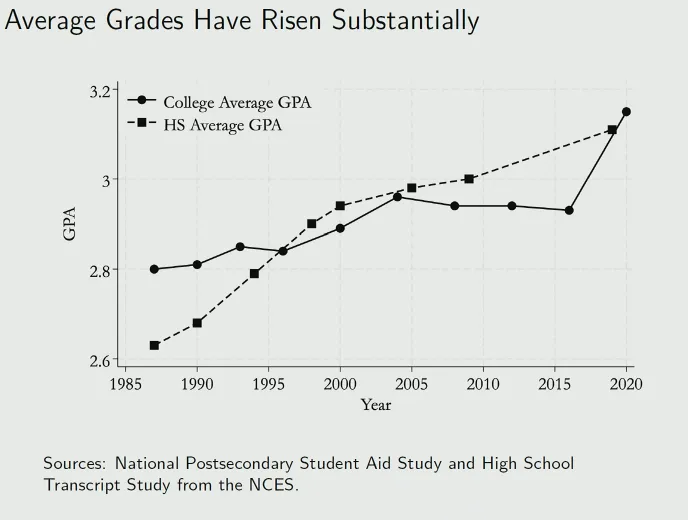
- According to the University of California, Los Angeles and its Higher Education Research Institute, which runs the long-running American Freshman Survey, just 21.8% of incoming college freshmen reported an A average in high school back in 1966. By 2024, that figure had reached 84%.
- However, the data from the National Assessment of Educational Progress is contrasting: as of 2024, only 35% of 12th graders were proficient in reading, and just 22% in math.
- Put simply, grades went up while learning did not. In a recent Forbes article on how top colleges read AP scores, Emory University’s dean of admissions described grades as “definitely inflated and not as connected to true class performance as they used to be,” which is why the university now leans harder on outside measures like AP results.
More AP Courses or a Higher AP Score: Which Matters More?
Both matter, but they do different jobs. The AP courses on your transcript show ambition and rigor; the reported scores show mastery.
AP classes are usually the most demanding courses a high school offers, so choosing them shows academic motivation and ambition.
- Officers already know how many APs your school offers, and they judge how well you used what was available, especially in the subjects you say you care about.
- The catch is coherence: if you are applying as a pre-med but your only APs are Microeconomics, Macroeconomics, and English Language, you have not really shown your passion for STEM.
Minh-Ha Hoang, director of admissions at the University of San Diego, puts it this way:
“AP students are intellectually curious, disciplined, and incredibly resilient. You are the type of people who will follow through on things you’ve started.” (source)
- An AP score is evidence that you have the subject mastery. At the most selective schools, where the pool is deep and nearly everyone is academically qualified, small differences like more or stronger AP scores can nudge an applicant to the top.
- Because most colleges let you self-report on the Common Application, you usually control which scores they see.
Which AP Courses Should You Take for Your Intended Major?
The ones that build a coherent story toward what you want to study. Admissions officers read a transcript in the context of what a student says they want to study, so the goal is a course load that tells a consistent story.
| Intended path | AP courses that matter most | What to keep in mind |
|---|---|---|
| Engineering, Physics & Computer Science | AP Calculus BC, AP Physics C (Mechanics and E&M), AP Computer Science A. | Calculus BC is close to mandatory for elite programs, AP Computer Science A (Java) is preferred over the more conceptual Computer Science Principles. |
| Pre-Med, Biology & Life Sciences | AP Biology, AP Chemistry, AP Calculus (AB or BC). | Programs want lab-science background plus statistical knowledge. |
| Business, Finance & Economics | AP Macroeconomics, AP Microeconomics, AP Calculus BC. | Top business programs want quantitative fluency plus social-science analysis. |
| Humanities, Social Sciences & Pre-Law | AP English Language, AP US History, AP English Literature. | A 4 or 5 on AP English Language is universally read as proof of college-level writing. |
The Bottom Line for 2026 and Beyond
- AP classes can count as college credit, but the AP exam score is what earns it, not the class.
- Most colleges want a 4 or 5. Many state universities accept a 3. The most selective schools give placement instead of credit.
- One AP exam is usually worth 3 to 8 credit hours. STEM exams with a clear course match, like Calculus, convert most reliably.
- Every college sets its own policy, so always check your specific schools in College Board’s AP Credit Policy Search.
- AP Precalculus and med-school prerequisites are the two big exceptions: credit there is inconsistent, so verify before you count on it.
If this year’s score wasn’t what you hoped for, next year’s exam is the one that counts. If you’re earlier in high school, build the concepts ahead of time. A 1-on-1 Cuemath tutor helps you fix the exact weak spots that cost you points and build the conceptual foundation AP Calculus is built on.
Book a Free Evaluation→Frequently Asked Questions
Do AP classes count as college credit?
AP classes count as college credit when your AP exam score meets your college’s policy, usually a 4 or 5, though many state universities accept a 3. The class itself does not grant credit; the exam score does, and each college decides how much.
How many credit hours is an AP class worth?
An AP class is usually worth 3 to 8 college credit hours. A one-semester equivalent like Calculus AB gives about 4 credits, while a full-year equivalent like Calculus BC can give 8. Each college sets the exact number per exam.
What AP score do you need for college credit?
You usually need a 4 or 5 for college credit, though many state universities award credit for a 3. The most selective colleges often give course placement instead of credit, even for a 5.
Does AP Precalculus give college credit?
AP Precalculus gives college credit at some schools but not others, because it is a new exam and policies are still forming. Ohio State awards credit for a 3 or higher, while the University of California and University of Georgia currently award none. A strong score most reliably earns placement into calculus.
Do all colleges accept AP credit?
Not all colleges accept AP credit the same way. Every college sets its own policy, so a score that earns 8 credits at one school may earn none at another. We compare 23 popular colleges in AP Credit by College.
Do med schools accept AP credit?
Most med schools do not accept AP credit on its own for prerequisite courses like biology, chemistry, or physics. They expect that coursework at the college level, and often want a higher-level course in the same subject. Check each school in the AAMC’s MSAR database.
Is dual credit better than AP?
Dual credit is not automatically better than AP; they work differently. AP credit comes from one standardized exam and travels well to selective and out-of-state schools, while dual enrollment credit comes from a real college course and is most reliable at in-state public universities.
Do AP scores affect your college GPA?
No, AP scores do not affect your college GPA. Your college GPA is based only on courses you take at the college. Even when AP credit transfers in, the exam score is not counted in your GPA.
Can I retake an AP exam if I am not happy with my score?
Yes. AP exams are offered once a year, so you would retake the exam the following May, and your report shows all scores unless you withhold or cancel one. We walk through the process in Can You Retake AP Exams?
Sources
- College Board, Trends in College Pricing 2025–26 (average in-state public tuition and fees)
- Grade inflation and the changing admissions landscape (Top Tier Admissions)
- Forbes (Christopher Rim), “What Harvard, Yale and Penn Really Think About Your AP Scores”
- Forbes (Christopher Rim), “How To Leverage Your AP Exams For Ivy League Admissions”
- College Board blog, “Should I Commit to Taking AP Exams?”
- Stanford first-year testing policy
- MIT advanced placement / AP transfer credit
- University of Chicago placement / AP tests
- Caltech first-year admission catalog
- College Board, Getting Credit & Placement (how to send AP scores)
- College Board AP Credit Policy Search
- College Board, AP Precalculus course positioning
- Stony Brook University AP credit chart (credits by subject)
- University of Georgia AP credit (incl. no AP Precalculus credit)
- Ohio State AP examination credit
- University of California AP exam credits
- Yale pre-med curriculum advice (AP credit for med-school prerequisites)
- AAMC Medical School Admission Requirements (MSAR)
Nikita Joshi is an education writer at Cuemath. She works with Cuemath’s high school curriculum experts and gathers real AP score patterns and exam-prep insights from the tutors and students behind guides like this one. She doesn’t work in college admissions, so the admissions-policy facts here are cited directly from College Board and university sources.
Reviewed by Cuemath’s high school AP math curriculum experts. Last reviewed: July 2026.