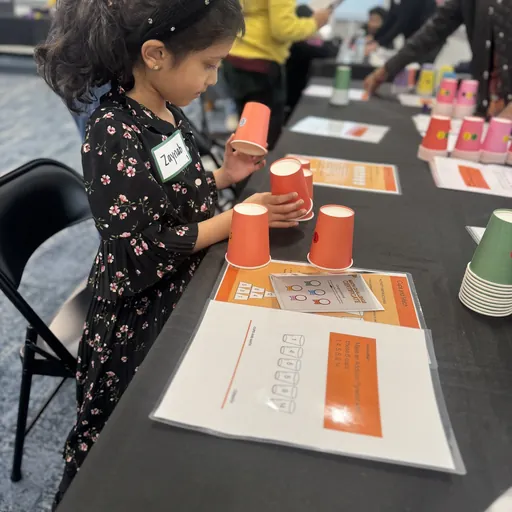
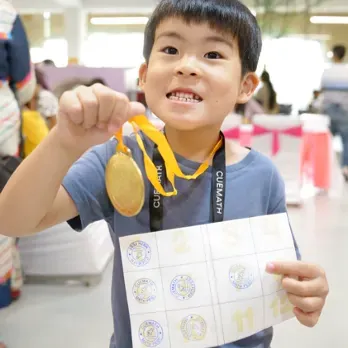
Being MathFit™ means having all-round math strength.
The ability to move through math with confidence — from instant recall to deep understanding to figuring out something entirely new.
Just as physical fitness prepares the body for life, MathFit prepares the mind.
Signs your child is MathFit
You won't always see it on a report card. You'll see it in how your child meets a problem they've never seen before.

They ask why until it clicks.
Not satisfied with "that's just the rule." They want the reason underneath — and remember it because they own it.

They see math everywhere.
In cricket scores, game strategies, or calculating whether the bigger pizza is actually the better deal.

They embrace the hard stuff.
Not because it is easy, but because they know they can make sense of it. Difficulty conquered builds confidence.

They see setbacks as reps.
Their first thought isn't "I can't do this." It's "this is where I get stronger" — so struggle becomes training.
With AI, answers are everywhere.
Thinkers are rare.
Every one of those signs describes something a machine still can't do. That is what makes them worth training now.


And that kind of thinking — logical, creative, and confident — is what math builds.
That's why being MathFit matters.
Even the people building AI agree:
“If I were a student right now, I would study mathematics. It will power the AI revolution.”
“The real danger is not that computers will begin to think like men, but that men will begin to think like computers.”
“The illiterate of the 21st century will not be those who cannot read and write, but those who cannot learn, unlearn, and relearn.”
“If I were a student right now, I would study mathematics. It will power the AI revolution.”
“The real danger is not that computers will begin to think like men, but that men will begin to think like computers.”
“The illiterate of the 21st century will not be those who cannot read and write, but those who cannot learn, unlearn, and relearn.”
“If I were a student right now, I would study mathematics. It will power the AI revolution.”
“The real danger is not that computers will begin to think like men, but that men will begin to think like computers.”
“The illiterate of the 21st century will not be those who cannot read and write, but those who cannot learn, unlearn, and relearn.”
What matters more now
How we measure a MathFit mind
Fitness needs exercise, and the discipline to keep going even when it's tough. Similarly, a MathFit mind needs math skills, and the mindset to use them when problems are unfamiliar.
Math Skills:

Fluency
Knowing facts, formulas and procedures, and executing them accurately without strain.
The moment that reveals it
7 × 8 arrives in a breath — not a finger-count.

Understanding
Knowing why a method works, not just how to run it.
The moment that reveals it
Looks at a wrong answer and can say why it's wrong.

Application
Math for real problems: What’s asked and which tool fits
The moment that reveals it
Splits the restaurant bill — tip included — for the whole table.

Reasoning
Working step by step through a problem nobody has taught them.
The moment that reveals it
Finds the pattern in a puzzle they've never met.
Math Mindset:

Growth
Believing ability isn't fixed, but responds directly to targeted training.
The moment that reveals it
“I can get better at this.”

Relevance
Seeing math connect to their world, making the effort feel worth it.
The moment that reveals it
“I see why math matters.”

Interest
Letting curiosity fuel progress where pressure and drills fall short.
The moment that reveals it
“I enjoy solving problems.”

Confidence
Welcoming struggle as proof of progress rather than lack of ability.
The moment that reveals it
“I can figure this out.”
Neither half works alone.
Skills without mindset make anxious performers. Mindset without skills makes confidence without competence. A MathFit child carries both.

Cuemath coaches help your
child become MathFit
The best athletes still have coaches — not because they can't perform, but because nobody can see their own form. A Cuemath coach does that job in three ways.

Not a lecture
Cue, don't tell
The coach never hands over the answer — they ask questions and have your child explain each step out loud, so the thinking stays theirs.
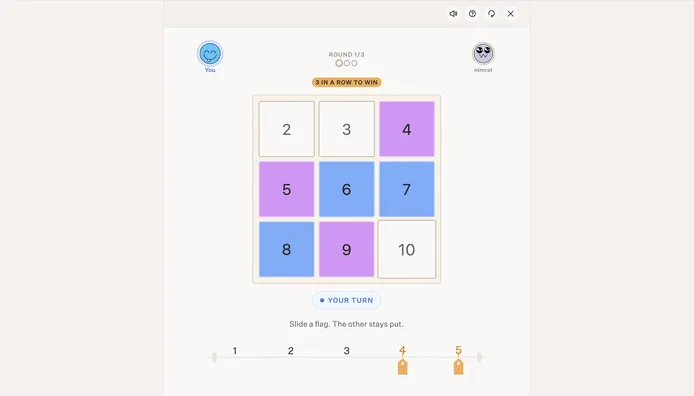
Not a basic whiteboard
Write & reason together
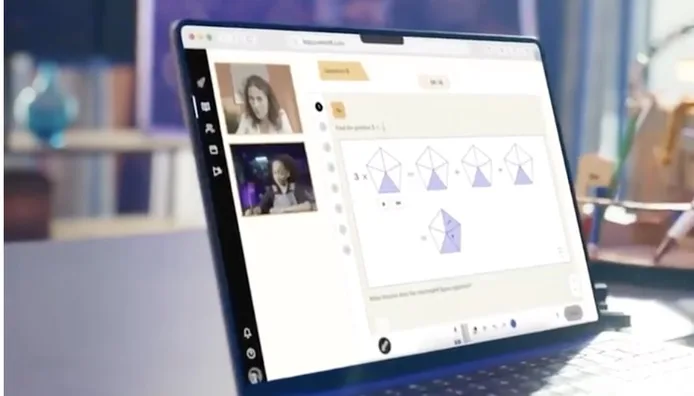
On the collaborative Math Canvas, coach and child draw, measure and solve together. Built-in tools make every concept easy to explore.
Not a fixed lesson
Adapt, don't standardize
The coach personalizes lessons — never so easy that interest fades, never so hard that fear creeps in. Just the right zone of difficulty.
Discover how MathFit your child really is
Most report cards only tell you if your child got the answer right. But the MathFit Evaluation goes deeper—revealing how your child actually thinks.
A school grade
Measures
Performance on what was just taught — with the method fresh and the format familiar.
A test score
Measures
Preparation for that test. It says little about what happens when the problem is new.
A timed drill
Measures
Speed. Which even a calculator has. It can't hear a child's reasoning.
The MathFit Evaluation
Reveals
How your child actually thinks across Fluency, Understanding, Application, and Reasoning. It's a 1:1, hour-long conversation between your child and a trained Specialist, not a test. You leave knowing where your child stands, and exactly what to build next.
Frequently Asked Questions
Being MathFit means having all-round math strength — a child’s ability to reason clearly, see patterns, explain ideas in their own words, and solve unfamiliar problems with confidence. It has two halves: the MathFit skills (Fluency, Understanding, Application, Reasoning) and the MathFit mindset (Growth, Relevance, Interest, Confidence). Like physical fitness, it’s built through training — and every child can build it.
No. Being MathFit is a state, like being physically fit — something a child becomes, not something you buy. Cuemath’s coaching, evaluation and app are ways to build it and see it; being MathFit is the outcome.
"Good at math" usually means fast and accurate — one skill out of four. A child can score well on familiar problems and still freeze when a problem looks new. A MathFit child is fluent, understands why methods work, applies math to real situations, and reasons through problems they’ve never seen.
Through the MathFit Evaluation — an hour, one-on-one with a trained Specialist. It isn’t a test or a class: the Specialist maps how your child thinks across all four skills, then gives you a complete picture and the clearest next thing to build.
Yes. It’s built, not born. Children start at different points, but how fit a child becomes depends on training, not talent — and any child can become more MathFit. When a child struggles with math, the problem is never the child. It’s the method.
AI can calculate, but it can’t decide which problem matters, frame it correctly, question a dubious claim, or judge whether an answer makes sense. Those are exactly the abilities a MathFit child has. As machines make thinking optional, deliberately training a child’s mind becomes a parent’s choice — the way physical fitness already is.
One hour. One conversation. A complete picture of your child’s mathematical mind — and the clearest next step to strengthen it.
You leave with your child’s written MathFit profile, a recommended plan — whether or not you continue with Cuemath — and simple next steps to use at home.
Online · One hour · One-on-one with a Specialist